

equally traced back to the existence of superior and inimitable resources that are valuable to the firm’s customers and
consumers, possessed by an organisation, as is stipulated in
the thinking of the resource-based view.
An important aspect of the sustainability of the positioning as a competitive advantage stems from the fact that it
is quite challenging for any competitor to fully understand
the nature of the resources that have been used in achieving
this positioning and exactly how they were used. A specific
positioning also usually results from a sophisticated set of
intricate decisions taken by the firm, which also would make
it difficult to decipher by any competitor. Lippman and
Rumelt (1982) refer to this problem as Causal Ambiguity,
explained in an earlier section of this paper in the context of
the resource-based view. Examples of the positioning
advanced by Hooley and Greenley (2005) are: price, technical product/service quality, service, innovation, and customisation. Their research has demonstrated that the
positioning most likely to lead to competitive advantage in a
sustainable way is related to service and innovation, as they
exhibit greater inimitability through causal ambiguity or
rely on non-tradable resources (Hooley and Greenley
2005).
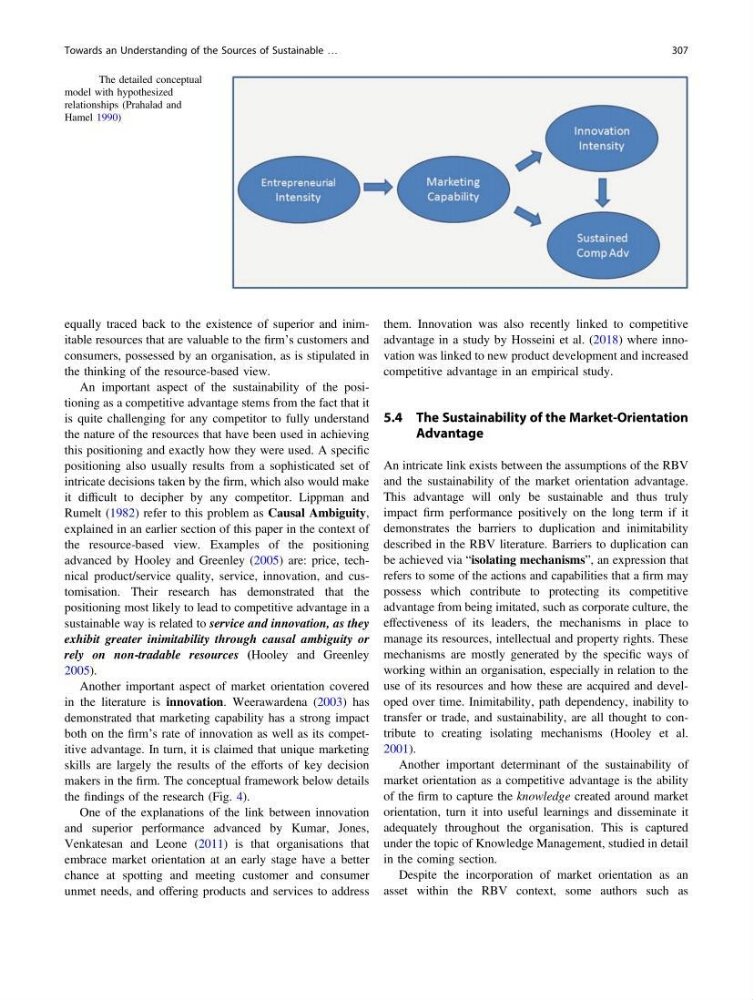
Another important aspect of market orientation covered
in the literature is innovation. Weerawardena (2003) has
demonstrated that marketing capability has a strong impact
both on the firm’s rate of innovation as well as its competitive advantage. In turn, it is claimed that unique marketing
skills are largely the results of the efforts of key decision
makers in the firm. The conceptual framework below details
the findings of the research (Fig. 4).
One of the explanations of the link between innovation
and superior performance advanced by Kumar, Jones,
Venkatesan and Leone (2011) is that organisations that
embrace market orientation at an early stage have a better
chance at spotting and meeting customer and consumer
unmet needs, and offering products and services to address
them. Innovation was also recently linked to competitive
advantage in a study by Hosseini et al. (2018) where innovation was linked to new product development and increased
competitive advantage in an empirical study.
5.4 The Sustainability of the Market-Orientation
Advantage
An intricate link exists between the assumptions of the RBV
and the sustainability of the market orientation advantage.
This advantage will only be sustainable and thus truly
impact firm performance positively on the long term if it
demonstrates the barriers to duplication and inimitability
described in the RBV literature. Barriers to duplication can
be achieved via “isolating mechanisms”, an expression that
refers to some of the actions and capabilities that a firm may
possess which contribute to protecting its competitive
advantage from being imitated, such as corporate culture, the
effectiveness of its leaders, the mechanisms in place to
manage its resources, intellectual and property rights. These
mechanisms are mostly generated by the specific ways of
working within an organisation, especially in relation to the
use of its resources and how these are acquired and developed over time. Inimitability, path dependency, inability to
transfer or trade, and sustainability, are all thought to contribute to creating isolating mechanisms (Hooley et al.
2001).
Another important determinant of the sustainability of
market orientation as a competitive advantage is the ability
of the firm to capture the knowledge created around market
orientation, turn it into useful learnings and disseminate it
adequately throughout the organisation. This is captured
under the topic of Knowledge Management, studied in detail
in the coming section.
Despite the incorporation of market orientation as an
asset within the RBV context, some authors such as
Fig. 4 The detailed conceptual
model with hypothesized
relationships (Prahalad and
Hamel 1990)
Towards an Understanding of the Sources of Sustainable …
307
consumers, possessed by an organisation, as is stipulated in
the thinking of the resource-based view.
An important aspect of the sustainability of the positioning as a competitive advantage stems from the fact that it
is quite challenging for any competitor to fully understand
the nature of the resources that have been used in achieving
this positioning and exactly how they were used. A specific
positioning also usually results from a sophisticated set of
intricate decisions taken by the firm, which also would make
it difficult to decipher by any competitor. Lippman and
Rumelt (1982) refer to this problem as Causal Ambiguity,
explained in an earlier section of this paper in the context of
the resource-based view. Examples of the positioning
advanced by Hooley and Greenley (2005) are: price, technical product/service quality, service, innovation, and customisation. Their research has demonstrated that the
positioning most likely to lead to competitive advantage in a
sustainable way is related to service and innovation, as they
exhibit greater inimitability through causal ambiguity or
rely on non-tradable resources (Hooley and Greenley
2005).
Another important aspect of market orientation covered
in the literature is innovation. Weerawardena (2003) has
demonstrated that marketing capability has a strong impact
both on the firm’s rate of innovation as well as its competitive advantage. In turn, it is claimed that unique marketing
skills are largely the results of the efforts of key decision
makers in the firm. The conceptual framework below details
the findings of the research (Fig. 4).
One of the explanations of the link between innovation
and superior performance advanced by Kumar, Jones,
Venkatesan and Leone (2011) is that organisations that
embrace market orientation at an early stage have a better
chance at spotting and meeting customer and consumer
unmet needs, and offering products and services to address
them. Innovation was also recently linked to competitive
advantage in a study by Hosseini et al. (2018) where innovation was linked to new product development and increased
competitive advantage in an empirical study.
5.4 The Sustainability of the Market-Orientation
Advantage
An intricate link exists between the assumptions of the RBV
and the sustainability of the market orientation advantage.
This advantage will only be sustainable and thus truly
impact firm performance positively on the long term if it
demonstrates the barriers to duplication and inimitability
described in the RBV literature. Barriers to duplication can
be achieved via “isolating mechanisms”, an expression that
refers to some of the actions and capabilities that a firm may
possess which contribute to protecting its competitive
advantage from being imitated, such as corporate culture, the
effectiveness of its leaders, the mechanisms in place to
manage its resources, intellectual and property rights. These
mechanisms are mostly generated by the specific ways of
working within an organisation, especially in relation to the
use of its resources and how these are acquired and developed over time. Inimitability, path dependency, inability to
transfer or trade, and sustainability, are all thought to contribute to creating isolating mechanisms (Hooley et al.
2001).
Another important determinant of the sustainability of
market orientation as a competitive advantage is the ability
of the firm to capture the knowledge created around market
orientation, turn it into useful learnings and disseminate it
adequately throughout the organisation. This is captured
under the topic of Knowledge Management, studied in detail
in the coming section.
Despite the incorporation of market orientation as an
asset within the RBV context, some authors such as
Fig. 4 The detailed conceptual
model with hypothesized
relationships (Prahalad and
Hamel 1990)
Towards an Understanding of the Sources of Sustainable …
307