

it difficult to articulate the reasons for their success. Inimitability is at the heart of value creation because it limits
competition. If a resource is inimitable, then any profit
stream it generates is more likely to be sustainable (Collis
and Montgomery 1995).
Finally, appropriability encourages managers to question:
who captures the value that the resource creates? Basing a
strategy on resources that are not inextricably bound to the
company can make profits hard to capture (Collis and
Montgomery 1995).
3.5 General Comments on the Evolution
of the Resource Based View
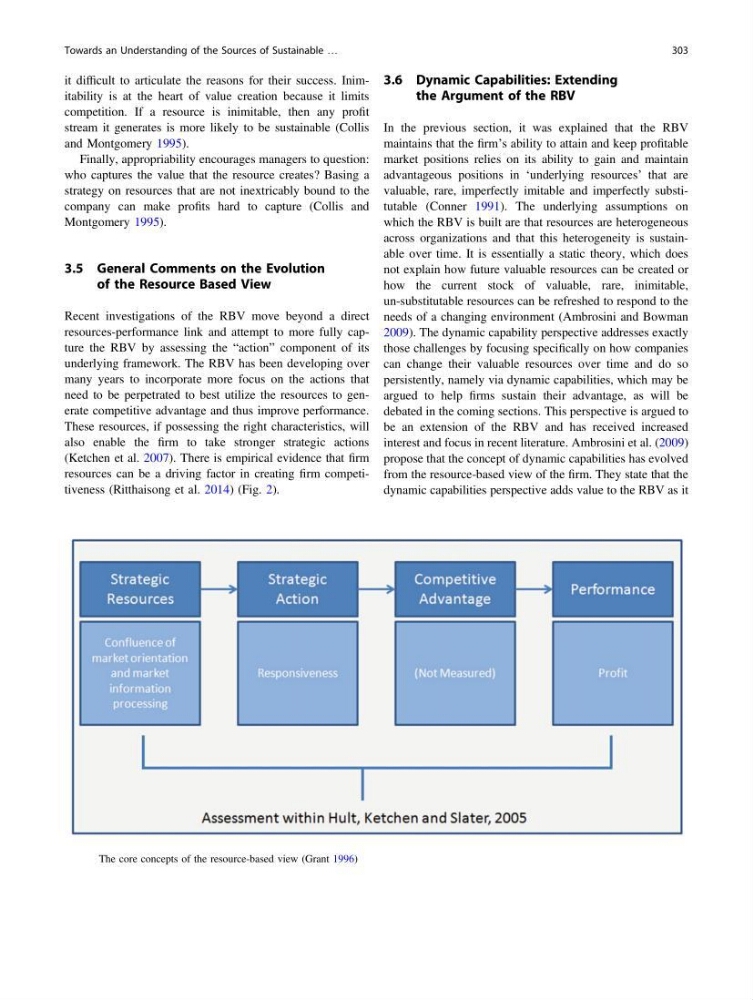
Recent investigations of the RBV move beyond a direct
resources-performance link and attempt to more fully capture the RBV by assessing the “action” component of its
underlying framework. The RBV has been developing over
many years to incorporate more focus on the actions that
need to be perpetrated to best utilize the resources to generate competitive advantage and thus improve performance.
These resources, if possessing the right characteristics, will
also enable the firm to take stronger strategic actions
(Ketchen et al. 2007). There is empirical evidence that firm
resources can be a driving factor in creating firm competitiveness (Ritthaisong et al. 2014) (Fig. 2).
3.6 Dynamic Capabilities: Extending
the Argument of the RBV
In the previous section, it was explained that the RBV
maintains that the firm’s ability to attain and keep profitable
market positions relies on its ability to gain and maintain
advantageous positions in ‘underlying resources’ that are
valuable, rare, imperfectly imitable and imperfectly substitutable (Conner 1991). The underlying assumptions on
which the RBV is built are that resources are heterogeneous
across organizations and that this heterogeneity is sustainable over time. It is essentially a static theory, which does
not explain how future valuable resources can be created or
how the current stock of valuable, rare, inimitable,
un-substitutable resources can be refreshed to respond to the
needs of a changing environment (Ambrosini and Bowman
2009). The dynamic capability perspective addresses exactly
those challenges by focusing specifically on how companies
can change their valuable resources over time and do so
persistently, namely via dynamic capabilities, which may be
argued to help firms sustain their advantage, as will be
debated in the coming sections. This perspective is argued to
be an extension of the RBV and has received increased
interest and focus in recent literature. Ambrosini et al. (2009)
propose that the concept of dynamic capabilities has evolved
from the resource-based view of the firm. They state that the
dynamic capabilities perspective adds value to the RBV as it
Fig. 2 The core concepts of the resource-based view (Grant 1996)
Towards an Understanding of the Sources of Sustainable …
303
competition. If a resource is inimitable, then any profit
stream it generates is more likely to be sustainable (Collis
and Montgomery 1995).
Finally, appropriability encourages managers to question:
who captures the value that the resource creates? Basing a
strategy on resources that are not inextricably bound to the
company can make profits hard to capture (Collis and
Montgomery 1995).
3.5 General Comments on the Evolution
of the Resource Based View
Recent investigations of the RBV move beyond a direct
resources-performance link and attempt to more fully capture the RBV by assessing the “action” component of its
underlying framework. The RBV has been developing over
many years to incorporate more focus on the actions that
need to be perpetrated to best utilize the resources to generate competitive advantage and thus improve performance.
These resources, if possessing the right characteristics, will
also enable the firm to take stronger strategic actions
(Ketchen et al. 2007). There is empirical evidence that firm
resources can be a driving factor in creating firm competitiveness (Ritthaisong et al. 2014) (Fig. 2).
3.6 Dynamic Capabilities: Extending
the Argument of the RBV
In the previous section, it was explained that the RBV
maintains that the firm’s ability to attain and keep profitable
market positions relies on its ability to gain and maintain
advantageous positions in ‘underlying resources’ that are
valuable, rare, imperfectly imitable and imperfectly substitutable (Conner 1991). The underlying assumptions on
which the RBV is built are that resources are heterogeneous
across organizations and that this heterogeneity is sustainable over time. It is essentially a static theory, which does
not explain how future valuable resources can be created or
how the current stock of valuable, rare, inimitable,
un-substitutable resources can be refreshed to respond to the
needs of a changing environment (Ambrosini and Bowman
2009). The dynamic capability perspective addresses exactly
those challenges by focusing specifically on how companies
can change their valuable resources over time and do so
persistently, namely via dynamic capabilities, which may be
argued to help firms sustain their advantage, as will be
debated in the coming sections. This perspective is argued to
be an extension of the RBV and has received increased
interest and focus in recent literature. Ambrosini et al. (2009)
propose that the concept of dynamic capabilities has evolved
from the resource-based view of the firm. They state that the
dynamic capabilities perspective adds value to the RBV as it
Fig. 2 The core concepts of the resource-based view (Grant 1996)
Towards an Understanding of the Sources of Sustainable …
303