

transparency, transferability and replicability as the
important criteria for these advantage-creating resources.
Collis and Montgomery (1995) address the topic in the form
of “tests”. The five tests they propose are inimitability,
durability, appropriability, substitutability and competitive
superiority (Collis and Montgomery 1995). Amit and
Schoemaker echo the first 4 of the 5 tests proposed by Collis
and Montgomery and add another 4, for a total of eight
criteria. Those four include complementarity, scarcity, low
tradability and overlap with strategic industry factors (Amit
and Schoemaker 1993).
Views thus abound on what characteristics define these
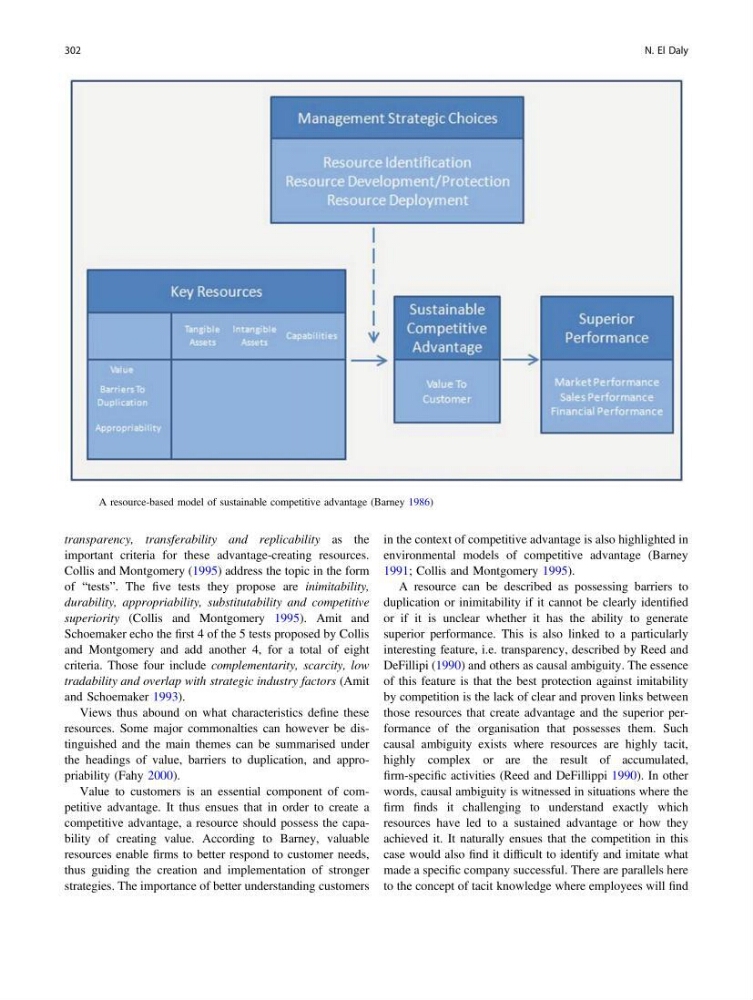
resources. Some major commonalties can however be distinguished and the main themes can be summarised under
the headings of value, barriers to duplication, and appropriability (Fahy 2000).
Value to customers is an essential component of competitive advantage. It thus ensues that in order to create a
competitive advantage, a resource should possess the capability of creating value. According to Barney, valuable
resources enable firms to better respond to customer needs,
thus guiding the creation and implementation of stronger
strategies. The importance of better understanding customers
in the context of competitive advantage is also highlighted in
environmental models of competitive advantage (Barney
1991; Collis and Montgomery 1995).
A resource can be described as possessing barriers to
duplication or inimitability if it cannot be clearly identified
or if it is unclear whether it has the ability to generate
superior performance. This is also linked to a particularly
interesting feature, i.e. transparency, described by Reed and
DeFillipi (1990) and others as causal ambiguity. The essence
of this feature is that the best protection against imitability
by competition is the lack of clear and proven links between
those resources that create advantage and the superior performance of the organisation that possesses them. Such
causal ambiguity exists where resources are highly tacit,
highly complex or are the result of accumulated,
firm-specific activities (Reed and DeFillippi 1990). In other
words, causal ambiguity is witnessed in situations where the
firm finds it challenging to understand exactly which
resources have led to a sustained advantage or how they
achieved it. It naturally ensues that the competition in this
case would also find it difficult to identify and imitate what
made a specific company successful. There are parallels here
to the concept of tacit knowledge where employees will find
Fig. 1 A resource-based model of sustainable competitive advantage (Barney 1986)
302
N. El Daly
important criteria for these advantage-creating resources.
Collis and Montgomery (1995) address the topic in the form
of “tests”. The five tests they propose are inimitability,
durability, appropriability, substitutability and competitive
superiority (Collis and Montgomery 1995). Amit and
Schoemaker echo the first 4 of the 5 tests proposed by Collis
and Montgomery and add another 4, for a total of eight
criteria. Those four include complementarity, scarcity, low
tradability and overlap with strategic industry factors (Amit
and Schoemaker 1993).
Views thus abound on what characteristics define these
resources. Some major commonalties can however be distinguished and the main themes can be summarised under
the headings of value, barriers to duplication, and appropriability (Fahy 2000).
Value to customers is an essential component of competitive advantage. It thus ensues that in order to create a
competitive advantage, a resource should possess the capability of creating value. According to Barney, valuable
resources enable firms to better respond to customer needs,
thus guiding the creation and implementation of stronger
strategies. The importance of better understanding customers
in the context of competitive advantage is also highlighted in
environmental models of competitive advantage (Barney
1991; Collis and Montgomery 1995).
A resource can be described as possessing barriers to
duplication or inimitability if it cannot be clearly identified
or if it is unclear whether it has the ability to generate
superior performance. This is also linked to a particularly
interesting feature, i.e. transparency, described by Reed and
DeFillipi (1990) and others as causal ambiguity. The essence
of this feature is that the best protection against imitability
by competition is the lack of clear and proven links between
those resources that create advantage and the superior performance of the organisation that possesses them. Such
causal ambiguity exists where resources are highly tacit,
highly complex or are the result of accumulated,
firm-specific activities (Reed and DeFillippi 1990). In other
words, causal ambiguity is witnessed in situations where the
firm finds it challenging to understand exactly which
resources have led to a sustained advantage or how they
achieved it. It naturally ensues that the competition in this
case would also find it difficult to identify and imitate what
made a specific company successful. There are parallels here
to the concept of tacit knowledge where employees will find
Fig. 1 A resource-based model of sustainable competitive advantage (Barney 1986)
302
N. El Daly