

glazing (s) ranging from (s) = 10% (low transmittance) to
(s) = 90% (high transmittance).
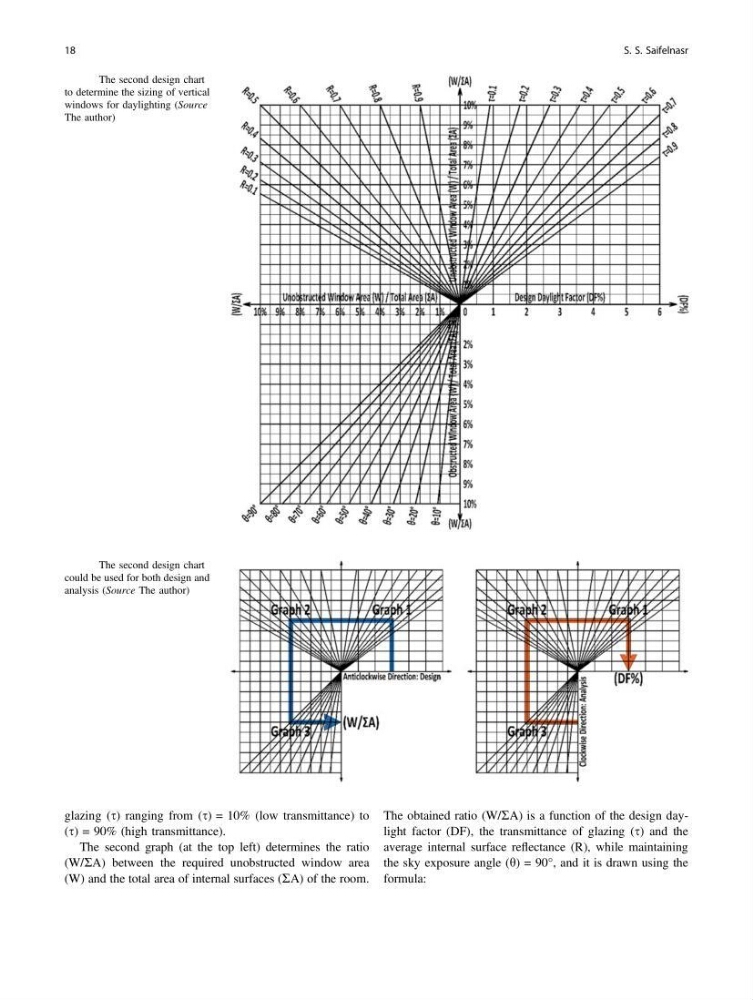
The second graph (at the top left) determines the ratio
(W/RA) between the required unobstructed window area
(W) and the total area of internal surfaces (RA) of the room.
The obtained ratio (W/RA) is a function of the design daylight factor (DF), the transmittance of glazing (s) and the
average internal surface reflectance (R), while maintaining
the sky exposure angle (h) = 90°, and it is drawn using the
formula:
Fig. 5 The second design chart
to determine the sizing of vertical
windows for daylighting (Source
The author)
Fig. 6 The second design chart
could be used for both design and
analysis (Source The author)
18
S. S. Saifelnasr
(s) = 90% (high transmittance).
The second graph (at the top left) determines the ratio
(W/RA) between the required unobstructed window area
(W) and the total area of internal surfaces (RA) of the room.
The obtained ratio (W/RA) is a function of the design daylight factor (DF), the transmittance of glazing (s) and the
average internal surface reflectance (R), while maintaining
the sky exposure angle (h) = 90°, and it is drawn using the
formula:
Fig. 5 The second design chart
to determine the sizing of vertical
windows for daylighting (Source
The author)
Fig. 6 The second design chart
could be used for both design and
analysis (Source The author)
18
S. S. Saifelnasr