

emergency department visit in the last 12 months, number of
medical providers visit in the last 12 months, inpatient
numbers in the hospital in the last 12 months, the number of
inpatient nights spent in the hospital in the past 12 months,
frequency of prescription of medicine used in the past
12 months, number of X-ray or other diagnostic images in
the past 12 months, and number of laboratory test or blood
analysis in the past 12 months.
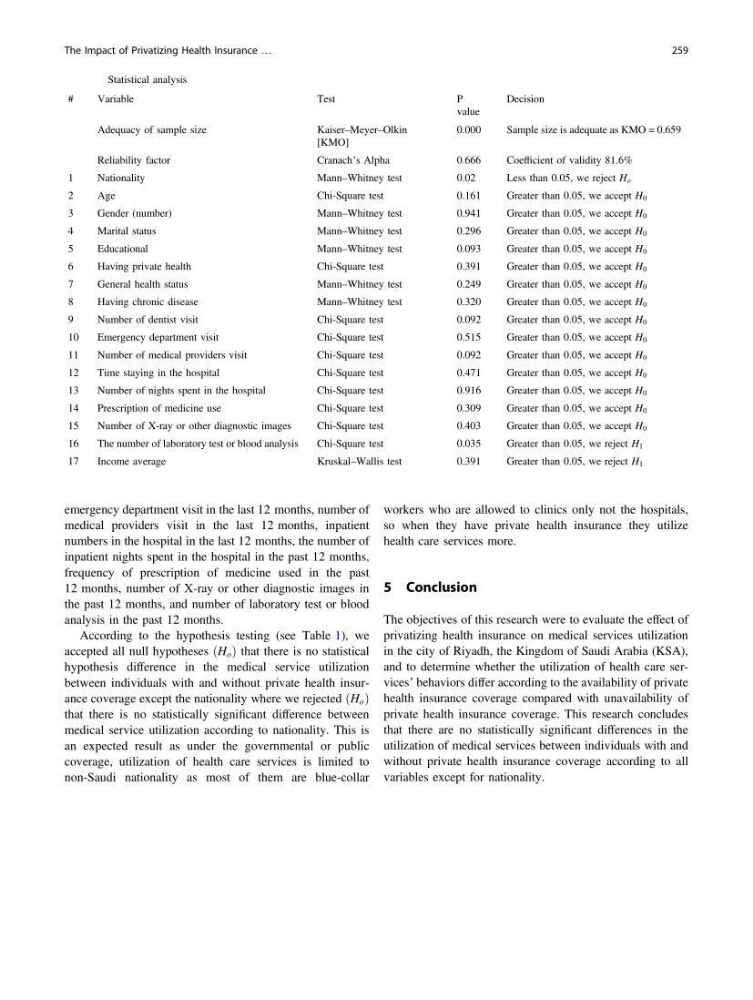
According to the hypothesis testing (see Table 1), we
accepted all null hypotheses ðH o Þ that there is no statistical
hypothesis difference in the medical service utilization
between individuals with and without private health insurance coverage except the nationality where we rejected ðH o Þ
that there is no statistically significant difference between
medical service utilization according to nationality. This is
an expected result as under the governmental or public
coverage, utilization of health care services is limited to
non-Saudi nationality as most of them are blue-collar
workers who are allowed to clinics only not the hospitals,
so when they have private health insurance they utilize
health care services more.
5 Conclusion
The objectives of this research were to evaluate the effect of
privatizing health insurance on medical services utilization
in the city of Riyadh, the Kingdom of Saudi Arabia (KSA),
and to determine whether the utilization of health care services’ behaviors differ according to the availability of private
health insurance coverage compared with unavailability of
private health insurance coverage. This research concludes
that there are no statistically significant differences in the
utilization of medical services between individuals with and
without private health insurance coverage according to all
variables except for nationality.
Table 1 Statistical analysis
#
Variable
Test
P
value
Decision
Adequacy of sample size
Kaiser–Meyer–Olkin
[KMO]
0.000
Sample size is adequate as KMO = 0.659
Reliability factor
Cranach’s Alpha
0.666
Coefficient of validity 81.6%
1
Nationality
Mann–Whitney test
0.02
Less than 0.05, we reject H o
2
Age
Chi-Square test
0.161
Greater than 0.05, we accept H 0
3
Gender (number)
Mann–Whitney test
0.941
Greater than 0.05, we accept H 0
4
Marital status
Mann–Whitney test
0.296
Greater than 0.05, we accept H 0
5
Educational
Mann–Whitney test
0.093
Greater than 0.05, we accept H 0
6
Having private health
Chi-Square test
0.391
Greater than 0.05, we accept H 0
7
General health status
Mann–Whitney test
0.249
Greater than 0.05, we accept H 0
8
Having chronic disease
Mann–Whitney test
0.320
Greater than 0.05, we accept H 0
9
Number of dentist visit
Chi-Square test
0.092
Greater than 0.05, we accept H 0
10
Emergency department visit
Chi-Square test
0.515
Greater than 0.05, we accept H 0
11
Number of medical providers visit
Chi-Square test
0.092
Greater than 0.05, we accept H 0
12
Time staying in the hospital
Chi-Square test
0.471
Greater than 0.05, we accept H 0
13
Number of nights spent in the hospital
Chi-Square test
0.916
Greater than 0.05, we accept H 0
14
Prescription of medicine use
Chi-Square test
0.309
Greater than 0.05, we accept H 0
15
Number of X-ray or other diagnostic images
Chi-Square test
0.403
Greater than 0.05, we accept H 0
16
The number of laboratory test or blood analysis
Chi-Square test
0.035
Greater than 0.05, we reject H 1
17
Income average
Kruskal–Wallis test
0.391
Greater than 0.05, we reject H 1
The Impact of Privatizing Health Insurance …
259
medical providers visit in the last 12 months, inpatient
numbers in the hospital in the last 12 months, the number of
inpatient nights spent in the hospital in the past 12 months,
frequency of prescription of medicine used in the past
12 months, number of X-ray or other diagnostic images in
the past 12 months, and number of laboratory test or blood
analysis in the past 12 months.
According to the hypothesis testing (see Table 1), we
accepted all null hypotheses ðH o Þ that there is no statistical
hypothesis difference in the medical service utilization
between individuals with and without private health insurance coverage except the nationality where we rejected ðH o Þ
that there is no statistically significant difference between
medical service utilization according to nationality. This is
an expected result as under the governmental or public
coverage, utilization of health care services is limited to
non-Saudi nationality as most of them are blue-collar
workers who are allowed to clinics only not the hospitals,
so when they have private health insurance they utilize
health care services more.
5 Conclusion
The objectives of this research were to evaluate the effect of
privatizing health insurance on medical services utilization
in the city of Riyadh, the Kingdom of Saudi Arabia (KSA),
and to determine whether the utilization of health care services’ behaviors differ according to the availability of private
health insurance coverage compared with unavailability of
private health insurance coverage. This research concludes
that there are no statistically significant differences in the
utilization of medical services between individuals with and
without private health insurance coverage according to all
variables except for nationality.
Table 1 Statistical analysis
#
Variable
Test
P
value
Decision
Adequacy of sample size
Kaiser–Meyer–Olkin
[KMO]
0.000
Sample size is adequate as KMO = 0.659
Reliability factor
Cranach’s Alpha
0.666
Coefficient of validity 81.6%
1
Nationality
Mann–Whitney test
0.02
Less than 0.05, we reject H o
2
Age
Chi-Square test
0.161
Greater than 0.05, we accept H 0
3
Gender (number)
Mann–Whitney test
0.941
Greater than 0.05, we accept H 0
4
Marital status
Mann–Whitney test
0.296
Greater than 0.05, we accept H 0
5
Educational
Mann–Whitney test
0.093
Greater than 0.05, we accept H 0
6
Having private health
Chi-Square test
0.391
Greater than 0.05, we accept H 0
7
General health status
Mann–Whitney test
0.249
Greater than 0.05, we accept H 0
8
Having chronic disease
Mann–Whitney test
0.320
Greater than 0.05, we accept H 0
9
Number of dentist visit
Chi-Square test
0.092
Greater than 0.05, we accept H 0
10
Emergency department visit
Chi-Square test
0.515
Greater than 0.05, we accept H 0
11
Number of medical providers visit
Chi-Square test
0.092
Greater than 0.05, we accept H 0
12
Time staying in the hospital
Chi-Square test
0.471
Greater than 0.05, we accept H 0
13
Number of nights spent in the hospital
Chi-Square test
0.916
Greater than 0.05, we accept H 0
14
Prescription of medicine use
Chi-Square test
0.309
Greater than 0.05, we accept H 0
15
Number of X-ray or other diagnostic images
Chi-Square test
0.403
Greater than 0.05, we accept H 0
16
The number of laboratory test or blood analysis
Chi-Square test
0.035
Greater than 0.05, we reject H 1
17
Income average
Kruskal–Wallis test
0.391
Greater than 0.05, we reject H 1
The Impact of Privatizing Health Insurance …
259