

self-efficacy Cronbach’s alpha equals 0.643. This value is
lower than 0.7 which is commonly considered as the
satisfactory level. However, this value is regarded as
acceptable due to relatively lower number of items for this
construct.
While there is no common consensus on measuring
financial behavior, both single item and multiple item measures have been used to create valid and reliable results
(Grable & Joo, 2004). Used multiple item measures were
composed either as scales or domains (Robb & Woodyard,
2011). Financial behavior scale was developed based on
Barbić (2017), Cvrlje (2014). Using six, five-point
Likert-type statements, the scale measures one’s financial
behavior. The reliability indicator Cronbach’s alpha for
financial behavior equals 0.828, which is considered as
good.
The study is conducted using the purposive sample of 150
education participants living in Croatia, aged 20–79 years.
The first research hypothesis of the paper is that financial
knowledge and self-efficacy have positive statistically significant impact on financial behavior. The second research
hypothesis is that self-efficacy exhibits stronger impact on
financial behavior in relation to financial knowledge.
3.2 Principal Components Analysis of Financial
Behavior and Self-efficacy
Variables that relate to financial behavior and self-efficacy
are often highly correlated. Because of that, if each item is
treated as a separate variable, a multicollinearity problem is
expected. Multicollinearity arises when there exists strong
linear relationships among independent variables in the
model. If multicollinearity is present, one of the assumptions
of linear regression models is violated and it is not possible
to conduct the proper ordinary least squares (OLS) estimation (Kennedy, 2008). A possible approach to avoiding this
problem is using principal components analysis, whereat
variables that are highly correlated are combined into components (Tabachnick & Fidell, 2007).
Thus, correlation analysis for items referring to financial
behavior and self-efficacy is provided in Table 2, while
correlation analysis for items that comprise self-efficacy is
given in Table 3.
Since Tables 2 and 3 show that for both constructs the
large number of correlation coefficients among items is
higher than 0.3, principal component analysis is suitable (see
Kinnear & Gray, 2000 for explanation). Moreover, the significance of Bartlett’s test for both constructs equals 0.000,
which indicates that the correlations between items are statistically significantly different from zero. The Kaiser–
Meyer–Olkin (KMO) measure of sampling adequacy for
financial behavior equals 0.788, which is considered as an
acceptable value in line with Kaiser (1974). The KMO
measure for self-efficacy equals 0.650, which points to the
average quality.
Thus, the principal component analysis is conducted for
both financial behavior and self-efficacy. Table 4 presents
eigenvalues for each component before and after extraction
for financial behavior. After extraction first component
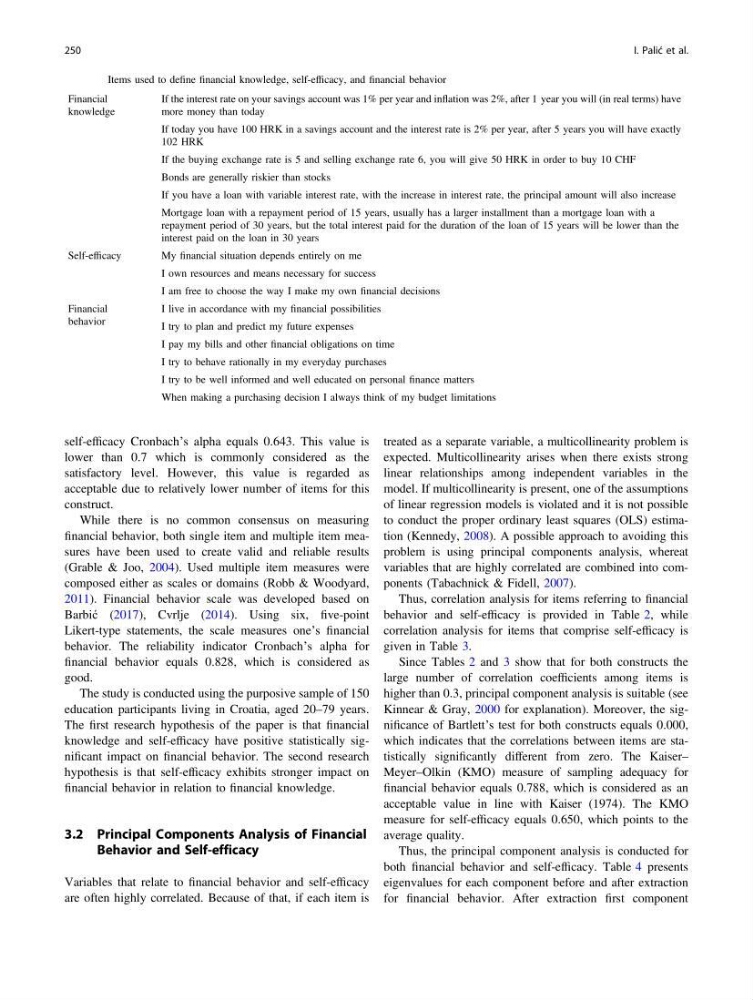
Table 1 Items used to define financial knowledge, self-efficacy, and financial behavior
Financial
knowledge
If the interest rate on your savings account was 1% per year and inflation was 2%, after 1 year you will (in real terms) have
more money than today
If today you have 100 HRK in a savings account and the interest rate is 2% per year, after 5 years you will have exactly
102 HRK
If the buying exchange rate is 5 and selling exchange rate 6, you will give 50 HRK in order to buy 10 CHF
Bonds are generally riskier than stocks
If you have a loan with variable interest rate, with the increase in interest rate, the principal amount will also increase
Mortgage loan with a repayment period of 15 years, usually has a larger installment than a mortgage loan with a
repayment period of 30 years, but the total interest paid for the duration of the loan of 15 years will be lower than the
interest paid on the loan in 30 years
Self-efficacy
My financial situation depends entirely on me
I own resources and means necessary for success
I am free to choose the way I make my own financial decisions
Financial
behavior
I live in accordance with my financial possibilities
I try to plan and predict my future expenses
I pay my bills and other financial obligations on time
I try to behave rationally in my everyday purchases
I try to be well informed and well educated on personal finance matters
When making a purchasing decision I always think of my budget limitations
250
I. Palić et al.
lower than 0.7 which is commonly considered as the
satisfactory level. However, this value is regarded as
acceptable due to relatively lower number of items for this
construct.
While there is no common consensus on measuring
financial behavior, both single item and multiple item measures have been used to create valid and reliable results
(Grable & Joo, 2004). Used multiple item measures were
composed either as scales or domains (Robb & Woodyard,
2011). Financial behavior scale was developed based on
Barbić (2017), Cvrlje (2014). Using six, five-point
Likert-type statements, the scale measures one’s financial
behavior. The reliability indicator Cronbach’s alpha for
financial behavior equals 0.828, which is considered as
good.
The study is conducted using the purposive sample of 150
education participants living in Croatia, aged 20–79 years.
The first research hypothesis of the paper is that financial
knowledge and self-efficacy have positive statistically significant impact on financial behavior. The second research
hypothesis is that self-efficacy exhibits stronger impact on
financial behavior in relation to financial knowledge.
3.2 Principal Components Analysis of Financial
Behavior and Self-efficacy
Variables that relate to financial behavior and self-efficacy
are often highly correlated. Because of that, if each item is
treated as a separate variable, a multicollinearity problem is
expected. Multicollinearity arises when there exists strong
linear relationships among independent variables in the
model. If multicollinearity is present, one of the assumptions
of linear regression models is violated and it is not possible
to conduct the proper ordinary least squares (OLS) estimation (Kennedy, 2008). A possible approach to avoiding this
problem is using principal components analysis, whereat
variables that are highly correlated are combined into components (Tabachnick & Fidell, 2007).
Thus, correlation analysis for items referring to financial
behavior and self-efficacy is provided in Table 2, while
correlation analysis for items that comprise self-efficacy is
given in Table 3.
Since Tables 2 and 3 show that for both constructs the
large number of correlation coefficients among items is
higher than 0.3, principal component analysis is suitable (see
Kinnear & Gray, 2000 for explanation). Moreover, the significance of Bartlett’s test for both constructs equals 0.000,
which indicates that the correlations between items are statistically significantly different from zero. The Kaiser–
Meyer–Olkin (KMO) measure of sampling adequacy for
financial behavior equals 0.788, which is considered as an
acceptable value in line with Kaiser (1974). The KMO
measure for self-efficacy equals 0.650, which points to the
average quality.
Thus, the principal component analysis is conducted for
both financial behavior and self-efficacy. Table 4 presents
eigenvalues for each component before and after extraction
for financial behavior. After extraction first component
Table 1 Items used to define financial knowledge, self-efficacy, and financial behavior
Financial
knowledge
If the interest rate on your savings account was 1% per year and inflation was 2%, after 1 year you will (in real terms) have
more money than today
If today you have 100 HRK in a savings account and the interest rate is 2% per year, after 5 years you will have exactly
102 HRK
If the buying exchange rate is 5 and selling exchange rate 6, you will give 50 HRK in order to buy 10 CHF
Bonds are generally riskier than stocks
If you have a loan with variable interest rate, with the increase in interest rate, the principal amount will also increase
Mortgage loan with a repayment period of 15 years, usually has a larger installment than a mortgage loan with a
repayment period of 30 years, but the total interest paid for the duration of the loan of 15 years will be lower than the
interest paid on the loan in 30 years
Self-efficacy
My financial situation depends entirely on me
I own resources and means necessary for success
I am free to choose the way I make my own financial decisions
Financial
behavior
I live in accordance with my financial possibilities
I try to plan and predict my future expenses
I pay my bills and other financial obligations on time
I try to behave rationally in my everyday purchases
I try to be well informed and well educated on personal finance matters
When making a purchasing decision I always think of my budget limitations
250
I. Palić et al.