

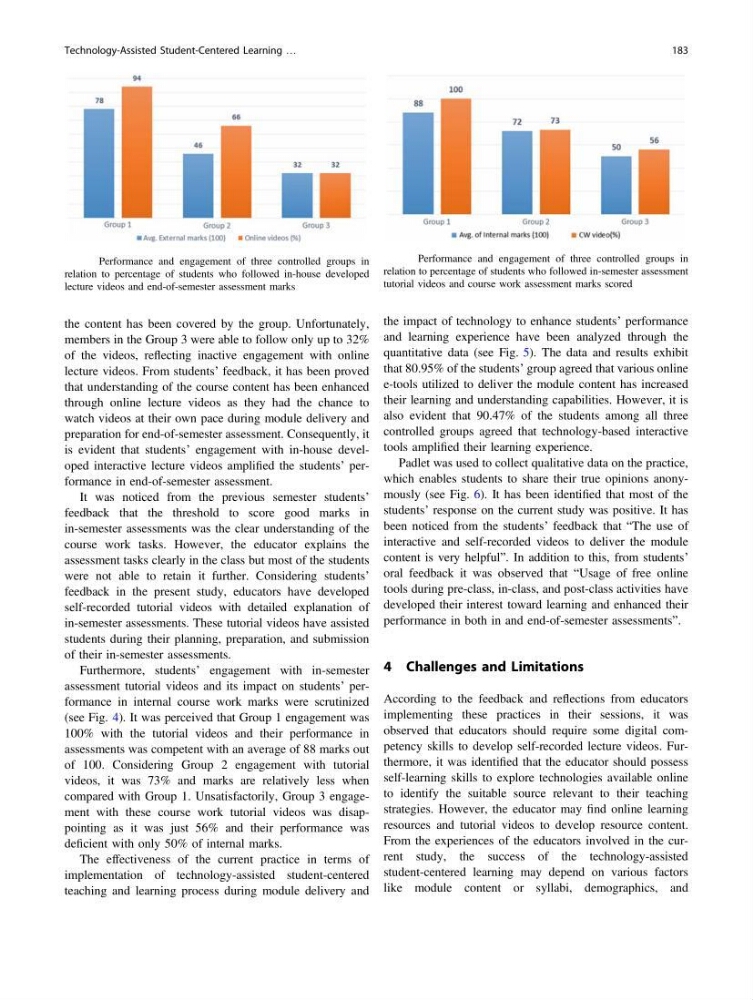
the content has been covered by the group. Unfortunately,
members in the Group 3 were able to follow only up to 32%
of the videos, reflecting inactive engagement with online
lecture videos. From students’ feedback, it has been proved
that understanding of the course content has been enhanced
through online lecture videos as they had the chance to
watch videos at their own pace during module delivery and
preparation for end-of-semester assessment. Consequently, it
is evident that students’ engagement with in-house developed interactive lecture videos amplified the students’ performance in end-of-semester assessment.
It was noticed from the previous semester students’
feedback that the threshold to score good marks in
in-semester assessments was the clear understanding of the
course work tasks. However, the educator explains the
assessment tasks clearly in the class but most of the students
were not able to retain it further. Considering students’
feedback in the present study, educators have developed
self-recorded tutorial videos with detailed explanation of
in-semester assessments. These tutorial videos have assisted
students during their planning, preparation, and submission
of their in-semester assessments.
Furthermore, students’ engagement with in-semester
assessment tutorial videos and its impact on students’ performance in internal course work marks were scrutinized
(see Fig. 4). It was perceived that Group 1 engagement was
100% with the tutorial videos and their performance in
assessments was competent with an average of 88 marks out
of 100. Considering Group 2 engagement with tutorial
videos, it was 73% and marks are relatively less when
compared with Group 1. Unsatisfactorily, Group 3 engagement with these course work tutorial videos was disappointing as it was just 56% and their performance was
deficient with only 50% of internal marks.
The effectiveness of the current practice in terms of
implementation of technology-assisted student-centered
teaching and learning process during module delivery and
the impact of technology to enhance students’ performance
and learning experience have been analyzed through the
quantitative data (see Fig. 5). The data and results exhibit
that 80.95% of the students’ group agreed that various online
e-tools utilized to deliver the module content has increased
their learning and understanding capabilities. However, it is
also evident that 90.47% of the students among all three
controlled groups agreed that technology-based interactive
tools amplified their learning experience.
Padlet was used to collect qualitative data on the practice,
which enables students to share their true opinions anonymously (see Fig. 6). It has been identified that most of the
students’ response on the current study was positive. It has
been noticed from the students’ feedback that “The use of
interactive and self-recorded videos to deliver the module
content is very helpful”. In addition to this, from students’
oral feedback it was observed that “Usage of free online
tools during pre-class, in-class, and post-class activities have
developed their interest toward learning and enhanced their
performance in both in and end-of-semester assessments”.
4 Challenges and Limitations
According to the feedback and reflections from educators
implementing these practices in their sessions, it was
observed that educators should require some digital competency skills to develop self-recorded lecture videos. Furthermore, it was identified that the educator should possess
self-learning skills to explore technologies available online
to identify the suitable source relevant to their teaching
strategies. However, the educator may find online learning
resources and tutorial videos to develop resource content.
From the experiences of the educators involved in the current study, the success of the technology-assisted
student-centered learning may depend on various factors
like module content or syllabi, demographics, and
Fig. 3 Performance and engagement of three controlled groups in
relation to percentage of students who followed in-house developed
lecture videos and end-of-semester assessment marks
Fig. 4 Performance and engagement of three controlled groups in
relation to percentage of students who followed in-semester assessment
tutorial videos and course work assessment marks scored
Technology-Assisted Student-Centered Learning …
183
members in the Group 3 were able to follow only up to 32%
of the videos, reflecting inactive engagement with online
lecture videos. From students’ feedback, it has been proved
that understanding of the course content has been enhanced
through online lecture videos as they had the chance to
watch videos at their own pace during module delivery and
preparation for end-of-semester assessment. Consequently, it
is evident that students’ engagement with in-house developed interactive lecture videos amplified the students’ performance in end-of-semester assessment.
It was noticed from the previous semester students’
feedback that the threshold to score good marks in
in-semester assessments was the clear understanding of the
course work tasks. However, the educator explains the
assessment tasks clearly in the class but most of the students
were not able to retain it further. Considering students’
feedback in the present study, educators have developed
self-recorded tutorial videos with detailed explanation of
in-semester assessments. These tutorial videos have assisted
students during their planning, preparation, and submission
of their in-semester assessments.
Furthermore, students’ engagement with in-semester
assessment tutorial videos and its impact on students’ performance in internal course work marks were scrutinized
(see Fig. 4). It was perceived that Group 1 engagement was
100% with the tutorial videos and their performance in
assessments was competent with an average of 88 marks out
of 100. Considering Group 2 engagement with tutorial
videos, it was 73% and marks are relatively less when
compared with Group 1. Unsatisfactorily, Group 3 engagement with these course work tutorial videos was disappointing as it was just 56% and their performance was
deficient with only 50% of internal marks.
The effectiveness of the current practice in terms of
implementation of technology-assisted student-centered
teaching and learning process during module delivery and
the impact of technology to enhance students’ performance
and learning experience have been analyzed through the
quantitative data (see Fig. 5). The data and results exhibit
that 80.95% of the students’ group agreed that various online
e-tools utilized to deliver the module content has increased
their learning and understanding capabilities. However, it is
also evident that 90.47% of the students among all three
controlled groups agreed that technology-based interactive
tools amplified their learning experience.
Padlet was used to collect qualitative data on the practice,
which enables students to share their true opinions anonymously (see Fig. 6). It has been identified that most of the
students’ response on the current study was positive. It has
been noticed from the students’ feedback that “The use of
interactive and self-recorded videos to deliver the module
content is very helpful”. In addition to this, from students’
oral feedback it was observed that “Usage of free online
tools during pre-class, in-class, and post-class activities have
developed their interest toward learning and enhanced their
performance in both in and end-of-semester assessments”.
4 Challenges and Limitations
According to the feedback and reflections from educators
implementing these practices in their sessions, it was
observed that educators should require some digital competency skills to develop self-recorded lecture videos. Furthermore, it was identified that the educator should possess
self-learning skills to explore technologies available online
to identify the suitable source relevant to their teaching
strategies. However, the educator may find online learning
resources and tutorial videos to develop resource content.
From the experiences of the educators involved in the current study, the success of the technology-assisted
student-centered learning may depend on various factors
like module content or syllabi, demographics, and
Fig. 3 Performance and engagement of three controlled groups in
relation to percentage of students who followed in-house developed
lecture videos and end-of-semester assessment marks
Fig. 4 Performance and engagement of three controlled groups in
relation to percentage of students who followed in-semester assessment
tutorial videos and course work assessment marks scored
Technology-Assisted Student-Centered Learning …
183