

2.6 Padlet
Padlet was also used in the current study as one of the
revision tools. This works on the similar concept of Google
Docs, where a shared page was generated online and the link
was shared with students during class hours. It was especially used at the end of class, so that students can write their
classroom reflections, in terms of topics they understood or
feedback on the flipped classroom practices being implemented (Sangeetha 2016). Unlike Google Docs, this provides a very colorful user-interface that can be customized.
The usage of Padlet was very interesting and fun as the feeds
were displayed timely on the projector screen. The only
issue with this tool was that students were able to type into
the feeds anonymously. Hence, in certain cases, it was difficult to identify who has posted a particular feed. However,
the overall experience with this tool was really affable.
2.7 Screencast-O-Matic
This is a screen-recorder tool which was used for recording
self-lectures (Cecile and Gladson 2014). It has options to
record screen actions along with video and audio through
built-in camera and microphone, respectively. In the present
study, it was used for recording many video-based instructional videos. Students found it helpful since they were able
to connect to the educator more easily due to the spoken
language and easy to understand accent. It was noticed from
students’ oral feedback that videos recorded through
screencast-o-matic were so effective and easily understandable rather than random online videos or YouTube videos.
2.8 Videopad Video Editor
This free tool was used to edit videos, which improved the
final quality of the self-recorded lecture videos (NCH Software Homepage 2019). The videos were later added with
titles and credits to make it more interesting. Finally, these
videos were converted to WMV format since it was required
to upload these videos on the streaming server of the college.
Students were able to access these videos through Moodle
and found them very useful. This tool also supports subtitling and some video-based demos were added with subtitles
for better understanding. Some students were also involved
to provide demonstrations in Arabic, and hence making the
overall experience of learning very fruitful.
3 Outcomes of the Practice
This study includes both quantitative and qualitative analysis
to compare the performance of students in three controlled
groups through their engagement with interactive online
activities and assessment results. Data from online tools like
Playposit, TedEd, Socrative, students’ feedback from SurveyMonkey, and both in-semester and end-of-semester
grades were analyzed to divide students into three controlled groups. Out of 24 students in the session, seven
students were in Group 1 as they were pro-active and highly
engaged with educational technology and flipped classroom
activities. Eight students who were moderately active in this
teaching and learning process were identified as Group 2.
The remaining nine students in the session who fall under
Group 3 were observed to be reactive and have shown
minimal engagement in the technology-assisted learning
process.
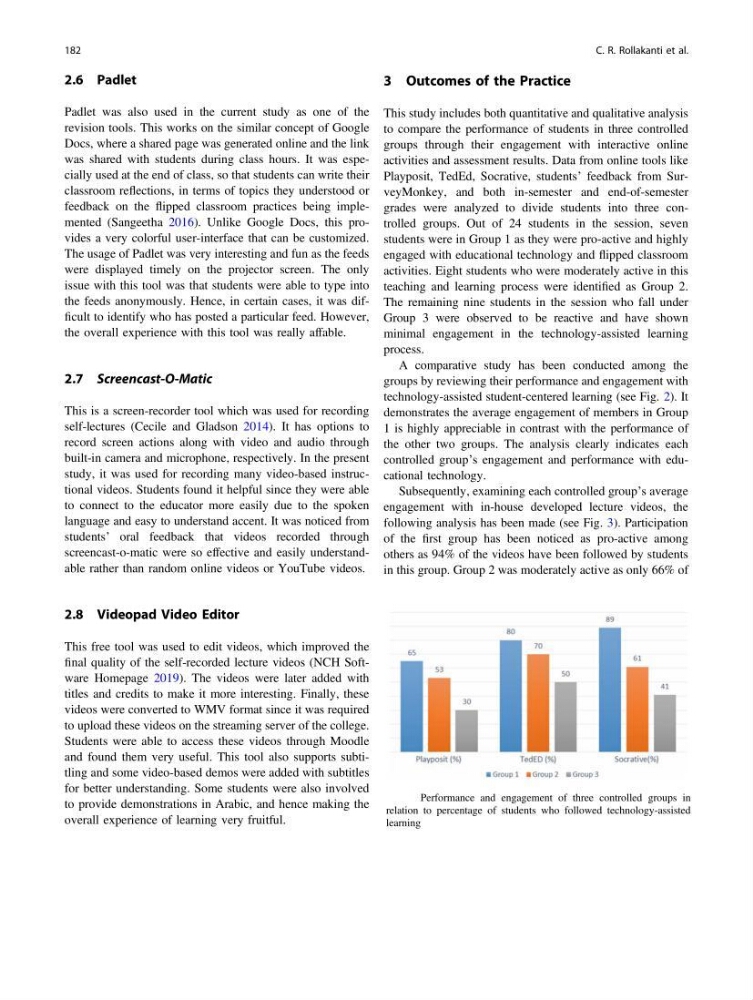
A comparative study has been conducted among the
groups by reviewing their performance and engagement with
technology-assisted student-centered learning (see Fig. 2). It
demonstrates the average engagement of members in Group
1 is highly appreciable in contrast with the performance of
the other two groups. The analysis clearly indicates each
controlled group’s engagement and performance with educational technology.
Subsequently, examining each controlled group’s average
engagement with in-house developed lecture videos, the
following analysis has been made (see Fig. 3). Participation
of the first group has been noticed as pro-active among
others as 94% of the videos have been followed by students
in this group. Group 2 was moderately active as only 66% of
Fig. 2 Performance and engagement of three controlled groups in
relation to percentage of students who followed technology-assisted
learning
182
C. R. Rollakanti et al.
Padlet was also used in the current study as one of the
revision tools. This works on the similar concept of Google
Docs, where a shared page was generated online and the link
was shared with students during class hours. It was especially used at the end of class, so that students can write their
classroom reflections, in terms of topics they understood or
feedback on the flipped classroom practices being implemented (Sangeetha 2016). Unlike Google Docs, this provides a very colorful user-interface that can be customized.
The usage of Padlet was very interesting and fun as the feeds
were displayed timely on the projector screen. The only
issue with this tool was that students were able to type into
the feeds anonymously. Hence, in certain cases, it was difficult to identify who has posted a particular feed. However,
the overall experience with this tool was really affable.
2.7 Screencast-O-Matic
This is a screen-recorder tool which was used for recording
self-lectures (Cecile and Gladson 2014). It has options to
record screen actions along with video and audio through
built-in camera and microphone, respectively. In the present
study, it was used for recording many video-based instructional videos. Students found it helpful since they were able
to connect to the educator more easily due to the spoken
language and easy to understand accent. It was noticed from
students’ oral feedback that videos recorded through
screencast-o-matic were so effective and easily understandable rather than random online videos or YouTube videos.
2.8 Videopad Video Editor
This free tool was used to edit videos, which improved the
final quality of the self-recorded lecture videos (NCH Software Homepage 2019). The videos were later added with
titles and credits to make it more interesting. Finally, these
videos were converted to WMV format since it was required
to upload these videos on the streaming server of the college.
Students were able to access these videos through Moodle
and found them very useful. This tool also supports subtitling and some video-based demos were added with subtitles
for better understanding. Some students were also involved
to provide demonstrations in Arabic, and hence making the
overall experience of learning very fruitful.
3 Outcomes of the Practice
This study includes both quantitative and qualitative analysis
to compare the performance of students in three controlled
groups through their engagement with interactive online
activities and assessment results. Data from online tools like
Playposit, TedEd, Socrative, students’ feedback from SurveyMonkey, and both in-semester and end-of-semester
grades were analyzed to divide students into three controlled groups. Out of 24 students in the session, seven
students were in Group 1 as they were pro-active and highly
engaged with educational technology and flipped classroom
activities. Eight students who were moderately active in this
teaching and learning process were identified as Group 2.
The remaining nine students in the session who fall under
Group 3 were observed to be reactive and have shown
minimal engagement in the technology-assisted learning
process.
A comparative study has been conducted among the
groups by reviewing their performance and engagement with
technology-assisted student-centered learning (see Fig. 2). It
demonstrates the average engagement of members in Group
1 is highly appreciable in contrast with the performance of
the other two groups. The analysis clearly indicates each
controlled group’s engagement and performance with educational technology.
Subsequently, examining each controlled group’s average
engagement with in-house developed lecture videos, the
following analysis has been made (see Fig. 3). Participation
of the first group has been noticed as pro-active among
others as 94% of the videos have been followed by students
in this group. Group 2 was moderately active as only 66% of
Fig. 2 Performance and engagement of three controlled groups in
relation to percentage of students who followed technology-assisted
learning
182
C. R. Rollakanti et al.