

dwellings consume more energy than smaller ones, thus the
owners of large dwelling are willing to invest in
energy-efficient retrofit to reduce energy consumption
(Santin et al. 2009). Energy consumption is also linked to
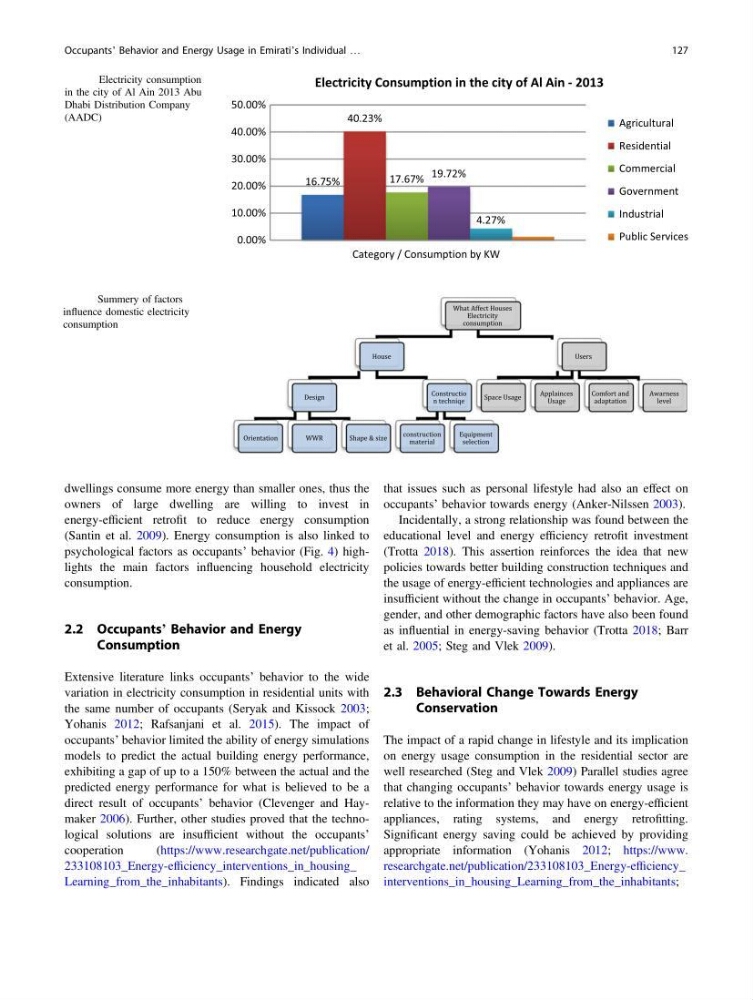
psychological factors as occupants’ behavior (Fig. 4) highlights the main factors influencing household electricity
consumption.
2.2 Occupants’ Behavior and Energy
Consumption
Extensive literature links occupants’ behavior to the wide
variation in electricity consumption in residential units with
the same number of occupants (Seryak and Kissock 2003;
Yohanis 2012; Rafsanjani et al. 2015). The impact of
occupants’ behavior limited the ability of energy simulations
models to predict the actual building energy performance,
exhibiting a gap of up to a 150% between the actual and the
predicted energy performance for what is believed to be a
direct result of occupants’ behavior (Clevenger and Haymaker 2006). Further, other studies proved that the technological solutions are insufficient without the occupants’
cooperation
(https://www.researchgate.net/publication/
233108103_Energy-efficiency_interventions_in_housing_
Learning_from_the_inhabitants). Findings indicated also
that issues such as personal lifestyle had also an effect on
occupants’ behavior towards energy (Anker-Nilssen 2003).
Incidentally, a strong relationship was found between the
educational level and energy efficiency retrofit investment
(Trotta 2018). This assertion reinforces the idea that new
policies towards better building construction techniques and
the usage of energy-efficient technologies and appliances are
insufficient without the change in occupants’ behavior. Age,
gender, and other demographic factors have also been found
as influential in energy-saving behavior (Trotta 2018; Barr
et al. 2005; Steg and Vlek 2009).
2.3 Behavioral Change Towards Energy
Conservation
The impact of a rapid change in lifestyle and its implication
on energy usage consumption in the residential sector are
well researched (Steg and Vlek 2009) Parallel studies agree
that changing occupants’ behavior towards energy usage is
relative to the information they may have on energy-efficient
appliances, rating systems, and energy retrofitting.
Significant energy saving could be achieved by providing
appropriate information (Yohanis 2012; https://www.
researchgate.net/publication/233108103_Energy-efficiency_
interventions_in_housing_Learning_from_the_inhabitants;
16.75%
40.23%
17.67% 19.72%
4.27%
0.00%
10.00%
20.00%
30.00%
40.00%
50.00%
Category / Consumption by KW
Electricity Consumption in the city of Al Ain - 2013
Agricultural
Residential
Commercial
Government
Industrial
Public Services
Fig. 3 Electricity consumption
in the city of Al Ain 2013 Abu
Dhabi Distribution Company
(AADC)
Fig. 4 Summery of factors
influence domestic electricity
consumption
Occupants’ Behavior and Energy Usage in Emirati’s Individual …
127
owners of large dwelling are willing to invest in
energy-efficient retrofit to reduce energy consumption
(Santin et al. 2009). Energy consumption is also linked to
psychological factors as occupants’ behavior (Fig. 4) highlights the main factors influencing household electricity
consumption.
2.2 Occupants’ Behavior and Energy
Consumption
Extensive literature links occupants’ behavior to the wide
variation in electricity consumption in residential units with
the same number of occupants (Seryak and Kissock 2003;
Yohanis 2012; Rafsanjani et al. 2015). The impact of
occupants’ behavior limited the ability of energy simulations
models to predict the actual building energy performance,
exhibiting a gap of up to a 150% between the actual and the
predicted energy performance for what is believed to be a
direct result of occupants’ behavior (Clevenger and Haymaker 2006). Further, other studies proved that the technological solutions are insufficient without the occupants’
cooperation
(https://www.researchgate.net/publication/
233108103_Energy-efficiency_interventions_in_housing_
Learning_from_the_inhabitants). Findings indicated also
that issues such as personal lifestyle had also an effect on
occupants’ behavior towards energy (Anker-Nilssen 2003).
Incidentally, a strong relationship was found between the
educational level and energy efficiency retrofit investment
(Trotta 2018). This assertion reinforces the idea that new
policies towards better building construction techniques and
the usage of energy-efficient technologies and appliances are
insufficient without the change in occupants’ behavior. Age,
gender, and other demographic factors have also been found
as influential in energy-saving behavior (Trotta 2018; Barr
et al. 2005; Steg and Vlek 2009).
2.3 Behavioral Change Towards Energy
Conservation
The impact of a rapid change in lifestyle and its implication
on energy usage consumption in the residential sector are
well researched (Steg and Vlek 2009) Parallel studies agree
that changing occupants’ behavior towards energy usage is
relative to the information they may have on energy-efficient
appliances, rating systems, and energy retrofitting.
Significant energy saving could be achieved by providing
appropriate information (Yohanis 2012; https://www.
researchgate.net/publication/233108103_Energy-efficiency_
interventions_in_housing_Learning_from_the_inhabitants;
16.75%
40.23%
17.67% 19.72%
4.27%
0.00%
10.00%
20.00%
30.00%
40.00%
50.00%
Category / Consumption by KW
Electricity Consumption in the city of Al Ain - 2013
Agricultural
Residential
Commercial
Government
Industrial
Public Services
Fig. 3 Electricity consumption
in the city of Al Ain 2013 Abu
Dhabi Distribution Company
(AADC)
Fig. 4 Summery of factors
influence domestic electricity
consumption
Occupants’ Behavior and Energy Usage in Emirati’s Individual …
127