

68
5 How to Conduct an Experiment in the Field …
slope angle a is equal to the angle between the slope and the laser plane when the
laser source is perpendicular to the ground. However, if the laser source were rotated
away from the slope with an angle of b, the angle between the slope and the laser
plane, c, would be equal to (a − b). In this case, the observed slope does not deform
because the camera sightline is kept vertical to the laser plane; that is, no discrepancy
occurs between the real volume and the measured volume of the slope.
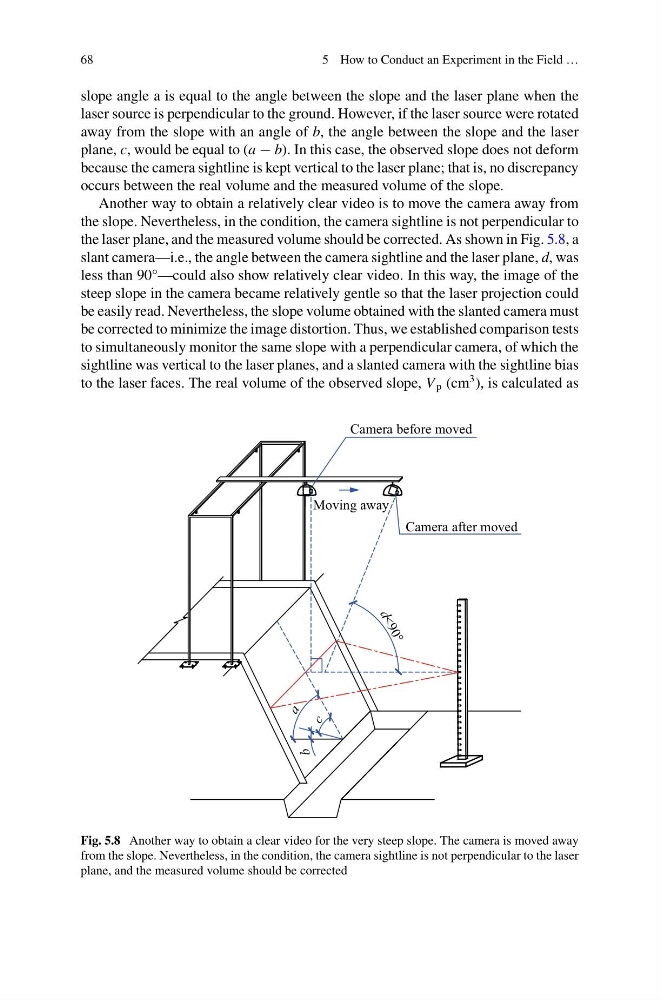
Another way to obtain a relatively clear video is to move the camera away from
the slope. Nevertheless, in the condition, the camera sightline is not perpendicular to
the laser plane, and the measured volume should be corrected. As shown in Fig. 5.8, a
slant camera—i.e., the angle between the camera sightline and the laser plane, d, was
less than 90°—could also show relatively clear video. In this way, the image of the
steep slope in the camera became relatively gentle so that the laser projection could
be easily read. Nevertheless, the slope volume obtained with the slanted camera must
be corrected to minimize the image distortion. Thus, we established comparison tests
to simultaneously monitor the same slope with a perpendicular camera, of which the
sightline was vertical to the laser planes, and a slanted camera with the sightline bias
to the laser faces. The real volume of the observed slope, V p (cm
3 ), is calculated as
Camera before moved
a
b
c
d
<
9
0
°
Camera after moved
Moving away
Fig. 5.8 Another way to obtain a clear video for the very steep slope. The camera is moved away
from the slope. Nevertheless, in the condition, the camera sightline is not perpendicular to the laser
plane, and the measured volume should be corrected
5 How to Conduct an Experiment in the Field …
slope angle a is equal to the angle between the slope and the laser plane when the
laser source is perpendicular to the ground. However, if the laser source were rotated
away from the slope with an angle of b, the angle between the slope and the laser
plane, c, would be equal to (a − b). In this case, the observed slope does not deform
because the camera sightline is kept vertical to the laser plane; that is, no discrepancy
occurs between the real volume and the measured volume of the slope.
Another way to obtain a relatively clear video is to move the camera away from
the slope. Nevertheless, in the condition, the camera sightline is not perpendicular to
the laser plane, and the measured volume should be corrected. As shown in Fig. 5.8, a
slant camera—i.e., the angle between the camera sightline and the laser plane, d, was
less than 90°—could also show relatively clear video. In this way, the image of the
steep slope in the camera became relatively gentle so that the laser projection could
be easily read. Nevertheless, the slope volume obtained with the slanted camera must
be corrected to minimize the image distortion. Thus, we established comparison tests
to simultaneously monitor the same slope with a perpendicular camera, of which the
sightline was vertical to the laser planes, and a slanted camera with the sightline bias
to the laser faces. The real volume of the observed slope, V p (cm
3 ), is calculated as
Camera before moved
a
b
c
d
<
9
0
°
Camera after moved
Moving away
Fig. 5.8 Another way to obtain a clear video for the very steep slope. The camera is moved away
from the slope. Nevertheless, in the condition, the camera sightline is not perpendicular to the laser
plane, and the measured volume should be corrected