

13.4 Results and Discussion
221
0
100
200
300
400
500
600
700
800
0
20
40
60
80
100
120
MSC (g/l)
Q (m
3 )
T1
T3
T4
T6
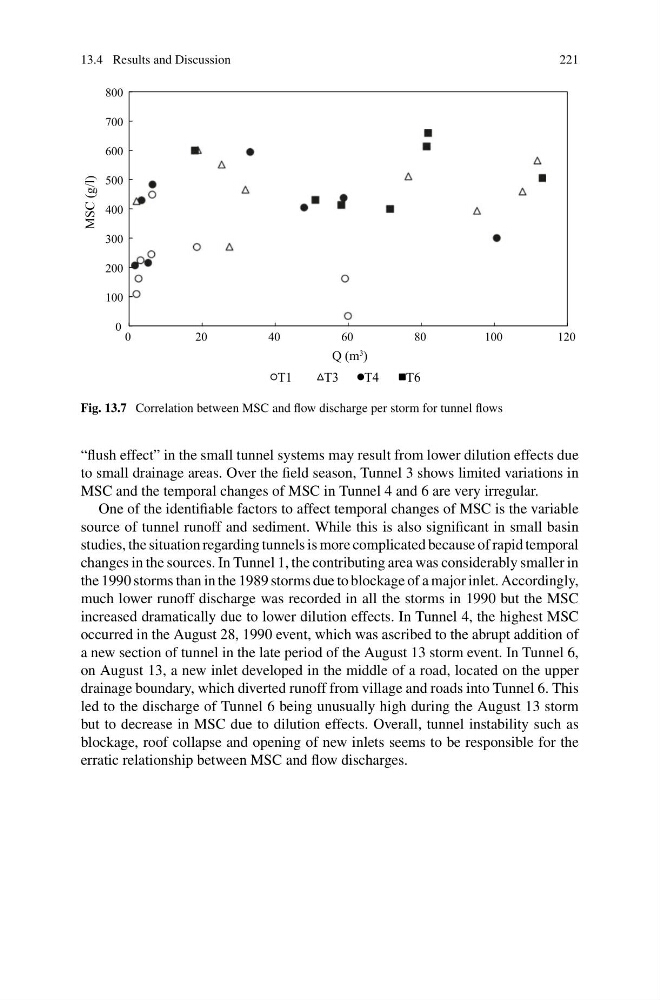
Fig. 13.7 Correlation between MSC and flow discharge per storm for tunnel flows
“flush effect” in the small tunnel systems may result from lower dilution effects due
to small drainage areas. Over the field season, Tunnel 3 shows limited variations in
MSC and the temporal changes of MSC in Tunnel 4 and 6 are very irregular.
One of the identifiable factors to affect temporal changes of MSC is the variable
source of tunnel runoff and sediment. While this is also significant in small basin
studies, the situation regarding tunnels is more complicated because of rapid temporal
changes in the sources. In Tunnel 1, the contributing area was considerably smaller in
the 1990 storms than in the 1989 storms due to blockage of a major inlet. Accordingly,
much lower runoff discharge was recorded in all the storms in 1990 but the MSC
increased dramatically due to lower dilution effects. In Tunnel 4, the highest MSC
occurred in the August 28, 1990 event, which was ascribed to the abrupt addition of
a new section of tunnel in the late period of the August 13 storm event. In Tunnel 6,
on August 13, a new inlet developed in the middle of a road, located on the upper
drainage boundary, which diverted runoff from village and roads into Tunnel 6. This
led to the discharge of Tunnel 6 being unusually high during the August 13 storm
but to decrease in MSC due to dilution effects. Overall, tunnel instability such as
blockage, roof collapse and opening of new inlets seems to be responsible for the
erratic relationship between MSC and flow discharges.
221
0
100
200
300
400
500
600
700
800
0
20
40
60
80
100
120
MSC (g/l)
Q (m
3 )
T1
T3
T4
T6
Fig. 13.7 Correlation between MSC and flow discharge per storm for tunnel flows
“flush effect” in the small tunnel systems may result from lower dilution effects due
to small drainage areas. Over the field season, Tunnel 3 shows limited variations in
MSC and the temporal changes of MSC in Tunnel 4 and 6 are very irregular.
One of the identifiable factors to affect temporal changes of MSC is the variable
source of tunnel runoff and sediment. While this is also significant in small basin
studies, the situation regarding tunnels is more complicated because of rapid temporal
changes in the sources. In Tunnel 1, the contributing area was considerably smaller in
the 1990 storms than in the 1989 storms due to blockage of a major inlet. Accordingly,
much lower runoff discharge was recorded in all the storms in 1990 but the MSC
increased dramatically due to lower dilution effects. In Tunnel 4, the highest MSC
occurred in the August 28, 1990 event, which was ascribed to the abrupt addition of
a new section of tunnel in the late period of the August 13 storm event. In Tunnel 6,
on August 13, a new inlet developed in the middle of a road, located on the upper
drainage boundary, which diverted runoff from village and roads into Tunnel 6. This
led to the discharge of Tunnel 6 being unusually high during the August 13 storm
but to decrease in MSC due to dilution effects. Overall, tunnel instability such as
blockage, roof collapse and opening of new inlets seems to be responsible for the
erratic relationship between MSC and flow discharges.