

204
12 Effects of Gravity Erosion on Particle Size Distribution …
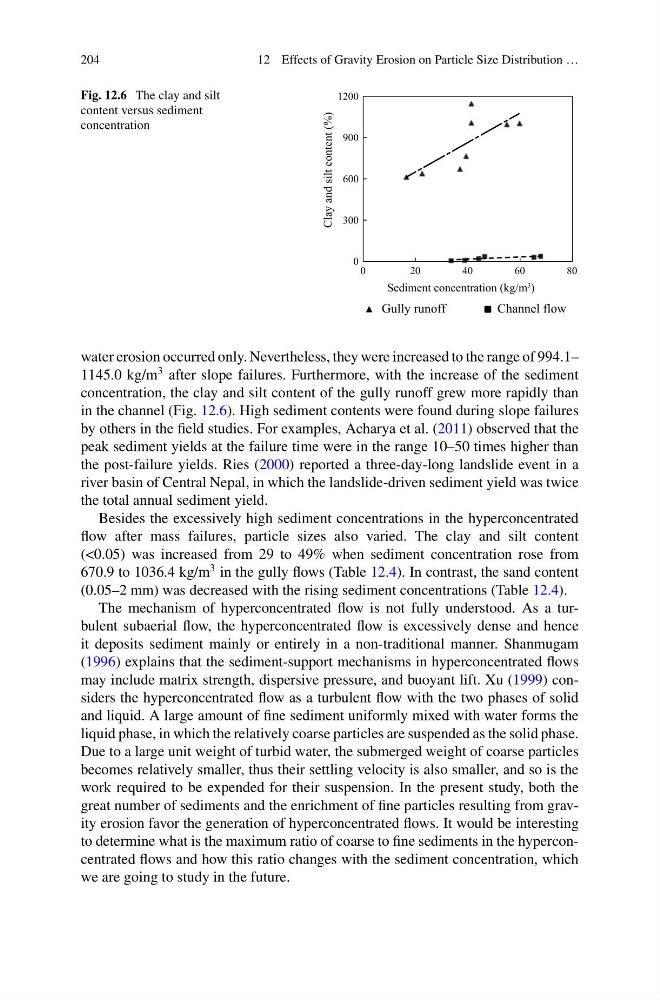
Fig. 12.6 The clay and silt
content versus sediment
concentration
0
300
600
900
1200
0
20
40
60
80
Clay and silt content (%)
Sediment concentration (kg/m
3 )
Gully runoff
Channel flow
water erosion occurred only. Nevertheless, they were increased to the range of 994.1–
1145.0 kg/m
3 after slope failures. Furthermore, with the increase of the sediment
concentration, the clay and silt content of the gully runoff grew more rapidly than
in the channel (Fig. 12.6). High sediment contents were found during slope failures
by others in the field studies. For examples, Acharya et al. (2011) observed that the
peak sediment yields at the failure time were in the range 10–50 times higher than
the post-failure yields. Ries (2000) reported a three-day-long landslide event in a
river basin of Central Nepal, in which the landslide-driven sediment yield was twice
the total annual sediment yield.
Besides the excessively high sediment concentrations in the hyperconcentrated
flow after mass failures, particle sizes also varied. The clay and silt content
(<0.05) was increased from 29 to 49% when sediment concentration rose from
670.9 to 1036.4 kg/m
3 in the gully flows (Table 12.4). In contrast, the sand content
(0.05–2 mm) was decreased with the rising sediment concentrations (Table 12.4).
The mechanism of hyperconcentrated flow is not fully understood. As a turbulent subaerial flow, the hyperconcentrated flow is excessively dense and hence
it deposits sediment mainly or entirely in a non-traditional manner. Shanmugam
(1996) explains that the sediment-support mechanisms in hyperconcentrated flows
may include matrix strength, dispersive pressure, and buoyant lift. Xu (1999) considers the hyperconcentrated flow as a turbulent flow with the two phases of solid
and liquid. A large amount of fine sediment uniformly mixed with water forms the
liquid phase, in which the relatively coarse particles are suspended as the solid phase.
Due to a large unit weight of turbid water, the submerged weight of coarse particles
becomes relatively smaller, thus their settling velocity is also smaller, and so is the
work required to be expended for their suspension. In the present study, both the
great number of sediments and the enrichment of fine particles resulting from gravity erosion favor the generation of hyperconcentrated flows. It would be interesting
to determine what is the maximum ratio of coarse to fine sediments in the hyperconcentrated flows and how this ratio changes with the sediment concentration, which
we are going to study in the future.
12 Effects of Gravity Erosion on Particle Size Distribution …
Fig. 12.6 The clay and silt
content versus sediment
concentration
0
300
600
900
1200
0
20
40
60
80
Clay and silt content (%)
Sediment concentration (kg/m
3 )
Gully runoff
Channel flow
water erosion occurred only. Nevertheless, they were increased to the range of 994.1–
1145.0 kg/m
3 after slope failures. Furthermore, with the increase of the sediment
concentration, the clay and silt content of the gully runoff grew more rapidly than
in the channel (Fig. 12.6). High sediment contents were found during slope failures
by others in the field studies. For examples, Acharya et al. (2011) observed that the
peak sediment yields at the failure time were in the range 10–50 times higher than
the post-failure yields. Ries (2000) reported a three-day-long landslide event in a
river basin of Central Nepal, in which the landslide-driven sediment yield was twice
the total annual sediment yield.
Besides the excessively high sediment concentrations in the hyperconcentrated
flow after mass failures, particle sizes also varied. The clay and silt content
(<0.05) was increased from 29 to 49% when sediment concentration rose from
670.9 to 1036.4 kg/m
3 in the gully flows (Table 12.4). In contrast, the sand content
(0.05–2 mm) was decreased with the rising sediment concentrations (Table 12.4).
The mechanism of hyperconcentrated flow is not fully understood. As a turbulent subaerial flow, the hyperconcentrated flow is excessively dense and hence
it deposits sediment mainly or entirely in a non-traditional manner. Shanmugam
(1996) explains that the sediment-support mechanisms in hyperconcentrated flows
may include matrix strength, dispersive pressure, and buoyant lift. Xu (1999) considers the hyperconcentrated flow as a turbulent flow with the two phases of solid
and liquid. A large amount of fine sediment uniformly mixed with water forms the
liquid phase, in which the relatively coarse particles are suspended as the solid phase.
Due to a large unit weight of turbid water, the submerged weight of coarse particles
becomes relatively smaller, thus their settling velocity is also smaller, and so is the
work required to be expended for their suspension. In the present study, both the
great number of sediments and the enrichment of fine particles resulting from gravity erosion favor the generation of hyperconcentrated flows. It would be interesting
to determine what is the maximum ratio of coarse to fine sediments in the hyperconcentrated flows and how this ratio changes with the sediment concentration, which
we are going to study in the future.