

12.4 Results and Discussion
203
in the region (e.g., Wang et al. 2010). Wendling et al. (2016) indicated that the suspended concentration controls the particle size distribution to some extent. Increasing the suspended concentration led to more frequent collisions between particles
(Abrahamson 1975). If the probability of breakdown or abrasion during a collision is
higher than the probability of cohesion, the statistical effect of an increasing collision
number is a decreased mean particle size.
12.4.5 Gravity Erosion and Hyper-Concentrated Flows
A considerable number of field observations indicated that hyperconcentrated flows
may be associated with mass movements (Li et al. 2009; Pierson 2005; Xu 1999).
There are different definitions of hyper-concentrated flows. Qian (1989) refers them
to the flows with sediment concentration greater than 800 kg/m
3 . In this study, we
experimentally observed a drastic increase in the sediment concentration after mass
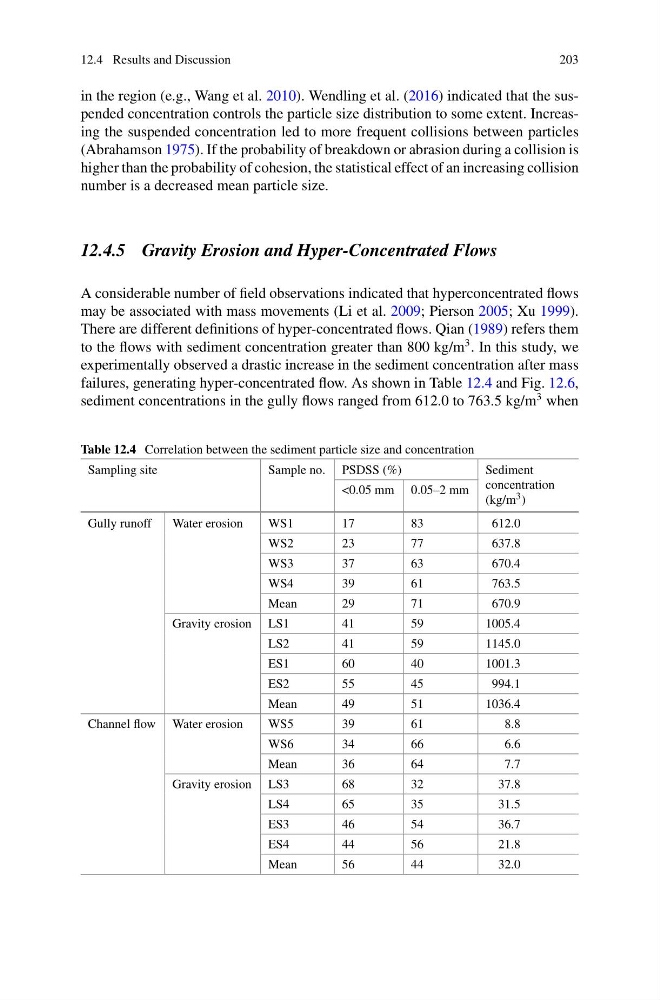
failures, generating hyper-concentrated flow. As shown in Table 12.4 and Fig. 12.6,
sediment concentrations in the gully flows ranged from 612.0 to 763.5 kg/m
3 when
Table 12.4 Correlation between the sediment particle size and concentration
Sampling site
Sample no. PSDSS (%)
Sediment
concentration
(kg/m 3 )
<0.05 mm 0.05–2 mm
Gully runoff
Water erosion
WS1
17
83
612.0
WS2
23
77
637.8
WS3
37
63
670.4
WS4
39
61
763.5
Mean
29
71
670.9
Gravity erosion LS1
41
59
1005.4
LS2
41
59
1145.0
ES1
60
40
1001.3
ES2
55
45
994.1
Mean
49
51
1036.4
Channel flow Water erosion
WS5
39
61
8.8
WS6
34
66
6.6
Mean
36
64
7.7
Gravity erosion LS3
68
32
37.8
LS4
65
35
31.5
ES3
46
54
36.7
ES4
44
56
21.8
Mean
56
44
32.0
203
in the region (e.g., Wang et al. 2010). Wendling et al. (2016) indicated that the suspended concentration controls the particle size distribution to some extent. Increasing the suspended concentration led to more frequent collisions between particles
(Abrahamson 1975). If the probability of breakdown or abrasion during a collision is
higher than the probability of cohesion, the statistical effect of an increasing collision
number is a decreased mean particle size.
12.4.5 Gravity Erosion and Hyper-Concentrated Flows
A considerable number of field observations indicated that hyperconcentrated flows
may be associated with mass movements (Li et al. 2009; Pierson 2005; Xu 1999).
There are different definitions of hyper-concentrated flows. Qian (1989) refers them
to the flows with sediment concentration greater than 800 kg/m
3 . In this study, we
experimentally observed a drastic increase in the sediment concentration after mass
failures, generating hyper-concentrated flow. As shown in Table 12.4 and Fig. 12.6,
sediment concentrations in the gully flows ranged from 612.0 to 763.5 kg/m
3 when
Table 12.4 Correlation between the sediment particle size and concentration
Sampling site
Sample no. PSDSS (%)
Sediment
concentration
(kg/m 3 )
<0.05 mm 0.05–2 mm
Gully runoff
Water erosion
WS1
17
83
612.0
WS2
23
77
637.8
WS3
37
63
670.4
WS4
39
61
763.5
Mean
29
71
670.9
Gravity erosion LS1
41
59
1005.4
LS2
41
59
1145.0
ES1
60
40
1001.3
ES2
55
45
994.1
Mean
49
51
1036.4
Channel flow Water erosion
WS5
39
61
8.8
WS6
34
66
6.6
Mean
36
64
7.7
Gravity erosion LS3
68
32
37.8
LS4
65
35
31.5
ES3
46
54
36.7
ES4
44
56
21.8
Mean
56
44
32.0