

196
12 Effects of Gravity Erosion on Particle Size Distribution …
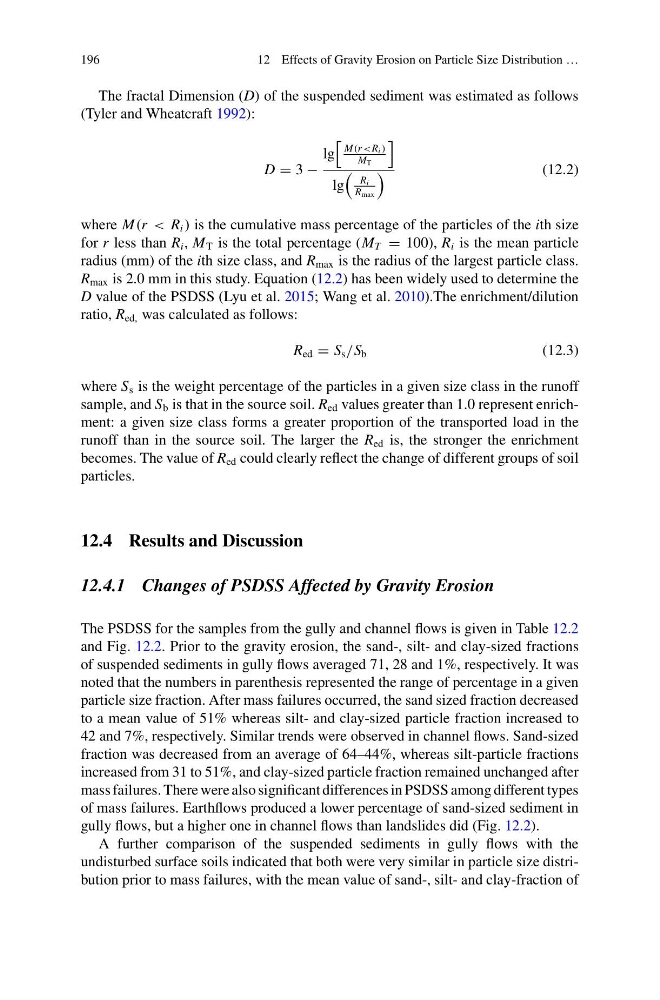
The fractal Dimension (D) of the suspended sediment was estimated as follows
(Tyler and Wheatcraft 1992):
D = 3 −
lg
M(r
lg
R i
R max
(12.2)
where M(r < R i ) is the cumulative mass percentage of the particles of the ith size
for r less than R i , M T is the total percentage (M T = 100), R i is the mean particle
radius (mm) of the ith size class, and R max is the radius of the largest particle class.
R max is 2.0 mm in this study. Equation (12.2) has been widely used to determine the
D value of the PSDSS (Lyu et al. 2015; Wang et al. 2010).The enrichment/dilution
ratio, R ed, was calculated as follows:
R ed = S s /S b
(12.3)
where S s is the weight percentage of the particles in a given size class in the runoff
sample, and S b is that in the source soil. R ed values greater than 1.0 represent enrichment: a given size class forms a greater proportion of the transported load in the
runoff than in the source soil. The larger the R ed is, the stronger the enrichment
becomes. The value of R ed could clearly reflect the change of different groups of soil
particles.
12.4 Results and Discussion
12.4.1 Changes of PSDSS Affected by Gravity Erosion
The PSDSS for the samples from the gully and channel flows is given in Table 12.2
and Fig. 12.2. Prior to the gravity erosion, the sand-, silt- and clay-sized fractions
of suspended sediments in gully flows averaged 71, 28 and 1%, respectively. It was
noted that the numbers in parenthesis represented the range of percentage in a given
particle size fraction. After mass failures occurred, the sand sized fraction decreased
to a mean value of 51% whereas silt- and clay-sized particle fraction increased to
42 and 7%, respectively. Similar trends were observed in channel flows. Sand-sized
fraction was decreased from an average of 64–44%, whereas silt-particle fractions
increased from 31 to 51%, and clay-sized particle fraction remained unchanged after
mass failures. There were also significant differences in PSDSS among different types
of mass failures. Earthflows produced a lower percentage of sand-sized sediment in
gully flows, but a higher one in channel flows than landslides did (Fig. 12.2).
A further comparison of the suspended sediments in gully flows with the
undisturbed surface soils indicated that both were very similar in particle size distribution prior to mass failures, with the mean value of sand-, silt- and clay-fraction of
12 Effects of Gravity Erosion on Particle Size Distribution …
The fractal Dimension (D) of the suspended sediment was estimated as follows
(Tyler and Wheatcraft 1992):
D = 3 −
lg
M(r
lg
R i
R max
(12.2)
where M(r < R i ) is the cumulative mass percentage of the particles of the ith size
for r less than R i , M T is the total percentage (M T = 100), R i is the mean particle
radius (mm) of the ith size class, and R max is the radius of the largest particle class.
R max is 2.0 mm in this study. Equation (12.2) has been widely used to determine the
D value of the PSDSS (Lyu et al. 2015; Wang et al. 2010).The enrichment/dilution
ratio, R ed, was calculated as follows:
R ed = S s /S b
(12.3)
where S s is the weight percentage of the particles in a given size class in the runoff
sample, and S b is that in the source soil. R ed values greater than 1.0 represent enrichment: a given size class forms a greater proportion of the transported load in the
runoff than in the source soil. The larger the R ed is, the stronger the enrichment
becomes. The value of R ed could clearly reflect the change of different groups of soil
particles.
12.4 Results and Discussion
12.4.1 Changes of PSDSS Affected by Gravity Erosion
The PSDSS for the samples from the gully and channel flows is given in Table 12.2
and Fig. 12.2. Prior to the gravity erosion, the sand-, silt- and clay-sized fractions
of suspended sediments in gully flows averaged 71, 28 and 1%, respectively. It was
noted that the numbers in parenthesis represented the range of percentage in a given
particle size fraction. After mass failures occurred, the sand sized fraction decreased
to a mean value of 51% whereas silt- and clay-sized particle fraction increased to
42 and 7%, respectively. Similar trends were observed in channel flows. Sand-sized
fraction was decreased from an average of 64–44%, whereas silt-particle fractions
increased from 31 to 51%, and clay-sized particle fraction remained unchanged after
mass failures. There were also significant differences in PSDSS among different types
of mass failures. Earthflows produced a lower percentage of sand-sized sediment in
gully flows, but a higher one in channel flows than landslides did (Fig. 12.2).
A further comparison of the suspended sediments in gully flows with the
undisturbed surface soils indicated that both were very similar in particle size distribution prior to mass failures, with the mean value of sand-, silt- and clay-fraction of