

11.3 Results and Discussion
183
(a)
(b)
(c)
(d)
Tension crack
Tension crack
Translational face
Downward concave scar
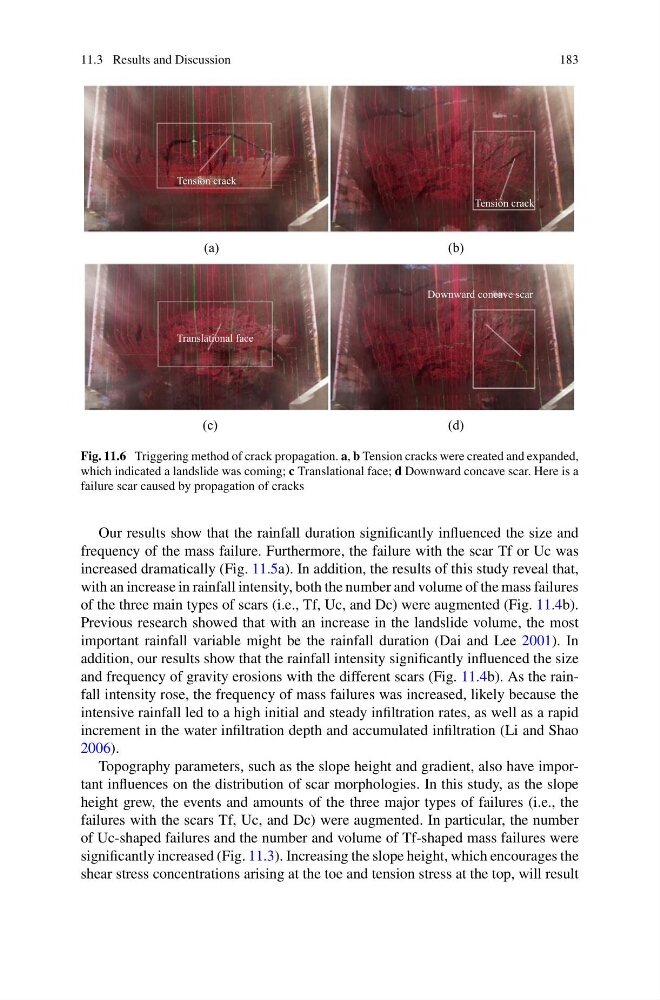
Fig. 11.6 Triggering method of crack propagation. a, b Tension cracks were created and expanded,
which indicated a landslide was coming; c Translational face; d Downward concave scar. Here is a
failure scar caused by propagation of cracks
Our results show that the rainfall duration significantly influenced the size and
frequency of the mass failure. Furthermore, the failure with the scar Tf or Uc was
increased dramatically (Fig. 11.5a). In addition, the results of this study reveal that,
with an increase in rainfall intensity, both the number and volume of the mass failures
of the three main types of scars (i.e., Tf, Uc, and Dc) were augmented (Fig. 11.4b).
Previous research showed that with an increase in the landslide volume, the most
important rainfall variable might be the rainfall duration (Dai and Lee 2001). In
addition, our results show that the rainfall intensity significantly influenced the size
and frequency of gravity erosions with the different scars (Fig. 11.4b). As the rainfall intensity rose, the frequency of mass failures was increased, likely because the
intensive rainfall led to a high initial and steady infiltration rates, as well as a rapid
increment in the water infiltration depth and accumulated infiltration (Li and Shao
2006).
Topography parameters, such as the slope height and gradient, also have important influences on the distribution of scar morphologies. In this study, as the slope
height grew, the events and amounts of the three major types of failures (i.e., the
failures with the scars Tf, Uc, and Dc) were augmented. In particular, the number
of Uc-shaped failures and the number and volume of Tf-shaped mass failures were
significantly increased (Fig. 11.3). Increasing the slope height, which encourages the
shear stress concentrations arising at the toe and tension stress at the top, will result
183
(a)
(b)
(c)
(d)
Tension crack
Tension crack
Translational face
Downward concave scar
Fig. 11.6 Triggering method of crack propagation. a, b Tension cracks were created and expanded,
which indicated a landslide was coming; c Translational face; d Downward concave scar. Here is a
failure scar caused by propagation of cracks
Our results show that the rainfall duration significantly influenced the size and
frequency of the mass failure. Furthermore, the failure with the scar Tf or Uc was
increased dramatically (Fig. 11.5a). In addition, the results of this study reveal that,
with an increase in rainfall intensity, both the number and volume of the mass failures
of the three main types of scars (i.e., Tf, Uc, and Dc) were augmented (Fig. 11.4b).
Previous research showed that with an increase in the landslide volume, the most
important rainfall variable might be the rainfall duration (Dai and Lee 2001). In
addition, our results show that the rainfall intensity significantly influenced the size
and frequency of gravity erosions with the different scars (Fig. 11.4b). As the rainfall intensity rose, the frequency of mass failures was increased, likely because the
intensive rainfall led to a high initial and steady infiltration rates, as well as a rapid
increment in the water infiltration depth and accumulated infiltration (Li and Shao
2006).
Topography parameters, such as the slope height and gradient, also have important influences on the distribution of scar morphologies. In this study, as the slope
height grew, the events and amounts of the three major types of failures (i.e., the
failures with the scars Tf, Uc, and Dc) were augmented. In particular, the number
of Uc-shaped failures and the number and volume of Tf-shaped mass failures were
significantly increased (Fig. 11.3). Increasing the slope height, which encourages the
shear stress concentrations arising at the toe and tension stress at the top, will result