

10.4 Results and Discussion
159
volume of the compound landslide was the difference of the slope volume in the
white frame among Figs. 10.6a, f.
10.4.2 Triggers: Rainfall Intensity and Duration
Changes in rainfall and terrain severely influence sediment dynamics, e.g., erosion
and retention processes (Sánchez-Canales et al. 2015; Ali et al. 2014). The erosional
history and the consequent morphology are also much more important than the
trimming induced by occasional very large run-off events (Thornes and AlcántaraAyala 1998). For any experiment with the same initial landform, the total volume of
the mass failures after five rainfalls, which might be transported to the lower reaches
by the gully flow, illustrated the potential contribution of gravity erosion to the soil
loss from the catchment. On the other hand, the maximum volume of the individual
failure masses indicated possible harm to the local building construction or human
lives. For all groups, the average value of total erosion and the maximum of individual
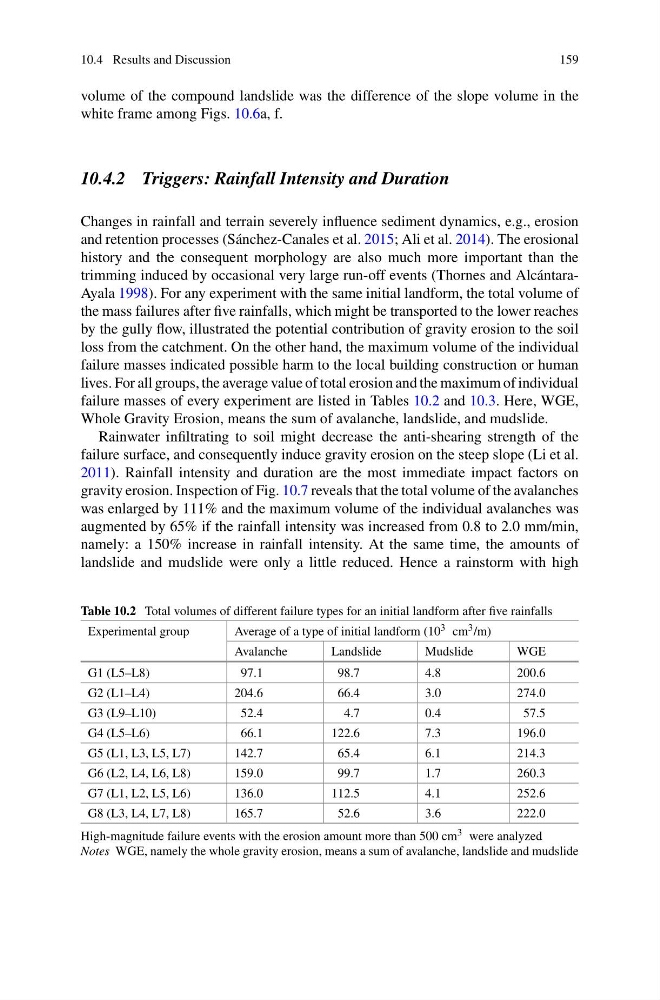
failure masses of every experiment are listed in Tables 10.2 and 10.3. Here, WGE,
Whole Gravity Erosion, means the sum of avalanche, landslide, and mudslide.
Rainwater infiltrating to soil might decrease the anti-shearing strength of the
failure surface, and consequently induce gravity erosion on the steep slope (Li et al.
2011). Rainfall intensity and duration are the most immediate impact factors on
gravity erosion. Inspection of Fig. 10.7 reveals that the total volume of the avalanches
was enlarged by 111% and the maximum volume of the individual avalanches was
augmented by 65% if the rainfall intensity was increased from 0.8 to 2.0 mm/min,
namely: a 150% increase in rainfall intensity. At the same time, the amounts of
landslide and mudslide were only a little reduced. Hence a rainstorm with high
Table 10.2 Total volumes of different failure types for an initial landform after five rainfalls
Experimental group
Average of a type of initial landform (10 3 cm 3 /m)
Avalanche
Landslide
Mudslide
WGE
G1 (L5–L8)
97.1
98.7
4.8
200.6
G2 (L1–L4)
204.6
66.4
3.0
274.0
G3 (L9–L10)
52.4
4.7
0.4
57.5
G4 (L5–L6)
66.1
122.6
7.3
196.0
G5 (L1, L3, L5, L7)
142.7
65.4
6.1
214.3
G6 (L2, L4, L6, L8)
159.0
99.7
1.7
260.3
G7 (L1, L2, L5, L6)
136.0
112.5
4.1
252.6
G8 (L3, L4, L7, L8)
165.7
52.6
3.6
222.0
High-magnitude failure events with the erosion amount more than 500 cm 3 were analyzed
Notes WGE, namely the whole gravity erosion, means a sum of avalanche, landslide and mudslide
159
volume of the compound landslide was the difference of the slope volume in the
white frame among Figs. 10.6a, f.
10.4.2 Triggers: Rainfall Intensity and Duration
Changes in rainfall and terrain severely influence sediment dynamics, e.g., erosion
and retention processes (Sánchez-Canales et al. 2015; Ali et al. 2014). The erosional
history and the consequent morphology are also much more important than the
trimming induced by occasional very large run-off events (Thornes and AlcántaraAyala 1998). For any experiment with the same initial landform, the total volume of
the mass failures after five rainfalls, which might be transported to the lower reaches
by the gully flow, illustrated the potential contribution of gravity erosion to the soil
loss from the catchment. On the other hand, the maximum volume of the individual
failure masses indicated possible harm to the local building construction or human
lives. For all groups, the average value of total erosion and the maximum of individual
failure masses of every experiment are listed in Tables 10.2 and 10.3. Here, WGE,
Whole Gravity Erosion, means the sum of avalanche, landslide, and mudslide.
Rainwater infiltrating to soil might decrease the anti-shearing strength of the
failure surface, and consequently induce gravity erosion on the steep slope (Li et al.
2011). Rainfall intensity and duration are the most immediate impact factors on
gravity erosion. Inspection of Fig. 10.7 reveals that the total volume of the avalanches
was enlarged by 111% and the maximum volume of the individual avalanches was
augmented by 65% if the rainfall intensity was increased from 0.8 to 2.0 mm/min,
namely: a 150% increase in rainfall intensity. At the same time, the amounts of
landslide and mudslide were only a little reduced. Hence a rainstorm with high
Table 10.2 Total volumes of different failure types for an initial landform after five rainfalls
Experimental group
Average of a type of initial landform (10 3 cm 3 /m)
Avalanche
Landslide
Mudslide
WGE
G1 (L5–L8)
97.1
98.7
4.8
200.6
G2 (L1–L4)
204.6
66.4
3.0
274.0
G3 (L9–L10)
52.4
4.7
0.4
57.5
G4 (L5–L6)
66.1
122.6
7.3
196.0
G5 (L1, L3, L5, L7)
142.7
65.4
6.1
214.3
G6 (L2, L4, L6, L8)
159.0
99.7
1.7
260.3
G7 (L1, L2, L5, L6)
136.0
112.5
4.1
252.6
G8 (L3, L4, L7, L8)
165.7
52.6
3.6
222.0
High-magnitude failure events with the erosion amount more than 500 cm 3 were analyzed
Notes WGE, namely the whole gravity erosion, means a sum of avalanche, landslide and mudslide