

10.4 Results and Discussion
157
(c)
(a)
(b)
Deposition
0
50(cm)
0
50(cm)
0
50(cm)
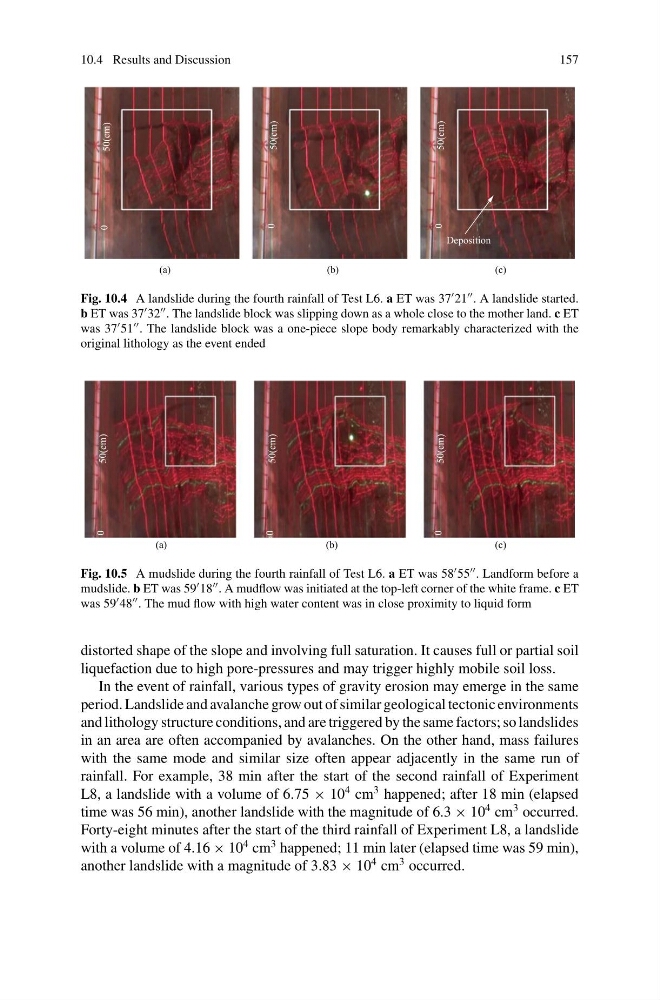
Fig. 10.4 A landslide during the fourth rainfall of Test L6. a ET was 37 21 . A landslide started.
b ET was 37 32 . The landslide block was slipping down as a whole close to the mother land. c ET
was 37 51 . The landslide block was a one-piece slope body remarkably characterized with the
original lithology as the event ended
(a)
(b)
(c)
0
50(cm)
0
50(cm)
0
50(cm)
Fig. 10.5 A mudslide during the fourth rainfall of Test L6. a ET was 58 55 . Landform before a
mudslide. b ET was 59 18 . A mudflow was initiated at the top-left corner of the white frame. c ET
was 59 48 . The mud flow with high water content was in close proximity to liquid form
distorted shape of the slope and involving full saturation. It causes full or partial soil
liquefaction due to high pore-pressures and may trigger highly mobile soil loss.
In the event of rainfall, various types of gravity erosion may emerge in the same
period. Landslide and avalanche grow out of similar geological tectonic environments
and lithology structure conditions, and are triggered by the same factors; so landslides
in an area are often accompanied by avalanches. On the other hand, mass failures
with the same mode and similar size often appear adjacently in the same run of
rainfall. For example, 38 min after the start of the second rainfall of Experiment
L8, a landslide with a volume of 6.75 × 10
4 cm
3 happened; after 18 min (elapsed
time was 56 min), another landslide with the magnitude of 6.3 × 10
4 cm
3 occurred.
Forty-eight minutes after the start of the third rainfall of Experiment L8, a landslide
with a volume of 4.16 × 10
4 cm
3 happened; 11 min later (elapsed time was 59 min),
another landslide with a magnitude of 3.83 × 10
4 cm
3 occurred.
157
(c)
(a)
(b)
Deposition
0
50(cm)
0
50(cm)
0
50(cm)
Fig. 10.4 A landslide during the fourth rainfall of Test L6. a ET was 37 21 . A landslide started.
b ET was 37 32 . The landslide block was slipping down as a whole close to the mother land. c ET
was 37 51 . The landslide block was a one-piece slope body remarkably characterized with the
original lithology as the event ended
(a)
(b)
(c)
0
50(cm)
0
50(cm)
0
50(cm)
Fig. 10.5 A mudslide during the fourth rainfall of Test L6. a ET was 58 55 . Landform before a
mudslide. b ET was 59 18 . A mudflow was initiated at the top-left corner of the white frame. c ET
was 59 48 . The mud flow with high water content was in close proximity to liquid form
distorted shape of the slope and involving full saturation. It causes full or partial soil
liquefaction due to high pore-pressures and may trigger highly mobile soil loss.
In the event of rainfall, various types of gravity erosion may emerge in the same
period. Landslide and avalanche grow out of similar geological tectonic environments
and lithology structure conditions, and are triggered by the same factors; so landslides
in an area are often accompanied by avalanches. On the other hand, mass failures
with the same mode and similar size often appear adjacently in the same run of
rainfall. For example, 38 min after the start of the second rainfall of Experiment
L8, a landslide with a volume of 6.75 × 10
4 cm
3 happened; after 18 min (elapsed
time was 56 min), another landslide with the magnitude of 6.3 × 10
4 cm
3 occurred.
Forty-eight minutes after the start of the third rainfall of Experiment L8, a landslide
with a volume of 4.16 × 10
4 cm
3 happened; 11 min later (elapsed time was 59 min),
another landslide with a magnitude of 3.83 × 10
4 cm
3 occurred.