

156
10 A Sensitivity Analysis on the Gravity …
10.4 Results and Discussion
10.4.1 Occurrence and Behavior of the Gravity Erosion
The failure style is classified such that it reflects the mechanism responsible for
failure movement style, failure block moisture, and debris distribution at the location
where the movement occurs. All three types of gravity erosion have been observed:
landslide, avalanche, and mudslide. A summary of the evolution of slope profiles
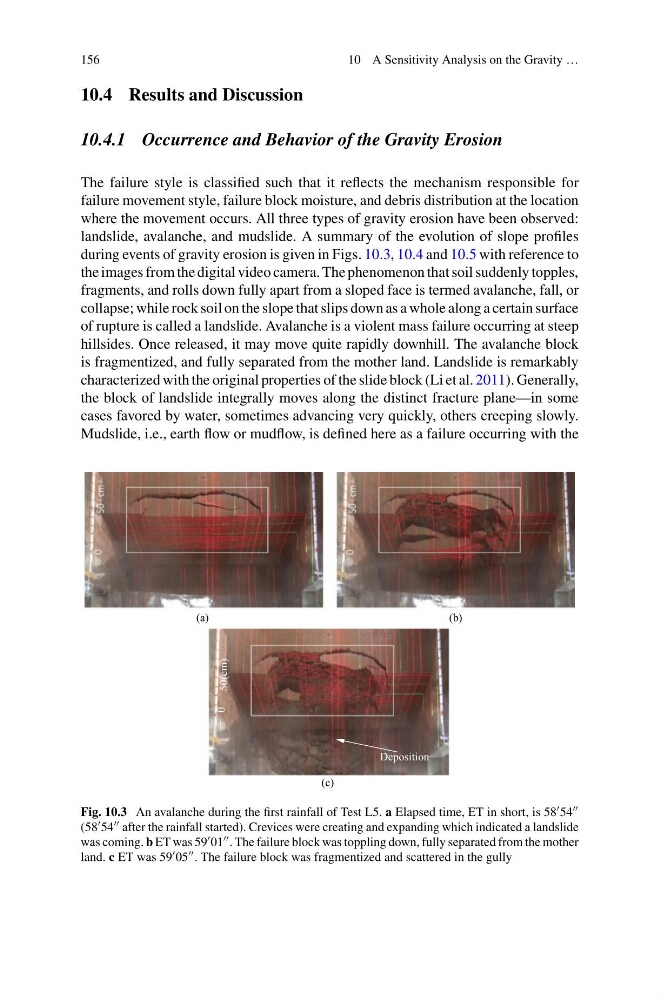
during events of gravity erosion is given in Figs. 10.3, 10.4 and 10.5 with reference to
the images from the digital video camera. The phenomenon that soil suddenly topples,
fragments, and rolls down fully apart from a sloped face is termed avalanche, fall, or
collapse; while rock soil on the slope that slips down as a whole along a certain surface
of rupture is called a landslide. Avalanche is a violent mass failure occurring at steep
hillsides. Once released, it may move quite rapidly downhill. The avalanche block
is fragmentized, and fully separated from the mother land. Landslide is remarkably
characterized with the original properties of the slide block (Li et al. 2011). Generally,
the block of landslide integrally moves along the distinct fracture plane—in some
cases favored by water, sometimes advancing very quickly, others creeping slowly.
Mudslide, i.e., earth flow or mudflow, is defined here as a failure occurring with the
(a)
(b)
(c)
Deposition
0
50(cm)
Fig. 10.3 An avalanche during the first rainfall of Test L5. a Elapsed time, ET in short, is 58 54
(58 54 after the rainfall started). Crevices were creating and expanding which indicated a landslide
was coming. b ET was 59 01 . The failure block was toppling down, fully separated from the mother
land. c ET was 59 05 . The failure block was fragmentized and scattered in the gully
10 A Sensitivity Analysis on the Gravity …
10.4 Results and Discussion
10.4.1 Occurrence and Behavior of the Gravity Erosion
The failure style is classified such that it reflects the mechanism responsible for
failure movement style, failure block moisture, and debris distribution at the location
where the movement occurs. All three types of gravity erosion have been observed:
landslide, avalanche, and mudslide. A summary of the evolution of slope profiles
during events of gravity erosion is given in Figs. 10.3, 10.4 and 10.5 with reference to
the images from the digital video camera. The phenomenon that soil suddenly topples,
fragments, and rolls down fully apart from a sloped face is termed avalanche, fall, or
collapse; while rock soil on the slope that slips down as a whole along a certain surface
of rupture is called a landslide. Avalanche is a violent mass failure occurring at steep
hillsides. Once released, it may move quite rapidly downhill. The avalanche block
is fragmentized, and fully separated from the mother land. Landslide is remarkably
characterized with the original properties of the slide block (Li et al. 2011). Generally,
the block of landslide integrally moves along the distinct fracture plane—in some
cases favored by water, sometimes advancing very quickly, others creeping slowly.
Mudslide, i.e., earth flow or mudflow, is defined here as a failure occurring with the
(a)
(b)
(c)
Deposition
0
50(cm)
Fig. 10.3 An avalanche during the first rainfall of Test L5. a Elapsed time, ET in short, is 58 54
(58 54 after the rainfall started). Crevices were creating and expanding which indicated a landslide
was coming. b ET was 59 01 . The failure block was toppling down, fully separated from the mother
land. c ET was 59 05 . The failure block was fragmentized and scattered in the gully