

8.1 Relative Stability and Optimum Programming …
117
where λ S is the volume scale and λ L is the length scale. Equations (8.2) and (8.3)
illustrate that erosion by a single simulated rainfall in the scaled model experiment
is equal to that in the prototype when R = 1. When R > 1, the model sediment
volume should be multiplied by a smaller coefficient to estimate sediment volume
for the prototype; when R < 1, the model sediment volume should be multiplied
by a larger coefficient to estimate sediment volume for the prototype. Compared
with sediment transport capacity and sedimentation similitude in river engineering,
the conditions of kinematic similitude and dynamic similitude are embodied in the
scale of cumulative sediment volume for each rainfall event (Eq. 8.3). In this study
four measures are recommended to ensure that the ratio R remains constant: (1) A
bare land model with a corresponding erosion rate is applied in the experiment. (2)
Dimensions of the landform, including the check-dam, are normally scaled down
according to the prototype watershed. (3) A soil similar to that in the prototype is
used. (4) Antecedent water content before each rainfall simulation is constant.
8.2 Characteristics of the Yangdaogou Catchment
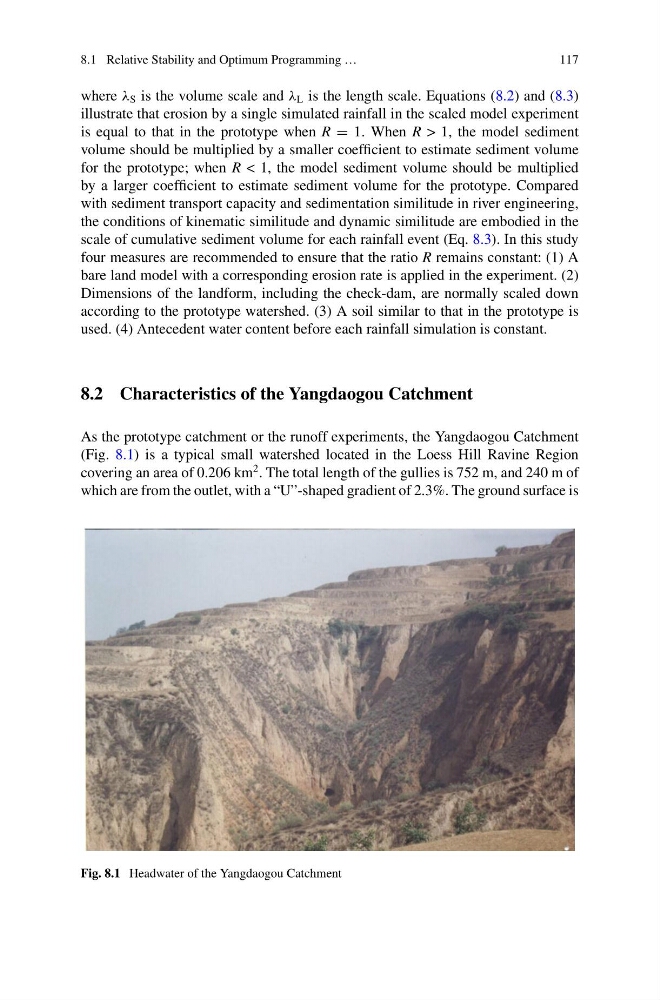
As the prototype catchment or the runoff experiments, the Yangdaogou Catchment
(Fig. 8.1) is a typical small watershed located in the Loess Hill Ravine Region
covering an area of 0.206 km
2 . The total length of the gullies is 752 m, and 240 m of
which are from the outlet, with a “U”-shaped gradient of 2.3%. The ground surface is
Fig. 8.1 Headwater of the Yangdaogou Catchment
117
where λ S is the volume scale and λ L is the length scale. Equations (8.2) and (8.3)
illustrate that erosion by a single simulated rainfall in the scaled model experiment
is equal to that in the prototype when R = 1. When R > 1, the model sediment
volume should be multiplied by a smaller coefficient to estimate sediment volume
for the prototype; when R < 1, the model sediment volume should be multiplied
by a larger coefficient to estimate sediment volume for the prototype. Compared
with sediment transport capacity and sedimentation similitude in river engineering,
the conditions of kinematic similitude and dynamic similitude are embodied in the
scale of cumulative sediment volume for each rainfall event (Eq. 8.3). In this study
four measures are recommended to ensure that the ratio R remains constant: (1) A
bare land model with a corresponding erosion rate is applied in the experiment. (2)
Dimensions of the landform, including the check-dam, are normally scaled down
according to the prototype watershed. (3) A soil similar to that in the prototype is
used. (4) Antecedent water content before each rainfall simulation is constant.
8.2 Characteristics of the Yangdaogou Catchment
As the prototype catchment or the runoff experiments, the Yangdaogou Catchment
(Fig. 8.1) is a typical small watershed located in the Loess Hill Ravine Region
covering an area of 0.206 km
2 . The total length of the gullies is 752 m, and 240 m of
which are from the outlet, with a “U”-shaped gradient of 2.3%. The ground surface is
Fig. 8.1 Headwater of the Yangdaogou Catchment