

8.1 Relative Stability and Optimum Programming …
115
requirements: (1) No flooding will occur. That is, it should be ensured that the checkdam system can withstand rainstorms. (2) Guarantee of harvest from the dam-land,
which implies the reducing of losses of the planted crops due to rainstorms. (3)
Conservation of floodwater and sediment via impounding. (4) Increasing of the dam
height and repairing of the dams after prolonged utilization are unnecessary. To attain
relative stability of the check-dam system to meet these purposes, many elements
have to be considered: hydrological, geographical and geological conditions of the
controlled small watersheds, area of the dam farmland, varieties of the crops, etc.
Empirically, the check-dam becomes relatively stable when the ratio of the dam
farmland area to that of the controlled watershed is between 1:25 and 1:15. When
the impounded water depth is less than 0.8 m and the storage time is shorter than
3–7 days, a dam designed for enduring a 100-year storm in a century is found to be
relatively stable (Zeng et al. 1995).
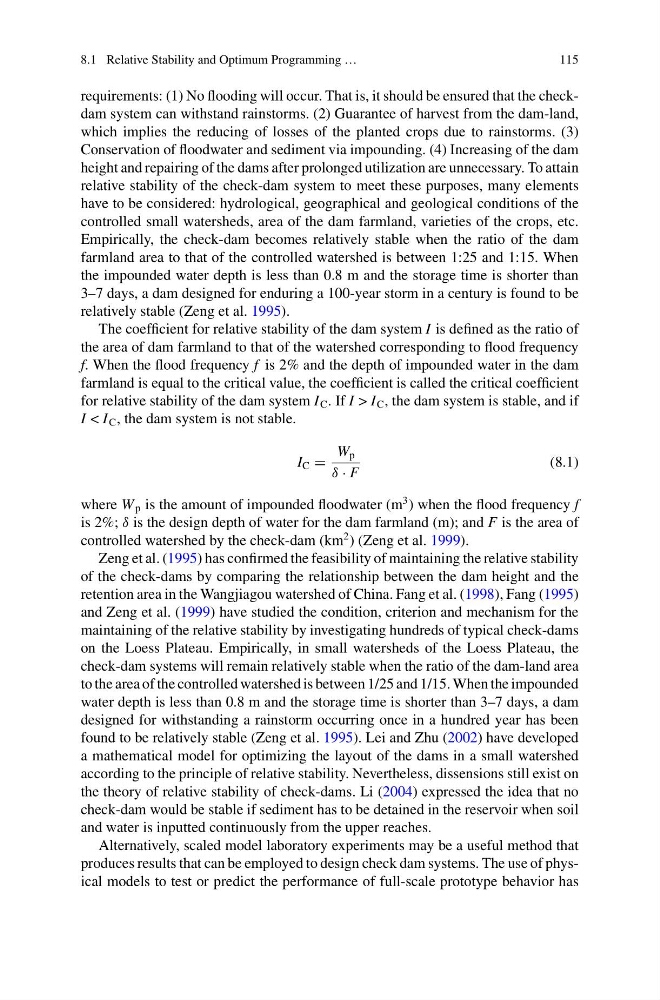
The coefficient for relative stability of the dam system I is defined as the ratio of
the area of dam farmland to that of the watershed corresponding to flood frequency
f. When the flood frequency f is 2% and the depth of impounded water in the dam
farmland is equal to the critical value, the coefficient is called the critical coefficient
for relative stability of the dam system I C . If I > I C , the dam system is stable, and if
I < I C , the dam system is not stable.
I C =
W p
δ · F
(8.1)
where W p is the amount of impounded floodwater (m
3 ) when the flood frequency f
is 2%; δ is the design depth of water for the dam farmland (m); and F is the area of
controlled watershed by the check-dam (km
2 ) (Zeng et al. 1999).
Zeng et al. (1995) has confirmed the feasibility of maintaining the relative stability
of the check-dams by comparing the relationship between the dam height and the
retention area in the Wangjiagou watershed of China. Fang et al. (1998), Fang (1995)
and Zeng et al. (1999) have studied the condition, criterion and mechanism for the
maintaining of the relative stability by investigating hundreds of typical check-dams
on the Loess Plateau. Empirically, in small watersheds of the Loess Plateau, the
check-dam systems will remain relatively stable when the ratio of the dam-land area
to the area of the controlled watershed is between 1/25 and 1/15. When the impounded
water depth is less than 0.8 m and the storage time is shorter than 3–7 days, a dam
designed for withstanding a rainstorm occurring once in a hundred year has been
found to be relatively stable (Zeng et al. 1995). Lei and Zhu (2002) have developed
a mathematical model for optimizing the layout of the dams in a small watershed
according to the principle of relative stability. Nevertheless, dissensions still exist on
the theory of relative stability of check-dams. Li (2004) expressed the idea that no
check-dam would be stable if sediment has to be detained in the reservoir when soil
and water is inputted continuously from the upper reaches.
Alternatively, scaled model laboratory experiments may be a useful method that
produces results that can be employed to design check dam systems. The use of physical models to test or predict the performance of full-scale prototype behavior has
115
requirements: (1) No flooding will occur. That is, it should be ensured that the checkdam system can withstand rainstorms. (2) Guarantee of harvest from the dam-land,
which implies the reducing of losses of the planted crops due to rainstorms. (3)
Conservation of floodwater and sediment via impounding. (4) Increasing of the dam
height and repairing of the dams after prolonged utilization are unnecessary. To attain
relative stability of the check-dam system to meet these purposes, many elements
have to be considered: hydrological, geographical and geological conditions of the
controlled small watersheds, area of the dam farmland, varieties of the crops, etc.
Empirically, the check-dam becomes relatively stable when the ratio of the dam
farmland area to that of the controlled watershed is between 1:25 and 1:15. When
the impounded water depth is less than 0.8 m and the storage time is shorter than
3–7 days, a dam designed for enduring a 100-year storm in a century is found to be
relatively stable (Zeng et al. 1995).
The coefficient for relative stability of the dam system I is defined as the ratio of
the area of dam farmland to that of the watershed corresponding to flood frequency
f. When the flood frequency f is 2% and the depth of impounded water in the dam
farmland is equal to the critical value, the coefficient is called the critical coefficient
for relative stability of the dam system I C . If I > I C , the dam system is stable, and if
I < I C , the dam system is not stable.
I C =
W p
δ · F
(8.1)
where W p is the amount of impounded floodwater (m
3 ) when the flood frequency f
is 2%; δ is the design depth of water for the dam farmland (m); and F is the area of
controlled watershed by the check-dam (km
2 ) (Zeng et al. 1999).
Zeng et al. (1995) has confirmed the feasibility of maintaining the relative stability
of the check-dams by comparing the relationship between the dam height and the
retention area in the Wangjiagou watershed of China. Fang et al. (1998), Fang (1995)
and Zeng et al. (1999) have studied the condition, criterion and mechanism for the
maintaining of the relative stability by investigating hundreds of typical check-dams
on the Loess Plateau. Empirically, in small watersheds of the Loess Plateau, the
check-dam systems will remain relatively stable when the ratio of the dam-land area
to the area of the controlled watershed is between 1/25 and 1/15. When the impounded
water depth is less than 0.8 m and the storage time is shorter than 3–7 days, a dam
designed for withstanding a rainstorm occurring once in a hundred year has been
found to be relatively stable (Zeng et al. 1995). Lei and Zhu (2002) have developed
a mathematical model for optimizing the layout of the dams in a small watershed
according to the principle of relative stability. Nevertheless, dissensions still exist on
the theory of relative stability of check-dams. Li (2004) expressed the idea that no
check-dam would be stable if sediment has to be detained in the reservoir when soil
and water is inputted continuously from the upper reaches.
Alternatively, scaled model laboratory experiments may be a useful method that
produces results that can be employed to design check dam systems. The use of physical models to test or predict the performance of full-scale prototype behavior has