

86
6 A Close Look of the Gravity Erosion …
In addition to the rainfall factor, adverse destabilization from human activities has
become another major contributory factor to landslides since the reform and opening
up of China. Inferred from statistical data mentioned above, the number of direct
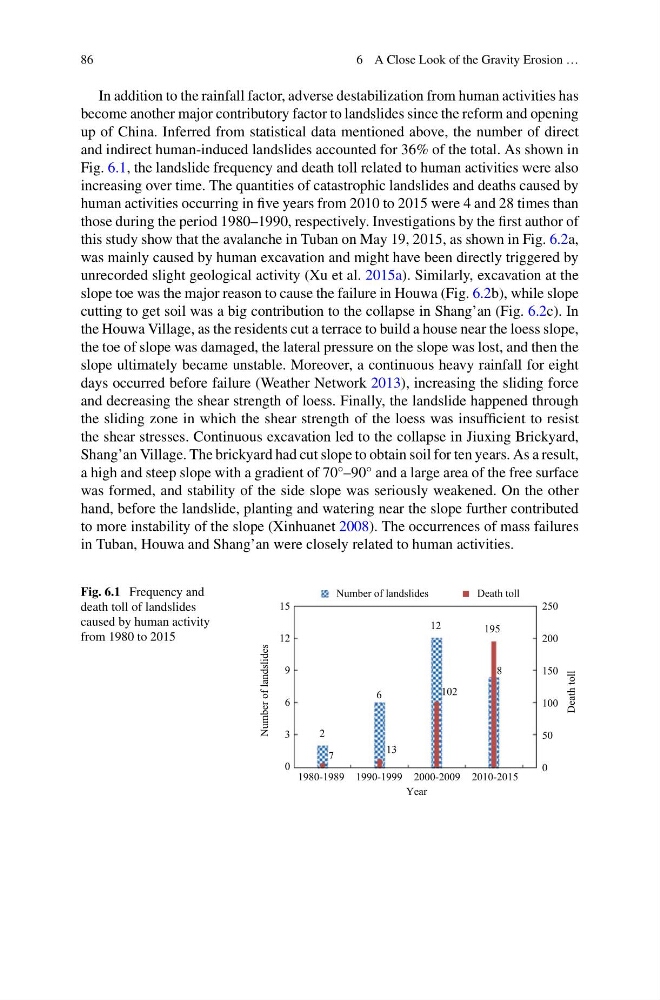
and indirect human-induced landslides accounted for 36% of the total. As shown in
Fig. 6.1, the landslide frequency and death toll related to human activities were also
increasing over time. The quantities of catastrophic landslides and deaths caused by
human activities occurring in five years from 2010 to 2015 were 4 and 28 times than
those during the period 1980–1990, respectively. Investigations by the first author of
this study show that the avalanche in Tuban on May 19, 2015, as shown in Fig. 6.2a,
was mainly caused by human excavation and might have been directly triggered by
unrecorded slight geological activity (Xu et al. 2015a). Similarly, excavation at the
slope toe was the major reason to cause the failure in Houwa (Fig. 6.2b), while slope
cutting to get soil was a big contribution to the collapse in Shang’an (Fig. 6.2c). In
the Houwa Village, as the residents cut a terrace to build a house near the loess slope,
the toe of slope was damaged, the lateral pressure on the slope was lost, and then the
slope ultimately became unstable. Moreover, a continuous heavy rainfall for eight
days occurred before failure (Weather Network 2013), increasing the sliding force
and decreasing the shear strength of loess. Finally, the landslide happened through
the sliding zone in which the shear strength of the loess was insufficient to resist
the shear stresses. Continuous excavation led to the collapse in Jiuxing Brickyard,
Shang’an Village. The brickyard had cut slope to obtain soil for ten years. As a result,
a high and steep slope with a gradient of 70°–90° and a large area of the free surface
was formed, and stability of the side slope was seriously weakened. On the other
hand, before the landslide, planting and watering near the slope further contributed
to more instability of the slope (Xinhuanet 2008). The occurrences of mass failures
in Tuban, Houwa and Shang’an were closely related to human activities.
Fig. 6.1 Frequency and
death toll of landslides
caused by human activity
from 1980 to 2015
2
6
12
8
7
13
102
195
0
50
100
150
200
250
0
3
6
9
12
15
1980-1989
Death toll
Number of landslides
Year
Number of landslides
Death toll
1990-1999 2000-2009 2010-2015
6 A Close Look of the Gravity Erosion …
In addition to the rainfall factor, adverse destabilization from human activities has
become another major contributory factor to landslides since the reform and opening
up of China. Inferred from statistical data mentioned above, the number of direct
and indirect human-induced landslides accounted for 36% of the total. As shown in
Fig. 6.1, the landslide frequency and death toll related to human activities were also
increasing over time. The quantities of catastrophic landslides and deaths caused by
human activities occurring in five years from 2010 to 2015 were 4 and 28 times than
those during the period 1980–1990, respectively. Investigations by the first author of
this study show that the avalanche in Tuban on May 19, 2015, as shown in Fig. 6.2a,
was mainly caused by human excavation and might have been directly triggered by
unrecorded slight geological activity (Xu et al. 2015a). Similarly, excavation at the
slope toe was the major reason to cause the failure in Houwa (Fig. 6.2b), while slope
cutting to get soil was a big contribution to the collapse in Shang’an (Fig. 6.2c). In
the Houwa Village, as the residents cut a terrace to build a house near the loess slope,
the toe of slope was damaged, the lateral pressure on the slope was lost, and then the
slope ultimately became unstable. Moreover, a continuous heavy rainfall for eight
days occurred before failure (Weather Network 2013), increasing the sliding force
and decreasing the shear strength of loess. Finally, the landslide happened through
the sliding zone in which the shear strength of the loess was insufficient to resist
the shear stresses. Continuous excavation led to the collapse in Jiuxing Brickyard,
Shang’an Village. The brickyard had cut slope to obtain soil for ten years. As a result,
a high and steep slope with a gradient of 70°–90° and a large area of the free surface
was formed, and stability of the side slope was seriously weakened. On the other
hand, before the landslide, planting and watering near the slope further contributed
to more instability of the slope (Xinhuanet 2008). The occurrences of mass failures
in Tuban, Houwa and Shang’an were closely related to human activities.
Fig. 6.1 Frequency and
death toll of landslides
caused by human activity
from 1980 to 2015
2
6
12
8
7
13
102
195
0
50
100
150
200
250
0
3
6
9
12
15
1980-1989
Death toll
Number of landslides
Year
Number of landslides
Death toll
1990-1999 2000-2009 2010-2015