

2 Systematic Descriptions
85
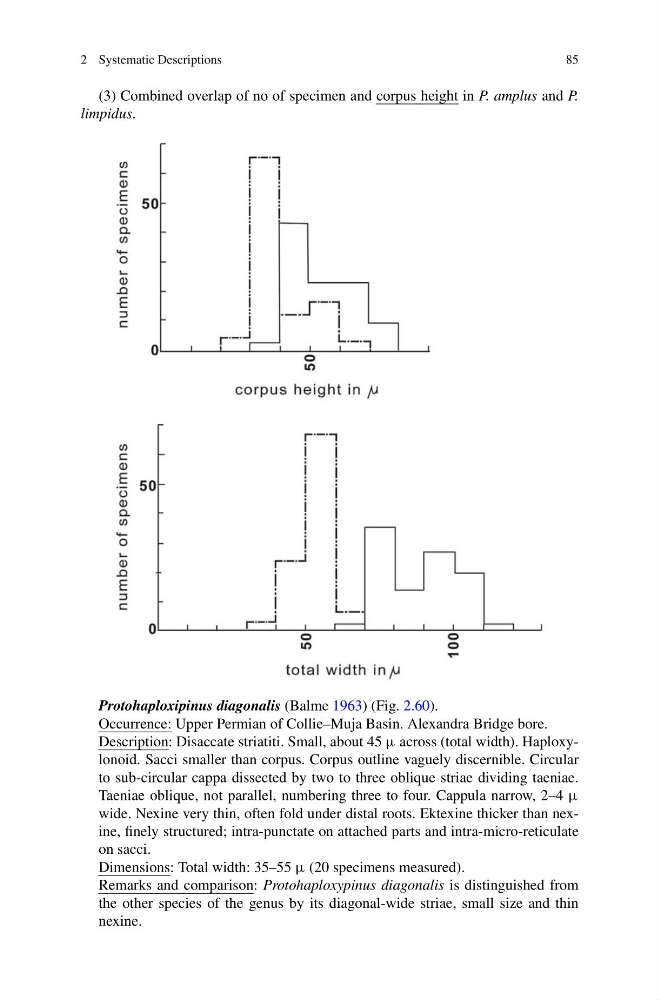
(3) Combined overlap of no of specimen and corpus height in P. amplus and P.
limpidus.
Protohaploxipinus diagonalis (Balme 1963) (Fig. 2.60).
Occurrence: Upper Permian of Collie–Muja Basin. Alexandra Bridge bore.
Description: Disaccate striatiti. Small, about 45 µ across (total width). Haploxylonoid. Sacci smaller than corpus. Corpus outline vaguely discernible. Circular
to sub-circular cappa dissected by two to three oblique striae dividing taeniae.
Taeniae oblique, not parallel, numbering three to four. Cappula narrow, 2–4 µ
wide. Nexine very thin, often fold under distal roots. Ektexine thicker than nexine, finely structured; intra-punctate on attached parts and intra-micro-reticulate
on sacci.
Dimensions: Total width: 35–55 µ (20 specimens measured).
Remarks and comparison: Protohaploxypinus diagonalis is distinguished from
the other species of the genus by its diagonal-wide striae, small size and thin
nexine.
85
(3) Combined overlap of no of specimen and corpus height in P. amplus and P.
limpidus.
Protohaploxipinus diagonalis (Balme 1963) (Fig. 2.60).
Occurrence: Upper Permian of Collie–Muja Basin. Alexandra Bridge bore.
Description: Disaccate striatiti. Small, about 45 µ across (total width). Haploxylonoid. Sacci smaller than corpus. Corpus outline vaguely discernible. Circular
to sub-circular cappa dissected by two to three oblique striae dividing taeniae.
Taeniae oblique, not parallel, numbering three to four. Cappula narrow, 2–4 µ
wide. Nexine very thin, often fold under distal roots. Ektexine thicker than nexine, finely structured; intra-punctate on attached parts and intra-micro-reticulate
on sacci.
Dimensions: Total width: 35–55 µ (20 specimens measured).
Remarks and comparison: Protohaploxypinus diagonalis is distinguished from
the other species of the genus by its diagonal-wide striae, small size and thin
nexine.