

80
2 Systematic Descriptions
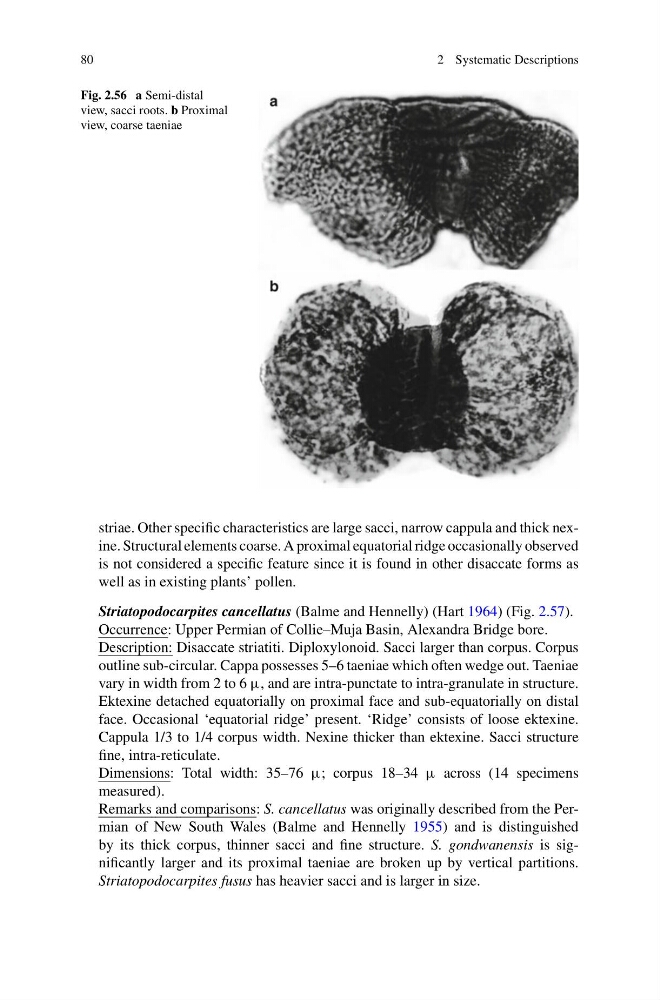
Fig. 2.56 a Semi-distal
view, sacci roots. b Proximal
view, coarse taeniae
striae. Other specific characteristics are large sacci, narrow cappula and thick nexine. Structural elements coarse. A proximal equatorial ridge occasionally observed
is not considered a specific feature since it is found in other disaccate forms as
well as in existing plants’ pollen.
Striatopodocarpites cancellatus (Balme and Hennelly) (Hart 1964) (Fig. 2.57).
Occurrence: Upper Permian of Collie–Muja Basin, Alexandra Bridge bore.
Description: Disaccate striatiti. Diploxylonoid. Sacci larger than corpus. Corpus
outline sub-circular. Cappa possesses 5–6 taeniae which often wedge out. Taeniae
vary in width from 2 to 6 µ, and are intra-punctate to intra-granulate in structure.
Ektexine detached equatorially on proximal face and sub-equatorially on distal
face. Occasional ‘equatorial ridge’ present. ‘Ridge’ consists of loose ektexine.
Cappula 1/3 to 1/4 corpus width. Nexine thicker than ektexine. Sacci structure
fine, intra-reticulate.
Dimensions: Total width: 35–76 µ; corpus 18–34 µ across (14 specimens
measured).
Remarks and comparisons: S. cancellatus was originally described from the Permian of New South Wales (Balme and Hennelly 1955) and is distinguished
by its thick corpus, thinner sacci and fine structure. S. gondwanensis is significantly larger and its proximal taeniae are broken up by vertical partitions.
Striatopodocarpites fusus has heavier sacci and is larger in size.
2 Systematic Descriptions
Fig. 2.56 a Semi-distal
view, sacci roots. b Proximal
view, coarse taeniae
striae. Other specific characteristics are large sacci, narrow cappula and thick nexine. Structural elements coarse. A proximal equatorial ridge occasionally observed
is not considered a specific feature since it is found in other disaccate forms as
well as in existing plants’ pollen.
Striatopodocarpites cancellatus (Balme and Hennelly) (Hart 1964) (Fig. 2.57).
Occurrence: Upper Permian of Collie–Muja Basin, Alexandra Bridge bore.
Description: Disaccate striatiti. Diploxylonoid. Sacci larger than corpus. Corpus
outline sub-circular. Cappa possesses 5–6 taeniae which often wedge out. Taeniae
vary in width from 2 to 6 µ, and are intra-punctate to intra-granulate in structure.
Ektexine detached equatorially on proximal face and sub-equatorially on distal
face. Occasional ‘equatorial ridge’ present. ‘Ridge’ consists of loose ektexine.
Cappula 1/3 to 1/4 corpus width. Nexine thicker than ektexine. Sacci structure
fine, intra-reticulate.
Dimensions: Total width: 35–76 µ; corpus 18–34 µ across (14 specimens
measured).
Remarks and comparisons: S. cancellatus was originally described from the Permian of New South Wales (Balme and Hennelly 1955) and is distinguished
by its thick corpus, thinner sacci and fine structure. S. gondwanensis is significantly larger and its proximal taeniae are broken up by vertical partitions.
Striatopodocarpites fusus has heavier sacci and is larger in size.