

2 Systematic Descriptions
79
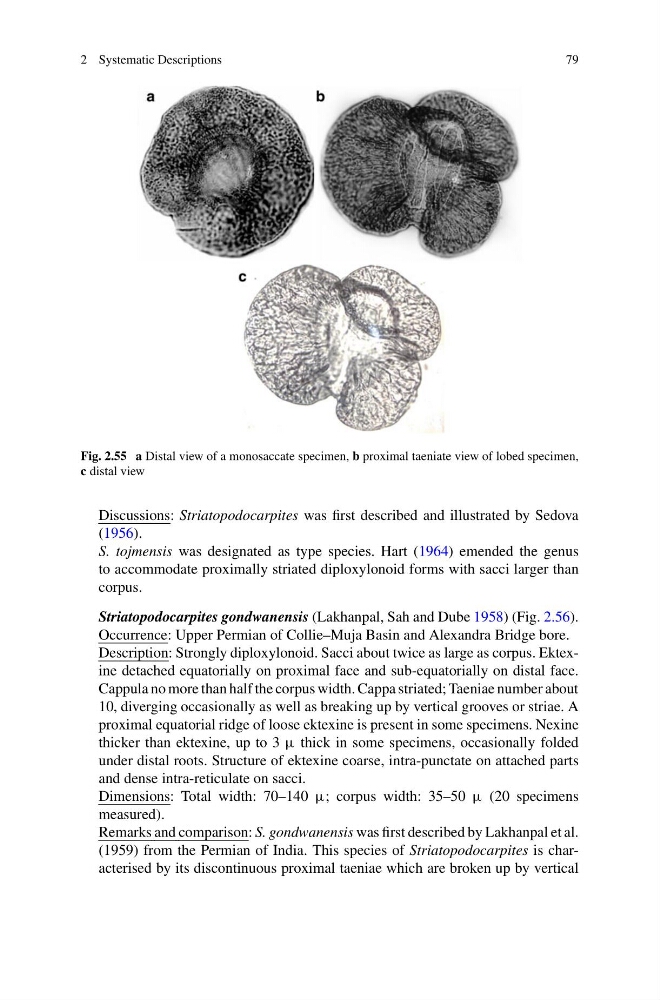
Fig. 2.55 a Distal view of a monosaccate specimen, b proximal taeniate view of lobed specimen,
c distal view
Discussions: Striatopodocarpites was first described and illustrated by Sedova
(1956).
S. tojmensis was designated as type species. Hart (1964) emended the genus
to accommodate proximally striated diploxylonoid forms with sacci larger than
corpus.
Striatopodocarpites gondwanensis (Lakhanpal, Sah and Dube 1958) (Fig. 2.56).
Occurrence: Upper Permian of Collie–Muja Basin and Alexandra Bridge bore.
Description: Strongly diploxylonoid. Sacci about twice as large as corpus. Ektexine detached equatorially on proximal face and sub-equatorially on distal face.
Cappula no more than half the corpus width. Cappa striated; Taeniae number about
10, diverging occasionally as well as breaking up by vertical grooves or striae. A
proximal equatorial ridge of loose ektexine is present in some specimens. Nexine
thicker than ektexine, up to 3 µ thick in some specimens, occasionally folded
under distal roots. Structure of ektexine coarse, intra-punctate on attached parts
and dense intra-reticulate on sacci.
Dimensions: Total width: 70–140 µ; corpus width: 35–50 µ (20 specimens
measured).
Remarks and comparison: S. gondwanensis was first described by Lakhanpal et al.
(1959) from the Permian of India. This species of Striatopodocarpites is characterised by its discontinuous proximal taeniae which are broken up by vertical
79
Fig. 2.55 a Distal view of a monosaccate specimen, b proximal taeniate view of lobed specimen,
c distal view
Discussions: Striatopodocarpites was first described and illustrated by Sedova
(1956).
S. tojmensis was designated as type species. Hart (1964) emended the genus
to accommodate proximally striated diploxylonoid forms with sacci larger than
corpus.
Striatopodocarpites gondwanensis (Lakhanpal, Sah and Dube 1958) (Fig. 2.56).
Occurrence: Upper Permian of Collie–Muja Basin and Alexandra Bridge bore.
Description: Strongly diploxylonoid. Sacci about twice as large as corpus. Ektexine detached equatorially on proximal face and sub-equatorially on distal face.
Cappula no more than half the corpus width. Cappa striated; Taeniae number about
10, diverging occasionally as well as breaking up by vertical grooves or striae. A
proximal equatorial ridge of loose ektexine is present in some specimens. Nexine
thicker than ektexine, up to 3 µ thick in some specimens, occasionally folded
under distal roots. Structure of ektexine coarse, intra-punctate on attached parts
and dense intra-reticulate on sacci.
Dimensions: Total width: 70–140 µ; corpus width: 35–50 µ (20 specimens
measured).
Remarks and comparison: S. gondwanensis was first described by Lakhanpal et al.
(1959) from the Permian of India. This species of Striatopodocarpites is characterised by its discontinuous proximal taeniae which are broken up by vertical