

48
2 Systematic Descriptions
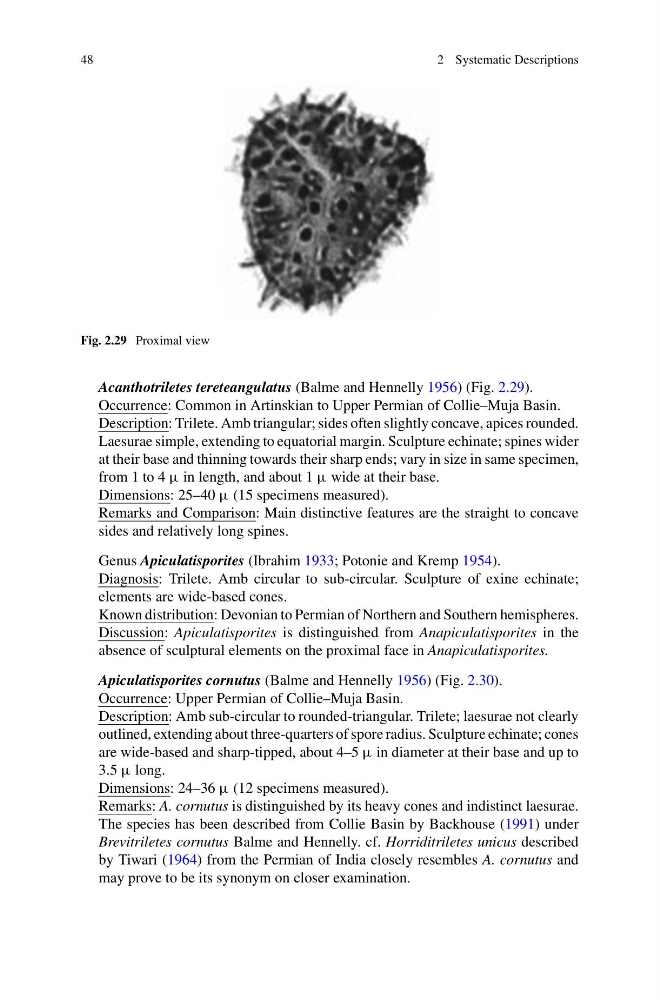
Fig. 2.29 Proximal view
Acanthotriletes tereteangulatus (Balme and Hennelly 1956) (Fig. 2.29).
Occurrence: Common in Artinskian to Upper Permian of Collie–Muja Basin.
Description: Trilete. Amb triangular; sides often slightly concave, apices rounded.
Laesurae simple, extending to equatorial margin. Sculpture echinate; spines wider
at their base and thinning towards their sharp ends; vary in size in same specimen,
from 1 to 4 µ in length, and about 1 µ wide at their base.
Dimensions: 25–40 µ (15 specimens measured).
Remarks and Comparison: Main distinctive features are the straight to concave
sides and relatively long spines.
Genus Apiculatisporites (Ibrahim 1933; Potonie and Kremp 1954).
Diagnosis: Trilete. Amb circular to sub-circular. Sculpture of exine echinate;
elements are wide-based cones.
Known distribution: Devonian to Permian of Northern and Southern hemispheres.
Discussion: Apiculatisporites is distinguished from Anapiculatisporites in the
absence of sculptural elements on the proximal face in Anapiculatisporites.
Apiculatisporites cornutus (Balme and Hennelly 1956) (Fig. 2.30).
Occurrence: Upper Permian of Collie–Muja Basin.
Description: Amb sub-circular to rounded-triangular. Trilete; laesurae not clearly
outlined, extending about three-quarters of spore radius. Sculpture echinate; cones
are wide-based and sharp-tipped, about 4–5 µ in diameter at their base and up to
3.5 µ long.
Dimensions: 24–36 µ (12 specimens measured).
Remarks: A. cornutus is distinguished by its heavy cones and indistinct laesurae.
The species has been described from Collie Basin by Backhouse (1991) under
Brevitriletes cornutus Balme and Hennelly. cf. Horriditriletes unicus described
by Tiwari (1964) from the Permian of India closely resembles A. cornutus and
may prove to be its synonym on closer examination.
2 Systematic Descriptions
Fig. 2.29 Proximal view
Acanthotriletes tereteangulatus (Balme and Hennelly 1956) (Fig. 2.29).
Occurrence: Common in Artinskian to Upper Permian of Collie–Muja Basin.
Description: Trilete. Amb triangular; sides often slightly concave, apices rounded.
Laesurae simple, extending to equatorial margin. Sculpture echinate; spines wider
at their base and thinning towards their sharp ends; vary in size in same specimen,
from 1 to 4 µ in length, and about 1 µ wide at their base.
Dimensions: 25–40 µ (15 specimens measured).
Remarks and Comparison: Main distinctive features are the straight to concave
sides and relatively long spines.
Genus Apiculatisporites (Ibrahim 1933; Potonie and Kremp 1954).
Diagnosis: Trilete. Amb circular to sub-circular. Sculpture of exine echinate;
elements are wide-based cones.
Known distribution: Devonian to Permian of Northern and Southern hemispheres.
Discussion: Apiculatisporites is distinguished from Anapiculatisporites in the
absence of sculptural elements on the proximal face in Anapiculatisporites.
Apiculatisporites cornutus (Balme and Hennelly 1956) (Fig. 2.30).
Occurrence: Upper Permian of Collie–Muja Basin.
Description: Amb sub-circular to rounded-triangular. Trilete; laesurae not clearly
outlined, extending about three-quarters of spore radius. Sculpture echinate; cones
are wide-based and sharp-tipped, about 4–5 µ in diameter at their base and up to
3.5 µ long.
Dimensions: 24–36 µ (12 specimens measured).
Remarks: A. cornutus is distinguished by its heavy cones and indistinct laesurae.
The species has been described from Collie Basin by Backhouse (1991) under
Brevitriletes cornutus Balme and Hennelly. cf. Horriditriletes unicus described
by Tiwari (1964) from the Permian of India closely resembles A. cornutus and
may prove to be its synonym on closer examination.