

2 Systematic Descriptions
47
a
b
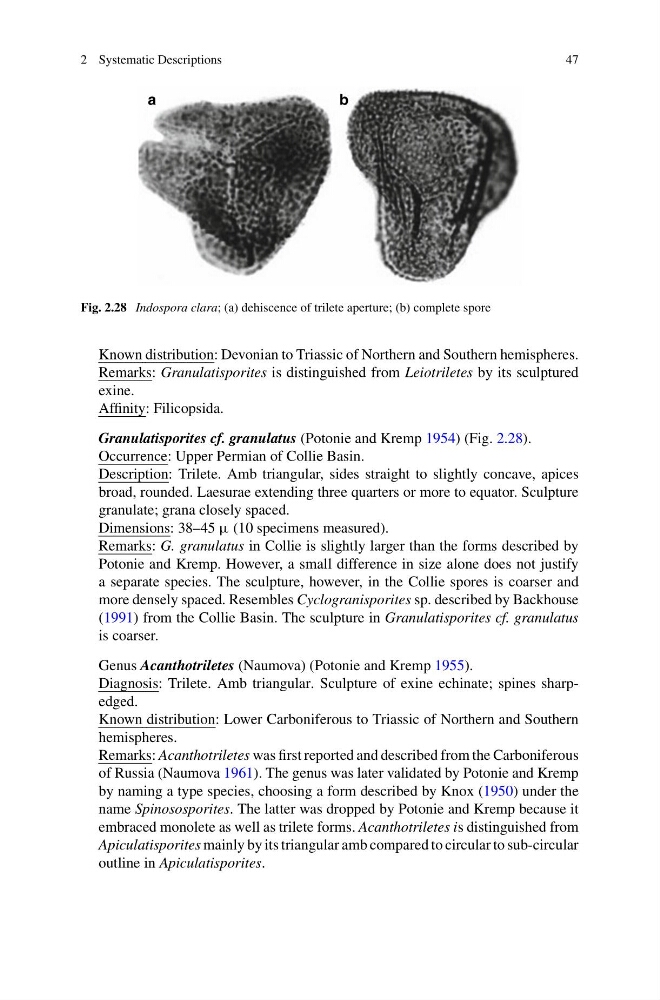
Fig. 2.28 Indospora clara; (a) dehiscence of trilete aperture; (b) complete spore
Known distribution: Devonian to Triassic of Northern and Southern hemispheres.
Remarks: Granulatisporites is distinguished from Leiotriletes by its sculptured
exine.
Affinity: Filicopsida.
Granulatisporites cf. granulatus (Potonie and Kremp 1954) (Fig. 2.28).
Occurrence: Upper Permian of Collie Basin.
Description: Trilete. Amb triangular, sides straight to slightly concave, apices
broad, rounded. Laesurae extending three quarters or more to equator. Sculpture
granulate; grana closely spaced.
Dimensions: 38–45 µ (10 specimens measured).
Remarks: G. granulatus in Collie is slightly larger than the forms described by
Potonie and Kremp. However, a small difference in size alone does not justify
a separate species. The sculpture, however, in the Collie spores is coarser and
more densely spaced. Resembles Cyclogranisporites sp. described by Backhouse
(1991) from the Collie Basin. The sculpture in Granulatisporites cf. granulatus
is coarser.
Genus Acanthotriletes (Naumova) (Potonie and Kremp 1955).
Diagnosis: Trilete. Amb triangular. Sculpture of exine echinate; spines sharpedged.
Known distribution: Lower Carboniferous to Triassic of Northern and Southern
hemispheres.
Remarks: Acanthotriletes was first reported and described from the Carboniferous
of Russia (Naumova 1961). The genus was later validated by Potonie and Kremp
by naming a type species, choosing a form described by Knox (1950) under the
name Spinososporites. The latter was dropped by Potonie and Kremp because it
embraced monolete as well as trilete forms. Acanthotriletes is distinguished from
Apiculatisporites mainly by its triangular amb compared to circular to sub-circular
outline in Apiculatisporites.
47
a
b
Fig. 2.28 Indospora clara; (a) dehiscence of trilete aperture; (b) complete spore
Known distribution: Devonian to Triassic of Northern and Southern hemispheres.
Remarks: Granulatisporites is distinguished from Leiotriletes by its sculptured
exine.
Affinity: Filicopsida.
Granulatisporites cf. granulatus (Potonie and Kremp 1954) (Fig. 2.28).
Occurrence: Upper Permian of Collie Basin.
Description: Trilete. Amb triangular, sides straight to slightly concave, apices
broad, rounded. Laesurae extending three quarters or more to equator. Sculpture
granulate; grana closely spaced.
Dimensions: 38–45 µ (10 specimens measured).
Remarks: G. granulatus in Collie is slightly larger than the forms described by
Potonie and Kremp. However, a small difference in size alone does not justify
a separate species. The sculpture, however, in the Collie spores is coarser and
more densely spaced. Resembles Cyclogranisporites sp. described by Backhouse
(1991) from the Collie Basin. The sculpture in Granulatisporites cf. granulatus
is coarser.
Genus Acanthotriletes (Naumova) (Potonie and Kremp 1955).
Diagnosis: Trilete. Amb triangular. Sculpture of exine echinate; spines sharpedged.
Known distribution: Lower Carboniferous to Triassic of Northern and Southern
hemispheres.
Remarks: Acanthotriletes was first reported and described from the Carboniferous
of Russia (Naumova 1961). The genus was later validated by Potonie and Kremp
by naming a type species, choosing a form described by Knox (1950) under the
name Spinososporites. The latter was dropped by Potonie and Kremp because it
embraced monolete as well as trilete forms. Acanthotriletes is distinguished from
Apiculatisporites mainly by its triangular amb compared to circular to sub-circular
outline in Apiculatisporites.