

CHAPTER I
LITTERATURE REVIEW
26
3.5 Morphological features
Spirulina species show great plasticity in morphology. This is attributed to environmental
factors like temperature and other physical and chemical factors and possibly also due to
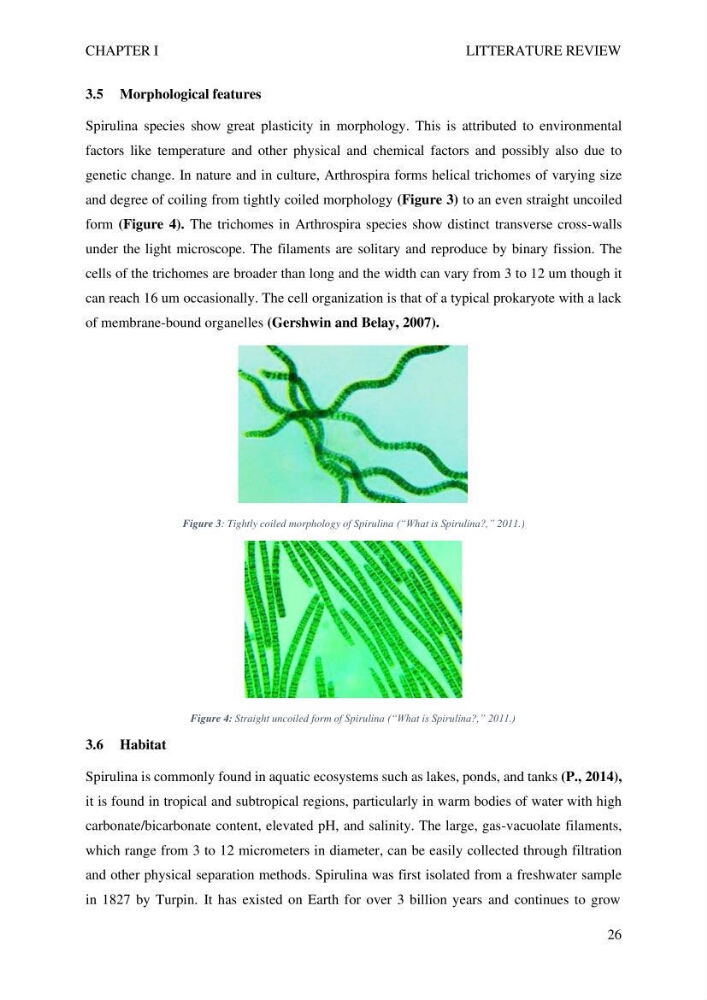
genetic change. In nature and in culture, Arthrospira forms helical trichomes of varying size
and degree of coiling from tightly coiled morphology (Figure 3) to an even straight uncoiled
form (Figure 4). The trichomes in Arthrospira species show distinct transverse cross-walls
under the light microscope. The filaments are solitary and reproduce by binary fission. The
cells of the trichomes are broader than long and the width can vary from 3 to 12 um though it
can reach 16 um occasionally. The cell organization is that of a typical prokaryote with a lack
of membrane-bound organelles (Gershwin and Belay, 2007).
Figure 3: Tightly coiled morphology of Spirulina (“What is Spirulina?,” 2011.)
3.6 Habitat
Figure 4: Straight uncoiled form of Spirulina (“What is Spirulina?,” 2011.)
Spirulina is commonly found in aquatic ecosystems such as lakes, ponds, and tanks (P., 2014),
it is found in tropical and subtropical regions, particularly in warm bodies of water with high
carbonate/bicarbonate content, elevated pH, and salinity. The large, gas-vacuolate filaments,
which range from 3 to 12 micrometers in diameter, can be easily collected through filtration
and other physical separation methods. Spirulina was first isolated from a freshwater sample
in 1827 by Turpin. It has existed on Earth for over 3 billion years and continues to grow
LITTERATURE REVIEW
26
3.5 Morphological features
Spirulina species show great plasticity in morphology. This is attributed to environmental
factors like temperature and other physical and chemical factors and possibly also due to
genetic change. In nature and in culture, Arthrospira forms helical trichomes of varying size
and degree of coiling from tightly coiled morphology (Figure 3) to an even straight uncoiled
form (Figure 4). The trichomes in Arthrospira species show distinct transverse cross-walls
under the light microscope. The filaments are solitary and reproduce by binary fission. The
cells of the trichomes are broader than long and the width can vary from 3 to 12 um though it
can reach 16 um occasionally. The cell organization is that of a typical prokaryote with a lack
of membrane-bound organelles (Gershwin and Belay, 2007).
Figure 3: Tightly coiled morphology of Spirulina (“What is Spirulina?,” 2011.)
3.6 Habitat
Figure 4: Straight uncoiled form of Spirulina (“What is Spirulina?,” 2011.)
Spirulina is commonly found in aquatic ecosystems such as lakes, ponds, and tanks (P., 2014),
it is found in tropical and subtropical regions, particularly in warm bodies of water with high
carbonate/bicarbonate content, elevated pH, and salinity. The large, gas-vacuolate filaments,
which range from 3 to 12 micrometers in diameter, can be easily collected through filtration
and other physical separation methods. Spirulina was first isolated from a freshwater sample
in 1827 by Turpin. It has existed on Earth for over 3 billion years and continues to grow