

CHAPTER I
LITTERATURE REVIEW
24
3.2 Composition of Spirulina platensis
Spirulina, a type of microalgae, has been identified to have a variety of biopolymers, such as
polysaccharides, proteins, and polyesters, that can be utilized in the manufacturing of
bioplastics. The polysaccharides found in Spirulina, such as carrageenan and agarose, have
been found to exhibit gelling and thickening properties, making them useful in the food and
cosmetic industries.
In addition, Spirulina proteins have demonstrated their potential in the development of
biodegradable plastics that have good mechanical properties. Spirulina, a protein source that
has been used in the food industry for decades, is well-known for its ability to adapt to extreme
conditions. Also, Spirulina contains many pigments including chlorophyll-a, β-carotene, etc.
and the phycobiliproteins, C-phycocyanin and allophycocyanin (P., 2012). Spirulina platensis
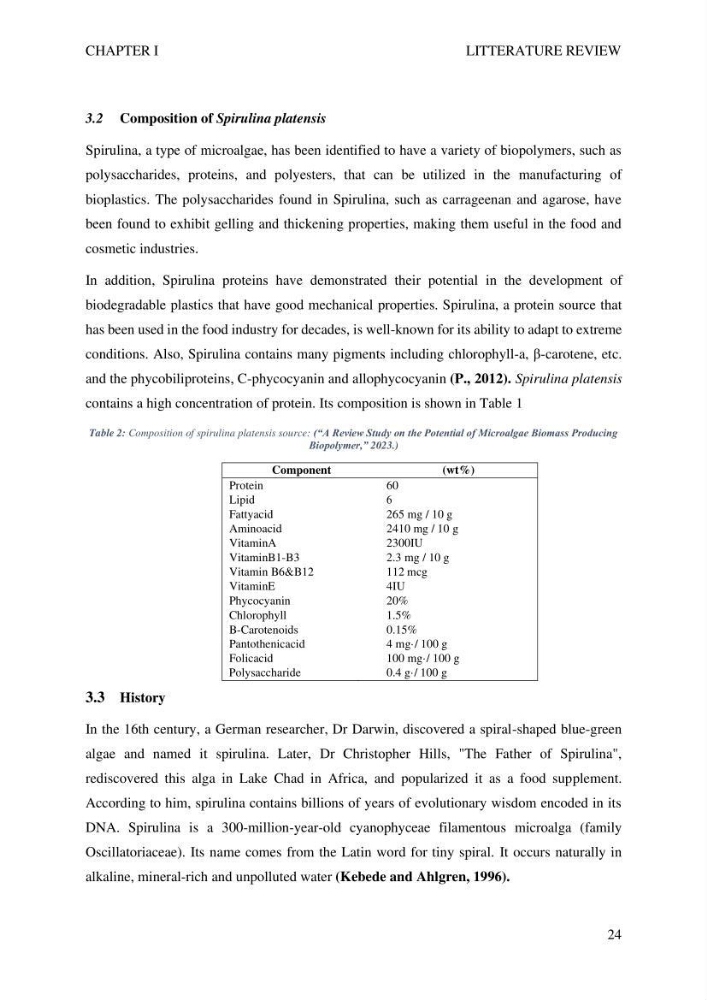
contains a high concentration of protein. Its composition is shown in Table 1
Table 2: Composition of spirulina platensis source: (“A Review Study on the Potential of Microalgae Biomass Producing
Biopolymer,” 2023.)
Component
(wt%)
Protein
60
Lipid
6
Fattyacid
265 mg / 10 g
Aminoacid
2410 mg / 10 g
VitaminA
2300IU
VitaminB1-B3
2.3 mg / 10 g
Vitamin B6&B12
112 mcg
VitaminE
4IU
Phycocyanin
20%
Chlorophyll
1.5%
B-Carotenoids
0.15%
Pantothenicacid
4 mg·/ 100 g
Folicacid
100 mg·/ 100 g
Polysaccharide
0.4 g·/ 100 g
3.3 History
In the 16th century, a German researcher, Dr Darwin, discovered a spiral-shaped blue-green
algae and named it spirulina. Later, Dr Christopher Hills, "The Father of Spirulina",
rediscovered this alga in Lake Chad in Africa, and popularized it as a food supplement.
According to him, spirulina contains billions of years of evolutionary wisdom encoded in its
DNA. Spirulina is a 300-million-year-old cyanophyceae filamentous microalga (family
Oscillatoriaceae). Its name comes from the Latin word for tiny spiral. It occurs naturally in
alkaline, mineral-rich and unpolluted water (Kebede and Ahlgren, 1996).
LITTERATURE REVIEW
24
3.2 Composition of Spirulina platensis
Spirulina, a type of microalgae, has been identified to have a variety of biopolymers, such as
polysaccharides, proteins, and polyesters, that can be utilized in the manufacturing of
bioplastics. The polysaccharides found in Spirulina, such as carrageenan and agarose, have
been found to exhibit gelling and thickening properties, making them useful in the food and
cosmetic industries.
In addition, Spirulina proteins have demonstrated their potential in the development of
biodegradable plastics that have good mechanical properties. Spirulina, a protein source that
has been used in the food industry for decades, is well-known for its ability to adapt to extreme
conditions. Also, Spirulina contains many pigments including chlorophyll-a, β-carotene, etc.
and the phycobiliproteins, C-phycocyanin and allophycocyanin (P., 2012). Spirulina platensis
contains a high concentration of protein. Its composition is shown in Table 1
Table 2: Composition of spirulina platensis source: (“A Review Study on the Potential of Microalgae Biomass Producing
Biopolymer,” 2023.)
Component
(wt%)
Protein
60
Lipid
6
Fattyacid
265 mg / 10 g
Aminoacid
2410 mg / 10 g
VitaminA
2300IU
VitaminB1-B3
2.3 mg / 10 g
Vitamin B6&B12
112 mcg
VitaminE
4IU
Phycocyanin
20%
Chlorophyll
1.5%
B-Carotenoids
0.15%
Pantothenicacid
4 mg·/ 100 g
Folicacid
100 mg·/ 100 g
Polysaccharide
0.4 g·/ 100 g
3.3 History
In the 16th century, a German researcher, Dr Darwin, discovered a spiral-shaped blue-green
algae and named it spirulina. Later, Dr Christopher Hills, "The Father of Spirulina",
rediscovered this alga in Lake Chad in Africa, and popularized it as a food supplement.
According to him, spirulina contains billions of years of evolutionary wisdom encoded in its
DNA. Spirulina is a 300-million-year-old cyanophyceae filamentous microalga (family
Oscillatoriaceae). Its name comes from the Latin word for tiny spiral. It occurs naturally in
alkaline, mineral-rich and unpolluted water (Kebede and Ahlgren, 1996).