

10.2 The Sustainable Development Goals (SDGs)
235
million children died. Newborns make up an increasing number of these deaths. This
goal seeks to reduce the under-five mortality to the lowest possible threshold (25
per 1000 live births) (Griggs et al. 2013). However, in case current trends continue
as they are, at least 60 nations will not meet the target by 2030. About 50% of
these states will not meet the target even if the period is extended up to 2050.
This goal also seeks to minimize maternal mortality to no more than 70 deaths for
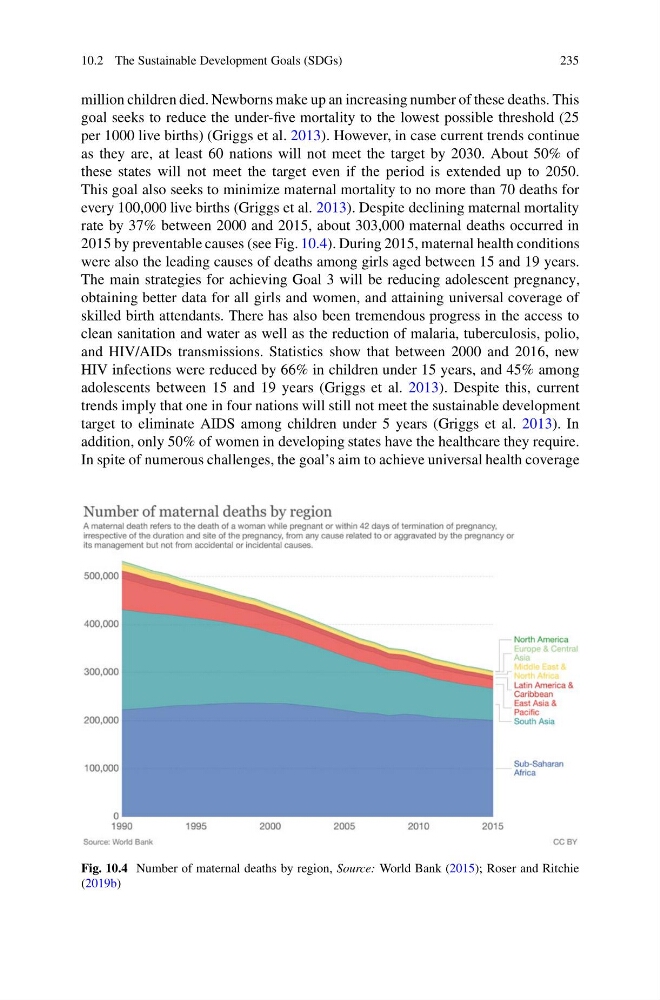
every 100,000 live births (Griggs et al. 2013). Despite declining maternal mortality
rate by 37% between 2000 and 2015, about 303,000 maternal deaths occurred in
2015 by preventable causes (see Fig. 10.4). During 2015, maternal health conditions
were also the leading causes of deaths among girls aged between 15 and 19 years.
The main strategies for achieving Goal 3 will be reducing adolescent pregnancy,
obtaining better data for all girls and women, and attaining universal coverage of
skilled birth attendants. There has also been tremendous progress in the access to
clean sanitation and water as well as the reduction of malaria, tuberculosis, polio,
and HIV/AIDs transmissions. Statistics show that between 2000 and 2016, new
HIV infections were reduced by 66% in children under 15 years, and 45% among
adolescents between 15 and 19 years (Griggs et al. 2013). Despite this, current
trends imply that one in four nations will still not meet the sustainable development
target to eliminate AIDS among children under 5 years (Griggs et al. 2013). In
addition, only 50% of women in developing states have the healthcare they require.
In spite of numerous challenges, the goal’s aim to achieve universal health coverage
Fig. 10.4 Number of maternal deaths by region, Source: World Bank (2015); Roser and Ritchie
(2019b)
235
million children died. Newborns make up an increasing number of these deaths. This
goal seeks to reduce the under-five mortality to the lowest possible threshold (25
per 1000 live births) (Griggs et al. 2013). However, in case current trends continue
as they are, at least 60 nations will not meet the target by 2030. About 50% of
these states will not meet the target even if the period is extended up to 2050.
This goal also seeks to minimize maternal mortality to no more than 70 deaths for
every 100,000 live births (Griggs et al. 2013). Despite declining maternal mortality
rate by 37% between 2000 and 2015, about 303,000 maternal deaths occurred in
2015 by preventable causes (see Fig. 10.4). During 2015, maternal health conditions
were also the leading causes of deaths among girls aged between 15 and 19 years.
The main strategies for achieving Goal 3 will be reducing adolescent pregnancy,
obtaining better data for all girls and women, and attaining universal coverage of
skilled birth attendants. There has also been tremendous progress in the access to
clean sanitation and water as well as the reduction of malaria, tuberculosis, polio,
and HIV/AIDs transmissions. Statistics show that between 2000 and 2016, new
HIV infections were reduced by 66% in children under 15 years, and 45% among
adolescents between 15 and 19 years (Griggs et al. 2013). Despite this, current
trends imply that one in four nations will still not meet the sustainable development
target to eliminate AIDS among children under 5 years (Griggs et al. 2013). In
addition, only 50% of women in developing states have the healthcare they require.
In spite of numerous challenges, the goal’s aim to achieve universal health coverage
Fig. 10.4 Number of maternal deaths by region, Source: World Bank (2015); Roser and Ritchie
(2019b)