

232
10 Sustainability
10.2.1 Goal 1: No Poverty
The main objective of this goal is to “end poverty in all its forms everywhere.”
Since 1990, it is estimated that extreme poverty has been reduced by more than
50%. Despite this progress, it is estimated that there is still more than one in
five individuals living on less than $1.25 per day (Le Blanc 2015). Poverty goes
beyond the lack of income resources, and includes living without basic services,
including security, education, and healthcare. In addition, people experience social
discrimination and marginalization as the result of key decision-making processes.
Children make up the larger proportion of people who live in extreme poverty,
and because of their vulnerability, this goal plays a crucial role in liberating young
people from the constraints of malnutrition, poor healthcare, and lack of education.
United Nations Development Policy (UNDP) stated in 2013 that about 385 million
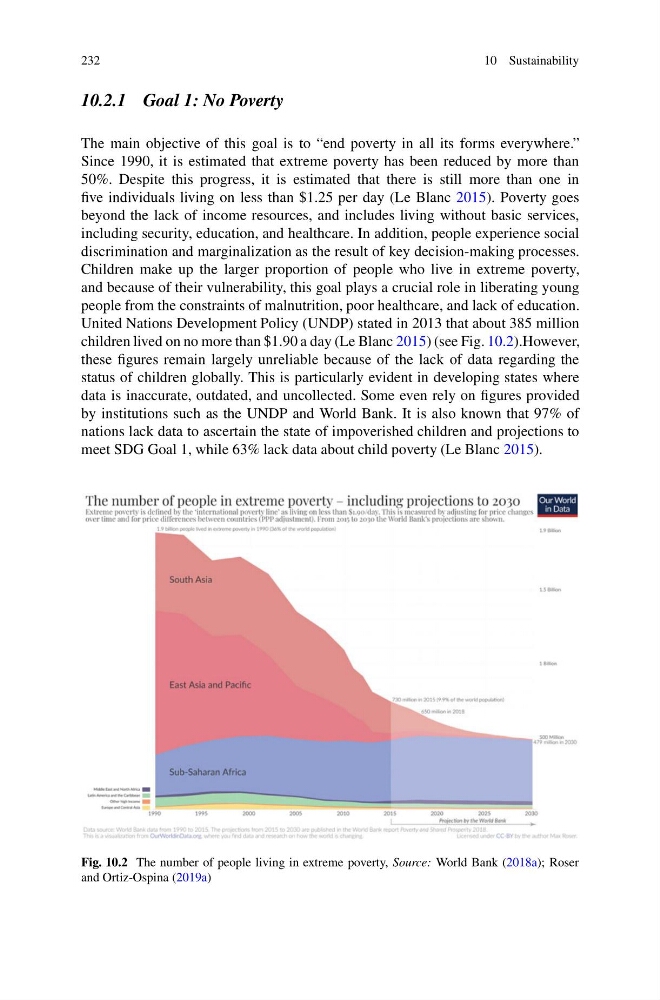
children lived on no more than $1.90 a day (Le Blanc 2015) (see Fig. 10.2).However,
these figures remain largely unreliable because of the lack of data regarding the
status of children globally. This is particularly evident in developing states where
data is inaccurate, outdated, and uncollected. Some even rely on figures provided
by institutions such as the UNDP and World Bank. It is also known that 97% of
nations lack data to ascertain the state of impoverished children and projections to
meet SDG Goal 1, while 63% lack data about child poverty (Le Blanc 2015).
Fig. 10.2 The number of people living in extreme poverty, Source: World Bank (2018a); Roser
and Ortiz-Ospina (2019a)
10 Sustainability
10.2.1 Goal 1: No Poverty
The main objective of this goal is to “end poverty in all its forms everywhere.”
Since 1990, it is estimated that extreme poverty has been reduced by more than
50%. Despite this progress, it is estimated that there is still more than one in
five individuals living on less than $1.25 per day (Le Blanc 2015). Poverty goes
beyond the lack of income resources, and includes living without basic services,
including security, education, and healthcare. In addition, people experience social
discrimination and marginalization as the result of key decision-making processes.
Children make up the larger proportion of people who live in extreme poverty,
and because of their vulnerability, this goal plays a crucial role in liberating young
people from the constraints of malnutrition, poor healthcare, and lack of education.
United Nations Development Policy (UNDP) stated in 2013 that about 385 million
children lived on no more than $1.90 a day (Le Blanc 2015) (see Fig. 10.2).However,
these figures remain largely unreliable because of the lack of data regarding the
status of children globally. This is particularly evident in developing states where
data is inaccurate, outdated, and uncollected. Some even rely on figures provided
by institutions such as the UNDP and World Bank. It is also known that 97% of
nations lack data to ascertain the state of impoverished children and projections to
meet SDG Goal 1, while 63% lack data about child poverty (Le Blanc 2015).
Fig. 10.2 The number of people living in extreme poverty, Source: World Bank (2018a); Roser
and Ortiz-Ospina (2019a)