

10.2 The Sustainable Development Goals (SDGs)
231
wherever they reside and whatever their socioeconomic status. This is humanity’s
shared challenge of sustainability.
10.2 The Sustainable Development Goals (SDGs)
In 2012, the United Nations Conference on Sustainable Development met with the
intention of discussing this and developing a specific set of goals and targets. At this
conference, it was noted that the “Millennium Development Goals” (MDG) was successful in some areas, but that there was more to do (Moldan et al. 2012). Building
on the successes and addressing the shortcomings of the previous goals, the SDGs
were established. Officially called “Transforming our World: the 2030 Agenda
for Sustainable Development,” a set of 17 global goals aiming at environmental
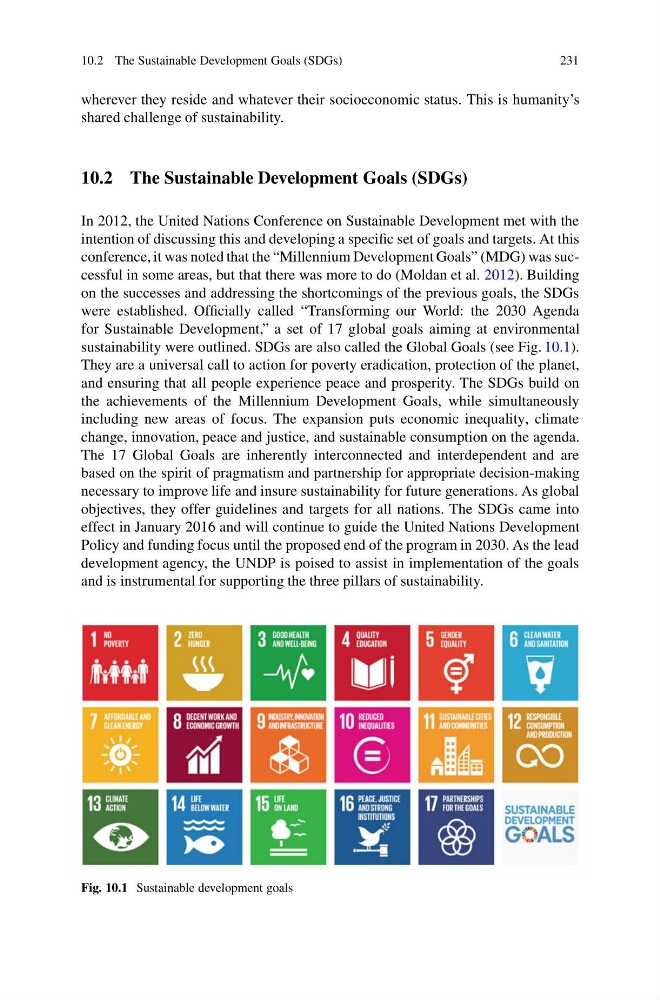
sustainability were outlined. SDGs are also called the Global Goals (see Fig. 10.1).
They are a universal call to action for poverty eradication, protection of the planet,
and ensuring that all people experience peace and prosperity. The SDGs build on
the achievements of the Millennium Development Goals, while simultaneously
including new areas of focus. The expansion puts economic inequality, climate
change, innovation, peace and justice, and sustainable consumption on the agenda.
The 17 Global Goals are inherently interconnected and interdependent and are
based on the spirit of pragmatism and partnership for appropriate decision-making
necessary to improve life and insure sustainability for future generations. As global
objectives, they offer guidelines and targets for all nations. The SDGs came into
effect in January 2016 and will continue to guide the United Nations Development
Policy and funding focus until the proposed end of the program in 2030. As the lead
development agency, the UNDP is poised to assist in implementation of the goals
and is instrumental for supporting the three pillars of sustainability.
Fig. 10.1 Sustainable development goals
231
wherever they reside and whatever their socioeconomic status. This is humanity’s
shared challenge of sustainability.
10.2 The Sustainable Development Goals (SDGs)
In 2012, the United Nations Conference on Sustainable Development met with the
intention of discussing this and developing a specific set of goals and targets. At this
conference, it was noted that the “Millennium Development Goals” (MDG) was successful in some areas, but that there was more to do (Moldan et al. 2012). Building
on the successes and addressing the shortcomings of the previous goals, the SDGs
were established. Officially called “Transforming our World: the 2030 Agenda
for Sustainable Development,” a set of 17 global goals aiming at environmental
sustainability were outlined. SDGs are also called the Global Goals (see Fig. 10.1).
They are a universal call to action for poverty eradication, protection of the planet,
and ensuring that all people experience peace and prosperity. The SDGs build on
the achievements of the Millennium Development Goals, while simultaneously
including new areas of focus. The expansion puts economic inequality, climate
change, innovation, peace and justice, and sustainable consumption on the agenda.
The 17 Global Goals are inherently interconnected and interdependent and are
based on the spirit of pragmatism and partnership for appropriate decision-making
necessary to improve life and insure sustainability for future generations. As global
objectives, they offer guidelines and targets for all nations. The SDGs came into
effect in January 2016 and will continue to guide the United Nations Development
Policy and funding focus until the proposed end of the program in 2030. As the lead
development agency, the UNDP is poised to assist in implementation of the goals
and is instrumental for supporting the three pillars of sustainability.
Fig. 10.1 Sustainable development goals