

341
identification of respondents (policy maker, fisherman, Honey/wax collector, prawn
seed collector and local inhabitant) (ii) identification of major Gods/Goddesses
worshipped in the deltaic Sundarbans (5 in number namely Bonobibi, Dakshin Rai,
Olabibi, Manik Pir and Ma Manasha) and (iii) evaluation of the respondent’s
response to construct the Mangrove God Devotion Scale (MGDS) through ranking
and voting. Although the magnitude of devotion varies from person to person
engaged in different types of occupations, the present list captures the percentage of
followers of major Gods/Goddesses of Indian Sundarbans and was ranked in terms
of their importance by building a Devotion Assessment Matrix (DAM). However, as
there is high probability of variation of this ranking amongst the category of respondents, therefore the views of the respondents were also considered (by inclusion of
the % of voting along with their respective ranking factor) and finally Mangrove
God Devotion Scale (MGDS) for each category of respondent/God/Goddess and
Combined Mangrove God Devotion Scale (CMGDS) in context to Indian Sundarban
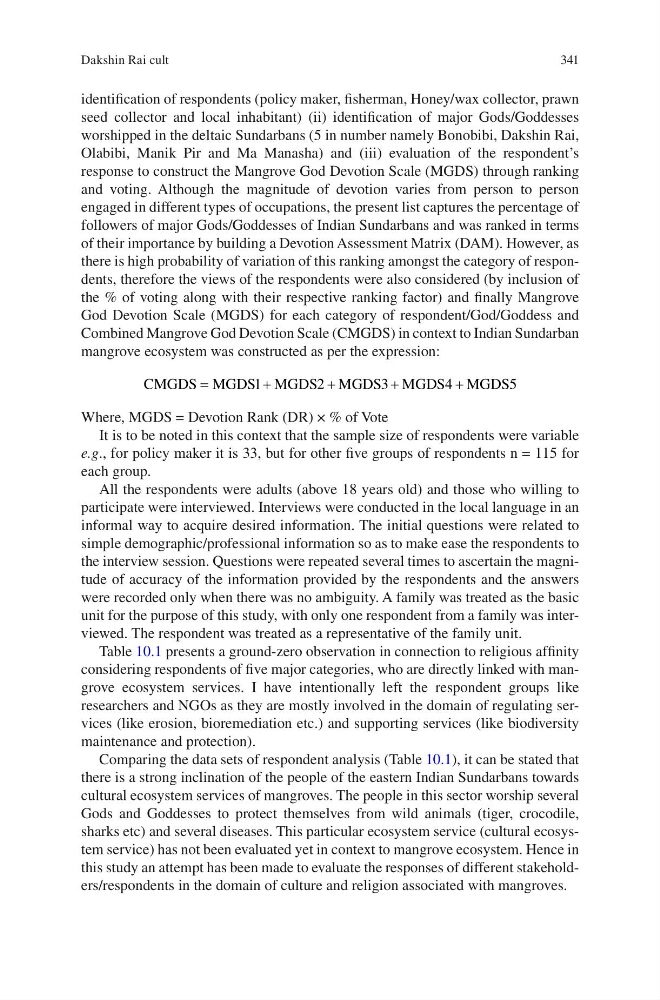
mangrove ecosystem was constructed as per the expression:
CMGDS MGDS MGDS MGDS MGDS MGDS
=
+
+
+
+
1
2
3
4
5
Where, MGDS = Devotion Rank (DR) × % of Vote
It is to be noted in this context that the sample size of respondents were variable
e.g., for policy maker it is 33, but for other five groups of respondents n = 115 for
each group.
All the respondents were adults (above 18 years old) and those who willing to
participate were interviewed. Interviews were conducted in the local language in an
informal way to acquire desired information. The initial questions were related to
simple demographic/professional information so as to make ease the respondents to
the interview session. Questions were repeated several times to ascertain the magnitude of accuracy of the information provided by the respondents and the answers
were recorded only when there was no ambiguity. A family was treated as the basic
unit for the purpose of this study, with only one respondent from a family was interviewed. The respondent was treated as a representative of the family unit.
Table 10.1 presents a ground-zero observation in connection to religious affinity
considering respondents of five major categories, who are directly linked with mangrove ecosystem services. I have intentionally left the respondent groups like
researchers and NGOs as they are mostly involved in the domain of regulating services (like erosion, bioremediation etc.) and supporting services (like biodiversity
maintenance and protection).
Comparing the data sets of respondent analysis (Table 10.1), it can be stated that
there is a strong inclination of the people of the eastern Indian Sundarbans towards
cultural ecosystem services of mangroves. The people in this sector worship several
Gods and Goddesses to protect themselves from wild animals (tiger, crocodile,
sharks etc) and several diseases. This particular ecosystem service (cultural ecosystem service) has not been evaluated yet in context to mangrove ecosystem. Hence in
this study an attempt has been made to evaluate the responses of different stakeholders/respondents in the domain of culture and religion associated with mangroves.
Dakshin Rai cult
identification of respondents (policy maker, fisherman, Honey/wax collector, prawn
seed collector and local inhabitant) (ii) identification of major Gods/Goddesses
worshipped in the deltaic Sundarbans (5 in number namely Bonobibi, Dakshin Rai,
Olabibi, Manik Pir and Ma Manasha) and (iii) evaluation of the respondent’s
response to construct the Mangrove God Devotion Scale (MGDS) through ranking
and voting. Although the magnitude of devotion varies from person to person
engaged in different types of occupations, the present list captures the percentage of
followers of major Gods/Goddesses of Indian Sundarbans and was ranked in terms
of their importance by building a Devotion Assessment Matrix (DAM). However, as
there is high probability of variation of this ranking amongst the category of respondents, therefore the views of the respondents were also considered (by inclusion of
the % of voting along with their respective ranking factor) and finally Mangrove
God Devotion Scale (MGDS) for each category of respondent/God/Goddess and
Combined Mangrove God Devotion Scale (CMGDS) in context to Indian Sundarban
mangrove ecosystem was constructed as per the expression:
CMGDS MGDS MGDS MGDS MGDS MGDS
=
+
+
+
+
1
2
3
4
5
Where, MGDS = Devotion Rank (DR) × % of Vote
It is to be noted in this context that the sample size of respondents were variable
e.g., for policy maker it is 33, but for other five groups of respondents n = 115 for
each group.
All the respondents were adults (above 18 years old) and those who willing to
participate were interviewed. Interviews were conducted in the local language in an
informal way to acquire desired information. The initial questions were related to
simple demographic/professional information so as to make ease the respondents to
the interview session. Questions were repeated several times to ascertain the magnitude of accuracy of the information provided by the respondents and the answers
were recorded only when there was no ambiguity. A family was treated as the basic
unit for the purpose of this study, with only one respondent from a family was interviewed. The respondent was treated as a representative of the family unit.
Table 10.1 presents a ground-zero observation in connection to religious affinity
considering respondents of five major categories, who are directly linked with mangrove ecosystem services. I have intentionally left the respondent groups like
researchers and NGOs as they are mostly involved in the domain of regulating services (like erosion, bioremediation etc.) and supporting services (like biodiversity
maintenance and protection).
Comparing the data sets of respondent analysis (Table 10.1), it can be stated that
there is a strong inclination of the people of the eastern Indian Sundarbans towards
cultural ecosystem services of mangroves. The people in this sector worship several
Gods and Goddesses to protect themselves from wild animals (tiger, crocodile,
sharks etc) and several diseases. This particular ecosystem service (cultural ecosystem service) has not been evaluated yet in context to mangrove ecosystem. Hence in
this study an attempt has been made to evaluate the responses of different stakeholders/respondents in the domain of culture and religion associated with mangroves.
Dakshin Rai cult