

325
cell concentration for hatchery rearing of edible oyster is around 1.0 million cells/
ml. The aquatic phase of Indian Sundarbans sustains 102 species of phytoplankton
(Mitra et al. 2004), with a dominancy of Coscinodiscus population. The mean population density of these free-floating producers is around 10
6
cells/m
3
× 10
3
, although
seasonal trend and oscillation are marked features. It has been confirmed from a
number of studies that phytoplankton biomass is a direct function of nutrient load in
ambient aquatic phase and with respect to Indian Sundarbans, the sources of phytoplankton nutrients are litters and detritus contributed by adjacent mangrove vegetation, anthropogenic inputs from the city of Kolkata and the newly developing Haldia
port-cum-industrial complex and sometimes drainage wastes from shrimp culture
farms. Hence in conclusion it can be advocated that the brackish water stretch in the
lower sector of Indian Sundarbans is an ideal nursery ground for the culture and
rearing of edible oyster species.
Seaweed Culture
There is no doubt that world population is increasing faster than global food supply.
While 99% of food comes from terrestrial agriculture (Pimentel and Giampietro
1994), this disguises the fact that in many, especially in developing countries, the
bulk of animal protein comes from fish and other aquatic products. Aquatic foods
have until recently been derived almost exclusively from capture fisheries sources.
In recent years, however, aquaculture has been playing an increasingly important
role. Brackishwater aquaculture can be defined as the farming in the estuarine,
coastal, delta mouth and similar brackishwater environment. A large and increasing
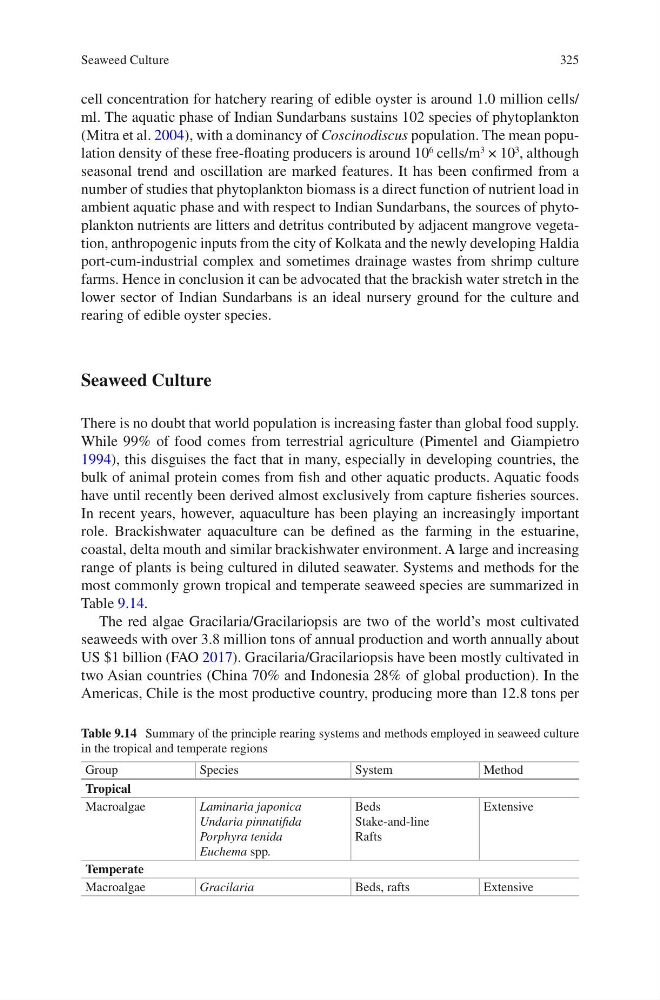
range of plants is being cultured in diluted seawater. Systems and methods for the
most commonly grown tropical and temperate seaweed species are summarized in
Table 9.14.
The red algae Gracilaria/Gracilariopsis are two of the world’s most cultivated
seaweeds with over 3.8 million tons of annual production and worth annually about
US $1 billion (FAO 2017). Gracilaria/Gracilariopsis have been mostly cultivated in
two Asian countries (China 70% and Indonesia 28% of global production). In the
Americas, Chile is the most productive country, producing more than 12.8 tons per
Table 9.14 Summary of the principle rearing systems and methods employed in seaweed culture
in the tropical and temperate regions
Group
Species
System
Method
Tropical
Macroalgae
Laminaria japonica
Undaria pinnatifida
Porphyra tenida
Euchema spp.
Beds
Stake-and-line
Rafts
Extensive
Temperate
Macroalgae
Gracilaria
Beds, rafts
Extensive
Seaweed Culture
cell concentration for hatchery rearing of edible oyster is around 1.0 million cells/
ml. The aquatic phase of Indian Sundarbans sustains 102 species of phytoplankton
(Mitra et al. 2004), with a dominancy of Coscinodiscus population. The mean population density of these free-floating producers is around 10
6
cells/m
3
× 10
3
, although
seasonal trend and oscillation are marked features. It has been confirmed from a
number of studies that phytoplankton biomass is a direct function of nutrient load in
ambient aquatic phase and with respect to Indian Sundarbans, the sources of phytoplankton nutrients are litters and detritus contributed by adjacent mangrove vegetation, anthropogenic inputs from the city of Kolkata and the newly developing Haldia
port-cum-industrial complex and sometimes drainage wastes from shrimp culture
farms. Hence in conclusion it can be advocated that the brackish water stretch in the
lower sector of Indian Sundarbans is an ideal nursery ground for the culture and
rearing of edible oyster species.
Seaweed Culture
There is no doubt that world population is increasing faster than global food supply.
While 99% of food comes from terrestrial agriculture (Pimentel and Giampietro
1994), this disguises the fact that in many, especially in developing countries, the
bulk of animal protein comes from fish and other aquatic products. Aquatic foods
have until recently been derived almost exclusively from capture fisheries sources.
In recent years, however, aquaculture has been playing an increasingly important
role. Brackishwater aquaculture can be defined as the farming in the estuarine,
coastal, delta mouth and similar brackishwater environment. A large and increasing
range of plants is being cultured in diluted seawater. Systems and methods for the
most commonly grown tropical and temperate seaweed species are summarized in
Table 9.14.
The red algae Gracilaria/Gracilariopsis are two of the world’s most cultivated
seaweeds with over 3.8 million tons of annual production and worth annually about
US $1 billion (FAO 2017). Gracilaria/Gracilariopsis have been mostly cultivated in
two Asian countries (China 70% and Indonesia 28% of global production). In the
Americas, Chile is the most productive country, producing more than 12.8 tons per
Table 9.14 Summary of the principle rearing systems and methods employed in seaweed culture
in the tropical and temperate regions
Group
Species
System
Method
Tropical
Macroalgae
Laminaria japonica
Undaria pinnatifida
Porphyra tenida
Euchema spp.
Beds
Stake-and-line
Rafts
Extensive
Temperate
Macroalgae
Gracilaria
Beds, rafts
Extensive
Seaweed Culture