

323
patterns are not extreme except during Nor-westers or equinoxes conditions. During
Nor-westers, the wind speed rises above 100 Km/hr and is usually accompanied by
huge tidal waves. When cyclonic incidences coincide with the spring tides, wave
height can rise over 5 m above the mean sea level. Ripple waves appear in the month
of October, November and December when wind generated wave height varies
approximately from 0.20 to 0.35 m. In the month of April to August, large wavelets
are formed in the shelf region, which starts breaking when they approach towards
the coastal margin. Wave height rises up to 2 m during this period, which causes
maximum scouring of landmasses. Wave actions, micro and macro-tidal cycles and
long shore currents are recorded in most of the islands in this ecosystem. With these
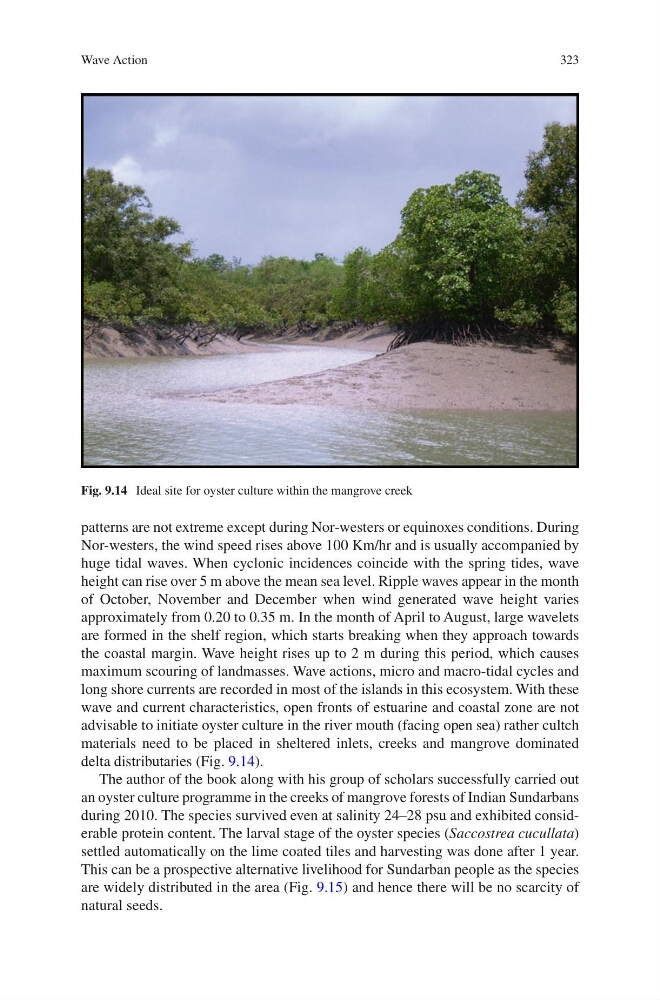
wave and current characteristics, open fronts of estuarine and coastal zone are not
advisable to initiate oyster culture in the river mouth (facing open sea) rather cultch
materials need to be placed in sheltered inlets, creeks and mangrove dominated
delta distributaries (Fig. 9.14).
The author of the book along with his group of scholars successfully carried out
an oyster culture programme in the creeks of mangrove forests of Indian Sundarbans
during 2010. The species survived even at salinity 24–28 psu and exhibited considerable protein content. The larval stage of the oyster species (Saccostrea cucullata)
settled automatically on the lime coated tiles and harvesting was done after 1 year.
This can be a prospective alternative livelihood for Sundarban people as the species
are widely distributed in the area (Fig. 9.15) and hence there will be no scarcity of
natural seeds.
Fig. 9.14 Ideal site for oyster culture within the mangrove creek
Wave Action
patterns are not extreme except during Nor-westers or equinoxes conditions. During
Nor-westers, the wind speed rises above 100 Km/hr and is usually accompanied by
huge tidal waves. When cyclonic incidences coincide with the spring tides, wave
height can rise over 5 m above the mean sea level. Ripple waves appear in the month
of October, November and December when wind generated wave height varies
approximately from 0.20 to 0.35 m. In the month of April to August, large wavelets
are formed in the shelf region, which starts breaking when they approach towards
the coastal margin. Wave height rises up to 2 m during this period, which causes
maximum scouring of landmasses. Wave actions, micro and macro-tidal cycles and
long shore currents are recorded in most of the islands in this ecosystem. With these
wave and current characteristics, open fronts of estuarine and coastal zone are not
advisable to initiate oyster culture in the river mouth (facing open sea) rather cultch
materials need to be placed in sheltered inlets, creeks and mangrove dominated
delta distributaries (Fig. 9.14).
The author of the book along with his group of scholars successfully carried out
an oyster culture programme in the creeks of mangrove forests of Indian Sundarbans
during 2010. The species survived even at salinity 24–28 psu and exhibited considerable protein content. The larval stage of the oyster species (Saccostrea cucullata)
settled automatically on the lime coated tiles and harvesting was done after 1 year.
This can be a prospective alternative livelihood for Sundarban people as the species
are widely distributed in the area (Fig. 9.15) and hence there will be no scarcity of
natural seeds.
Fig. 9.14 Ideal site for oyster culture within the mangrove creek
Wave Action