

319
Tyre Tray
Discarded motorcycle tyres can be used to make durable and cheap trays. The tyres
are turned inside out to form the frame for the tray. A leather punch is used to make
holes along the bottom edge of the inverted tyres. The spacing of the holes depends
on the mesh size of Netlon to be used. The Netlon is cut to the diameter of the
inverted tyres and tied in place with HDPE twine. A cover is commonly used to keep
predators out. These types of trays can carry about 100 oysters of marketable size.
Netlon Tray
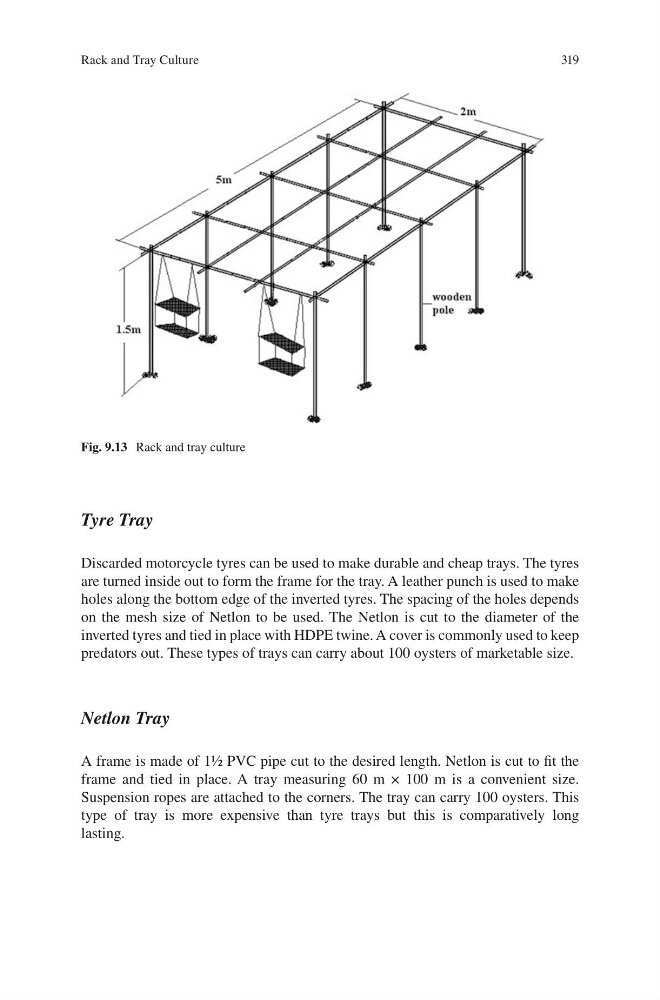
A frame is made of 1½ PVC pipe cut to the desired length. Netlon is cut to fit the
frame and tied in place. A tray measuring 60 m × 100 m is a convenient size.
Suspension ropes are attached to the corners. The tray can carry 100 oysters. This
type of tray is more expensive than tyre trays but this is comparatively long
lasting.
Fig. 9.13 Rack and tray culture
Rack and Tray Culture
Tyre Tray
Discarded motorcycle tyres can be used to make durable and cheap trays. The tyres
are turned inside out to form the frame for the tray. A leather punch is used to make
holes along the bottom edge of the inverted tyres. The spacing of the holes depends
on the mesh size of Netlon to be used. The Netlon is cut to the diameter of the
inverted tyres and tied in place with HDPE twine. A cover is commonly used to keep
predators out. These types of trays can carry about 100 oysters of marketable size.
Netlon Tray
A frame is made of 1½ PVC pipe cut to the desired length. Netlon is cut to fit the
frame and tied in place. A tray measuring 60 m × 100 m is a convenient size.
Suspension ropes are attached to the corners. The tray can carry 100 oysters. This
type of tray is more expensive than tyre trays but this is comparatively long
lasting.
Fig. 9.13 Rack and tray culture
Rack and Tray Culture