

309
certain medicines. Their potential value as cytotoxic and/or antineoplastic agents
and as antimicrobial agents has been demonstrated.
To sum up it can be stated that in the Sundarban deltaic complex, the traditional
livelihood practices (like paddy monoculture, fishing, aquaculture, animal husbandry, poultry) did not work out successfully to upgrade the local economic profile. The honey and wax could not provide substantial income to the local populations.
The pulse of climate change has put acute pressure on the economic structure of the
region. Poverty stricken people are more susceptible to adverse impact of climate
change. They have no proper shelter, no fund for resettlement and no insurances
against their lives, health and properties. Institutional help hardly reaches them.
Hence reduction of poverty is an important component in fighting against temperature rise, sea water intrusion, and disease outbreaks, which are the clutches of climate change potential to scratch the economics of the region. This component
engages a wide and diverse spectrum of specialists to utilize the available resources
for boosting up the living standard of the community. In Indian Sundarbans region
few anticipatory actions have already been initiated considering the seawater intrusion into the creeks and inlets criss-crossing the islands. These include training the
local population with the technology of oyster and seaweed culture, which are
widely distributed in the area. The island dwellers, however, have no idea of their
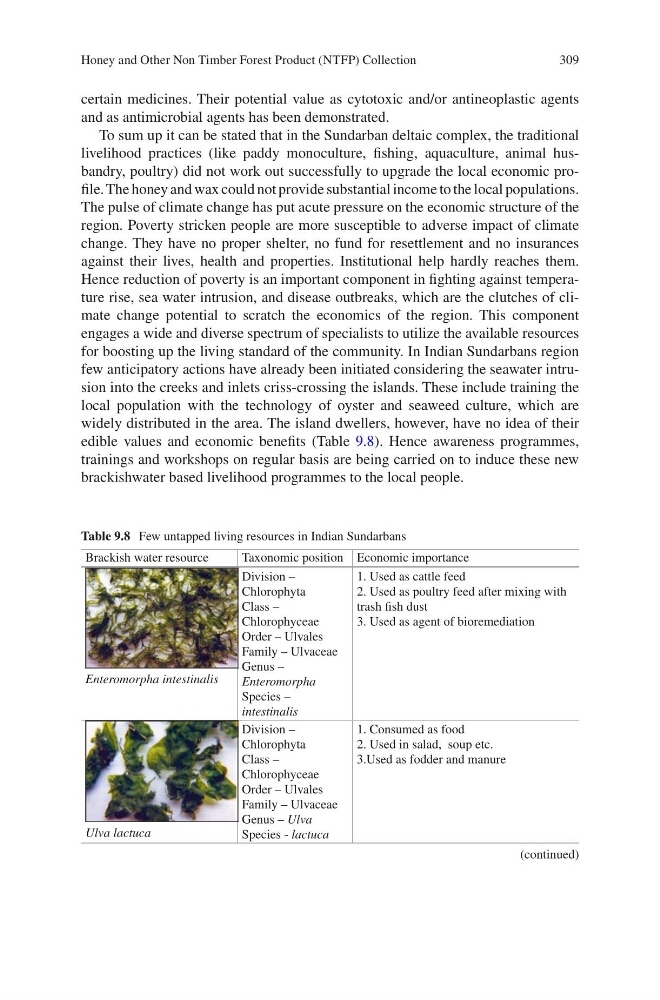
edible values and economic benefits (Table 9.8). Hence awareness programmes,
trainings and workshops on regular basis are being carried on to induce these new
brackishwater based livelihood programmes to the local people.
Table 9.8 Few untapped living resources in Indian Sundarbans
Brackish water resource
Taxonomic position Economic importance
Enteromorpha intestinalis
Division –
Chlorophyta
Class –
Chlorophyceae
Order – Ulvales
Family – Ulvaceae
Genus –
Enteromorpha
Species –
intestinalis
1. Used as cattle feed
2. Used as poultry feed after mixing with
trash fish dust
3. Used as agent of bioremediation
Ulva lactuca
Division –
Chlorophyta
Class –
Chlorophyceae
Order – Ulvales
Family – Ulvaceae
Genus – Ulva
Species - lactuca
1. Consumed as food
2. Used in salad, soup etc.
3.Used as fodder and manure
(continued)
Honey and Other Non Timber Forest Product (NTFP) Collection
certain medicines. Their potential value as cytotoxic and/or antineoplastic agents
and as antimicrobial agents has been demonstrated.
To sum up it can be stated that in the Sundarban deltaic complex, the traditional
livelihood practices (like paddy monoculture, fishing, aquaculture, animal husbandry, poultry) did not work out successfully to upgrade the local economic profile. The honey and wax could not provide substantial income to the local populations.
The pulse of climate change has put acute pressure on the economic structure of the
region. Poverty stricken people are more susceptible to adverse impact of climate
change. They have no proper shelter, no fund for resettlement and no insurances
against their lives, health and properties. Institutional help hardly reaches them.
Hence reduction of poverty is an important component in fighting against temperature rise, sea water intrusion, and disease outbreaks, which are the clutches of climate change potential to scratch the economics of the region. This component
engages a wide and diverse spectrum of specialists to utilize the available resources
for boosting up the living standard of the community. In Indian Sundarbans region
few anticipatory actions have already been initiated considering the seawater intrusion into the creeks and inlets criss-crossing the islands. These include training the
local population with the technology of oyster and seaweed culture, which are
widely distributed in the area. The island dwellers, however, have no idea of their
edible values and economic benefits (Table 9.8). Hence awareness programmes,
trainings and workshops on regular basis are being carried on to induce these new
brackishwater based livelihood programmes to the local people.
Table 9.8 Few untapped living resources in Indian Sundarbans
Brackish water resource
Taxonomic position Economic importance
Enteromorpha intestinalis
Division –
Chlorophyta
Class –
Chlorophyceae
Order – Ulvales
Family – Ulvaceae
Genus –
Enteromorpha
Species –
intestinalis
1. Used as cattle feed
2. Used as poultry feed after mixing with
trash fish dust
3. Used as agent of bioremediation
Ulva lactuca
Division –
Chlorophyta
Class –
Chlorophyceae
Order – Ulvales
Family – Ulvaceae
Genus – Ulva
Species - lactuca
1. Consumed as food
2. Used in salad, soup etc.
3.Used as fodder and manure
(continued)
Honey and Other Non Timber Forest Product (NTFP) Collection