

244
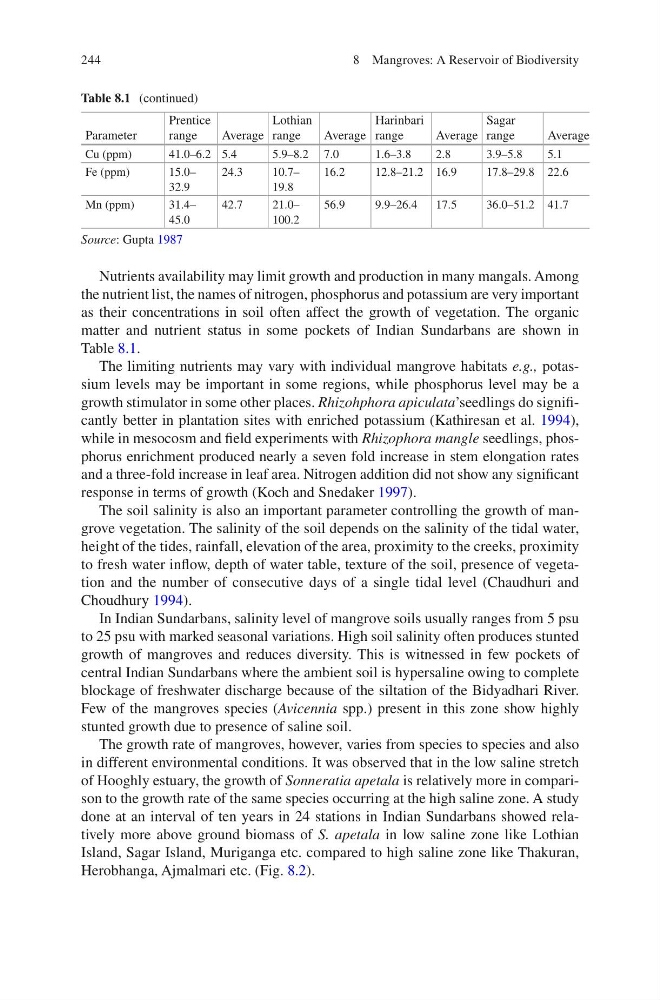
Nutrients availability may limit growth and production in many mangals. Among
the nutrient list, the names of nitrogen, phosphorus and potassium are very important
as their concentrations in soil often affect the growth of vegetation. The organic
matter and nutrient status in some pockets of Indian Sundarbans are shown in
Table 8.1.
The limiting nutrients may vary with individual mangrove habitats e.g., potassium levels may be important in some regions, while phosphorus level may be a
growth stimulator in some other places. Rhizohphora apiculata’seedlings do significantly better in plantation sites with enriched potassium (Kathiresan et al. 1994),
while in mesocosm and field experiments with Rhizophora mangle seedlings, phosphorus enrichment produced nearly a seven fold increase in stem elongation rates
and a three-fold increase in leaf area. Nitrogen addition did not show any significant
response in terms of growth (Koch and Snedaker 1997).
The soil salinity is also an important parameter controlling the growth of mangrove vegetation. The salinity of the soil depends on the salinity of the tidal water,
height of the tides, rainfall, elevation of the area, proximity to the creeks, proximity
to fresh water inflow, depth of water table, texture of the soil, presence of vegetation and the number of consecutive days of a single tidal level (Chaudhuri and
Choudhury 1994).
In Indian Sundarbans, salinity level of mangrove soils usually ranges from 5 psu
to 25 psu with marked seasonal variations. High soil salinity often produces stunted
growth of mangroves and reduces diversity. This is witnessed in few pockets of
central Indian Sundarbans where the ambient soil is hypersaline owing to complete
blockage of freshwater discharge because of the siltation of the Bidyadhari River.
Few of the mangroves species (Avicennia spp.) present in this zone show highly
stunted growth due to presence of saline soil.
The growth rate of mangroves, however, varies from species to species and also
in different environmental conditions. It was observed that in the low saline stretch
of Hooghly estuary, the growth of Sonneratia apetala is relatively more in comparison to the growth rate of the same species occurring at the high saline zone. A study
done at an interval of ten years in 24 stations in Indian Sundarbans showed relatively more above ground biomass of S. apetala in low saline zone like Lothian
Island, Sagar Island, Muriganga etc. compared to high saline zone like Thakuran,
Herobhanga, Ajmalmari etc. (Fig. 8.2).
Table 8.1 (continued)
Parameter
Prentice
range
Average
Lothian
range
Average
Harinbari
range
Average
Sagar
range
Average
Cu (ppm)
41.0–6.2 5.4
5.9–8.2 7.0
1.6–3.8
2.8
3.9–5.8
5.1
Fe (ppm)
15.0–
32.9
24.3
10.7–
19.8
16.2
12.8–21.2 16.9
17.8–29.8 22.6
Mn (ppm)
31.4–
45.0
42.7
21.0–
100.2
56.9
9.9–26.4
17.5
36.0–51.2 41.7
Source: Gupta 1987
8 Mangroves: A Reservoir of Biodiversity
Nutrients availability may limit growth and production in many mangals. Among
the nutrient list, the names of nitrogen, phosphorus and potassium are very important
as their concentrations in soil often affect the growth of vegetation. The organic
matter and nutrient status in some pockets of Indian Sundarbans are shown in
Table 8.1.
The limiting nutrients may vary with individual mangrove habitats e.g., potassium levels may be important in some regions, while phosphorus level may be a
growth stimulator in some other places. Rhizohphora apiculata’seedlings do significantly better in plantation sites with enriched potassium (Kathiresan et al. 1994),
while in mesocosm and field experiments with Rhizophora mangle seedlings, phosphorus enrichment produced nearly a seven fold increase in stem elongation rates
and a three-fold increase in leaf area. Nitrogen addition did not show any significant
response in terms of growth (Koch and Snedaker 1997).
The soil salinity is also an important parameter controlling the growth of mangrove vegetation. The salinity of the soil depends on the salinity of the tidal water,
height of the tides, rainfall, elevation of the area, proximity to the creeks, proximity
to fresh water inflow, depth of water table, texture of the soil, presence of vegetation and the number of consecutive days of a single tidal level (Chaudhuri and
Choudhury 1994).
In Indian Sundarbans, salinity level of mangrove soils usually ranges from 5 psu
to 25 psu with marked seasonal variations. High soil salinity often produces stunted
growth of mangroves and reduces diversity. This is witnessed in few pockets of
central Indian Sundarbans where the ambient soil is hypersaline owing to complete
blockage of freshwater discharge because of the siltation of the Bidyadhari River.
Few of the mangroves species (Avicennia spp.) present in this zone show highly
stunted growth due to presence of saline soil.
The growth rate of mangroves, however, varies from species to species and also
in different environmental conditions. It was observed that in the low saline stretch
of Hooghly estuary, the growth of Sonneratia apetala is relatively more in comparison to the growth rate of the same species occurring at the high saline zone. A study
done at an interval of ten years in 24 stations in Indian Sundarbans showed relatively more above ground biomass of S. apetala in low saline zone like Lothian
Island, Sagar Island, Muriganga etc. compared to high saline zone like Thakuran,
Herobhanga, Ajmalmari etc. (Fig. 8.2).
Table 8.1 (continued)
Parameter
Prentice
range
Average
Lothian
range
Average
Harinbari
range
Average
Sagar
range
Average
Cu (ppm)
41.0–6.2 5.4
5.9–8.2 7.0
1.6–3.8
2.8
3.9–5.8
5.1
Fe (ppm)
15.0–
32.9
24.3
10.7–
19.8
16.2
12.8–21.2 16.9
17.8–29.8 22.6
Mn (ppm)
31.4–
45.0
42.7
21.0–
100.2
56.9
9.9–26.4
17.5
36.0–51.2 41.7
Source: Gupta 1987
8 Mangroves: A Reservoir of Biodiversity