

10
8. Mangroves filter ground water and storm water run-off that often contain harmful pesticides, herbicides and hydrocarbons. Mangroves also recharge underground water table by collecting rain water and slowly releasing it into the
underground reservoir.
9. Mangrove prop roots protect and offer habitat for mammals, amphibians, reptiles, countless unique plants, juvenile fish and invertebrates that filter water
such as sponges, barnacles, oysters, mussels, crabs, shrimps etc.
10. Mangroves are ideal nesting grounds for many water birds such as the great
white heron, reddish egrets, roseate spoonbills, white-crowned pigeons, cuckoos and frigate birds. The excretory materials of these birds serve as the fertilizers of the adjacent water bodies on which the primary production of the
aquatic phase depends.
11. Mangrove forests are the housing complexes for bees, birds, mammals and reptiles from which honey, wax, food etc. are obtained.
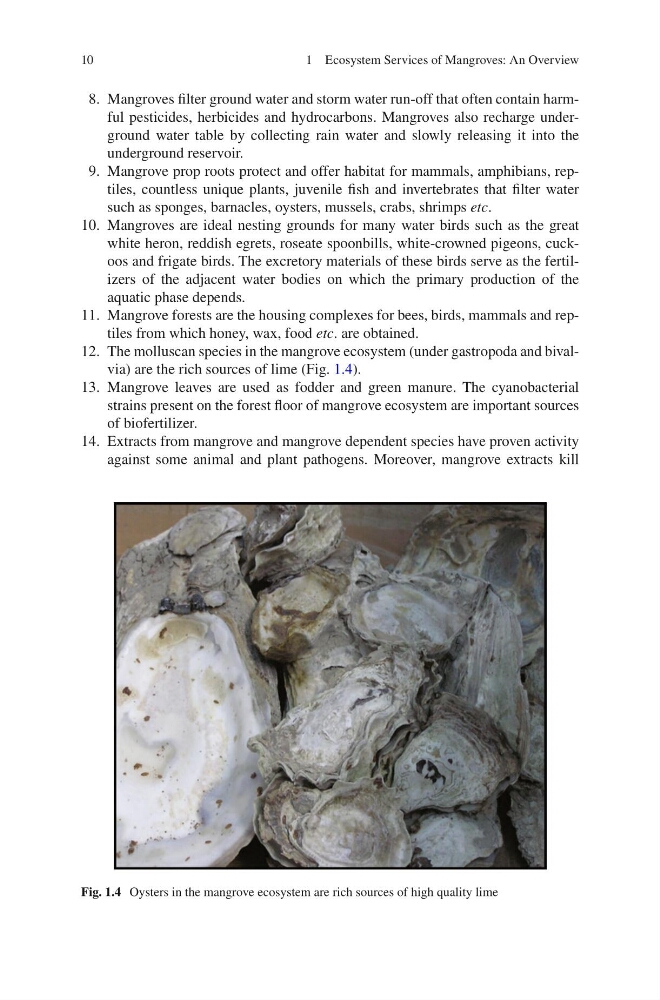
12. The molluscan species in the mangrove ecosystem (under gastropoda and bivalvia) are the rich sources of lime (Fig. 1.4).
13. Mangrove leaves are used as fodder and green manure. The cyanobacterial
strains present on the forest floor of mangrove ecosystem are important sources
of biofertilizer.
14. Extracts from mangrove and mangrove dependent species have proven activity
against some animal and plant pathogens. Moreover, mangrove extracts kill
Fig. 1.4 Oysters in the mangrove ecosystem are rich sources of high quality lime
1 Ecosystem Services of Mangroves: An Overview
8. Mangroves filter ground water and storm water run-off that often contain harmful pesticides, herbicides and hydrocarbons. Mangroves also recharge underground water table by collecting rain water and slowly releasing it into the
underground reservoir.
9. Mangrove prop roots protect and offer habitat for mammals, amphibians, reptiles, countless unique plants, juvenile fish and invertebrates that filter water
such as sponges, barnacles, oysters, mussels, crabs, shrimps etc.
10. Mangroves are ideal nesting grounds for many water birds such as the great
white heron, reddish egrets, roseate spoonbills, white-crowned pigeons, cuckoos and frigate birds. The excretory materials of these birds serve as the fertilizers of the adjacent water bodies on which the primary production of the
aquatic phase depends.
11. Mangrove forests are the housing complexes for bees, birds, mammals and reptiles from which honey, wax, food etc. are obtained.
12. The molluscan species in the mangrove ecosystem (under gastropoda and bivalvia) are the rich sources of lime (Fig. 1.4).
13. Mangrove leaves are used as fodder and green manure. The cyanobacterial
strains present on the forest floor of mangrove ecosystem are important sources
of biofertilizer.
14. Extracts from mangrove and mangrove dependent species have proven activity
against some animal and plant pathogens. Moreover, mangrove extracts kill
Fig. 1.4 Oysters in the mangrove ecosystem are rich sources of high quality lime
1 Ecosystem Services of Mangroves: An Overview