

235
Nitrogen is one of the key essential elements for the sustenance of plant and
animal life, but the dynamics of N in relation to mangrove ecosystem change and
development over time is not well understood.
Ms. Ankita Mitra, who topped in Environmental Science from Pondicherry
Central University, India has carried out an exhaustive study on stored nitrogen in
the mangrove species of Indian Sundarbans (Fig. 7.50). Along with monitoring the
stored nitrogen in the AGB of the selected species, Ms. Mitra also conducted a
simultaneous in situ analysis of salinity to evaluate the influence of this important
variable on the biomass of the species and their subsequent nitrogen storage.
N availability depends on environmental factors such as salinity, temperature,
soil fertility and geochemical redox reactions between dissolved organic and inorganic constituents in interstitial water. In highly reducing mangrove soils, for
instance, metal sulfide complexes readily bind to organic nutrients thereby limiting
the amount of nutrients available to the plant (Alongi 2009).
The magnitude of nitrogen sequestration is although very low of the order around
2% compared to carbon of the order around 48%, but still the stored nitrogen has
great implication in the domain of climate change. The storage pattern of this element is also influenced by salinity as it is the key player in mangrove ecosystem
controlling the survival, growth and biomass of the species. Tables 7.7, 7.8, 7.9,
7.10, and 7.11 highlight the stored nitrogen in the selected five dominant true mangrove floral species in Indian Sundarbans.
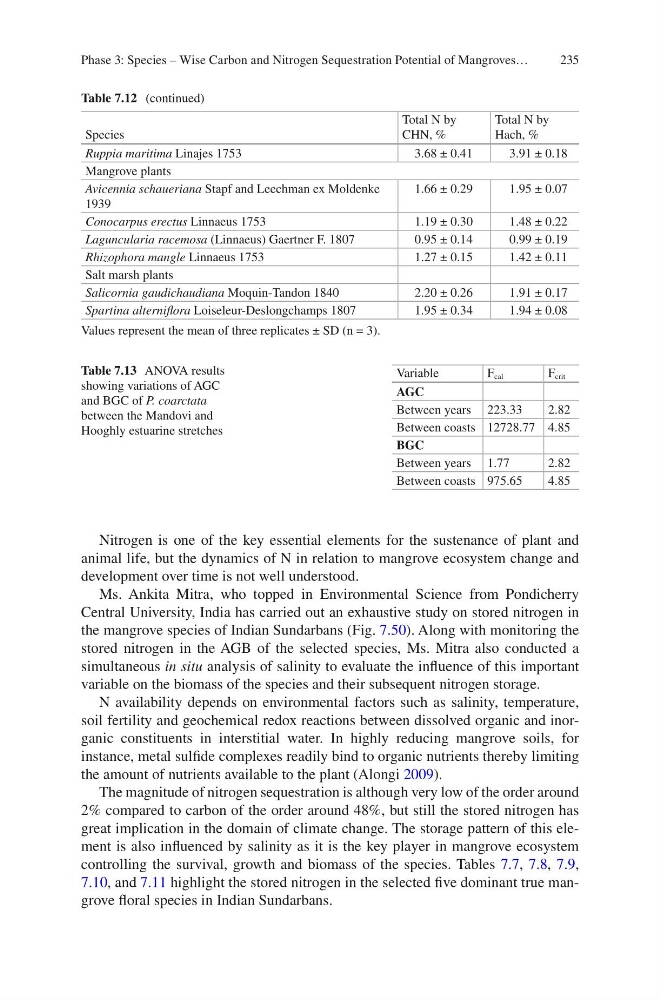
Table 7.13 ANOVA results
showing variations of AGC
and BGC of P. coarctata
between the Mandovi and
Hooghly estuarine stretches
Variable
F cal
F crit
AGC
Between years 223.33
2.82
Between coasts 12728.77 4.85
BGC
Between years 1.77
2.82
Between coasts 975.65
4.85
Table 7.12 (continued)
Species
Total N by
CHN, %
Total N by
Hach, %
Ruppia maritima Linajes 1753
3.68 ± 0.41
3.91 ± 0.18
Mangrove plants
Avicennia schaueriana Stapf and Leechman ex Moldenke
1939
1.66 ± 0.29
1.95 ± 0.07
Conocarpus erectus Linnaeus 1753
1.19 ± 0.30
1.48 ± 0.22
Laguncularia racemosa (Linnaeus) Gaertner F. 1807
0.95 ± 0.14
0.99 ± 0.19
Rhizophora mangle Linnaeus 1753
1.27 ± 0.15
1.42 ± 0.11
Salt marsh plants
Salicornia gaudichaudiana Moquin-Tandon 1840
2.20 ± 0.26
1.91 ± 0.17
Spartina alterniflora Loiseleur-Deslongchamps 1807
1.95 ± 0.34
1.94 ± 0.08
Values represent the mean of three replicates ± SD (n = 3).
Phase 3: Species – Wise Carbon and Nitrogen Sequestration Potential of Mangroves…
Nitrogen is one of the key essential elements for the sustenance of plant and
animal life, but the dynamics of N in relation to mangrove ecosystem change and
development over time is not well understood.
Ms. Ankita Mitra, who topped in Environmental Science from Pondicherry
Central University, India has carried out an exhaustive study on stored nitrogen in
the mangrove species of Indian Sundarbans (Fig. 7.50). Along with monitoring the
stored nitrogen in the AGB of the selected species, Ms. Mitra also conducted a
simultaneous in situ analysis of salinity to evaluate the influence of this important
variable on the biomass of the species and their subsequent nitrogen storage.
N availability depends on environmental factors such as salinity, temperature,
soil fertility and geochemical redox reactions between dissolved organic and inorganic constituents in interstitial water. In highly reducing mangrove soils, for
instance, metal sulfide complexes readily bind to organic nutrients thereby limiting
the amount of nutrients available to the plant (Alongi 2009).
The magnitude of nitrogen sequestration is although very low of the order around
2% compared to carbon of the order around 48%, but still the stored nitrogen has
great implication in the domain of climate change. The storage pattern of this element is also influenced by salinity as it is the key player in mangrove ecosystem
controlling the survival, growth and biomass of the species. Tables 7.7, 7.8, 7.9,
7.10, and 7.11 highlight the stored nitrogen in the selected five dominant true mangrove floral species in Indian Sundarbans.
Table 7.13 ANOVA results
showing variations of AGC
and BGC of P. coarctata
between the Mandovi and
Hooghly estuarine stretches
Variable
F cal
F crit
AGC
Between years 223.33
2.82
Between coasts 12728.77 4.85
BGC
Between years 1.77
2.82
Between coasts 975.65
4.85
Table 7.12 (continued)
Species
Total N by
CHN, %
Total N by
Hach, %
Ruppia maritima Linajes 1753
3.68 ± 0.41
3.91 ± 0.18
Mangrove plants
Avicennia schaueriana Stapf and Leechman ex Moldenke
1939
1.66 ± 0.29
1.95 ± 0.07
Conocarpus erectus Linnaeus 1753
1.19 ± 0.30
1.48 ± 0.22
Laguncularia racemosa (Linnaeus) Gaertner F. 1807
0.95 ± 0.14
0.99 ± 0.19
Rhizophora mangle Linnaeus 1753
1.27 ± 0.15
1.42 ± 0.11
Salt marsh plants
Salicornia gaudichaudiana Moquin-Tandon 1840
2.20 ± 0.26
1.91 ± 0.17
Spartina alterniflora Loiseleur-Deslongchamps 1807
1.95 ± 0.34
1.94 ± 0.08
Values represent the mean of three replicates ± SD (n = 3).
Phase 3: Species – Wise Carbon and Nitrogen Sequestration Potential of Mangroves…