

194
Biomass Estimation
Quadrate sampling technique was used in each site/station, which contained 1 year
old seedlings of five dominant species of Indian Sundarbans namely Sonneratia
apetala, Avicennia marina, Avicennia alba, Avicennia officinalis and Excoecaria
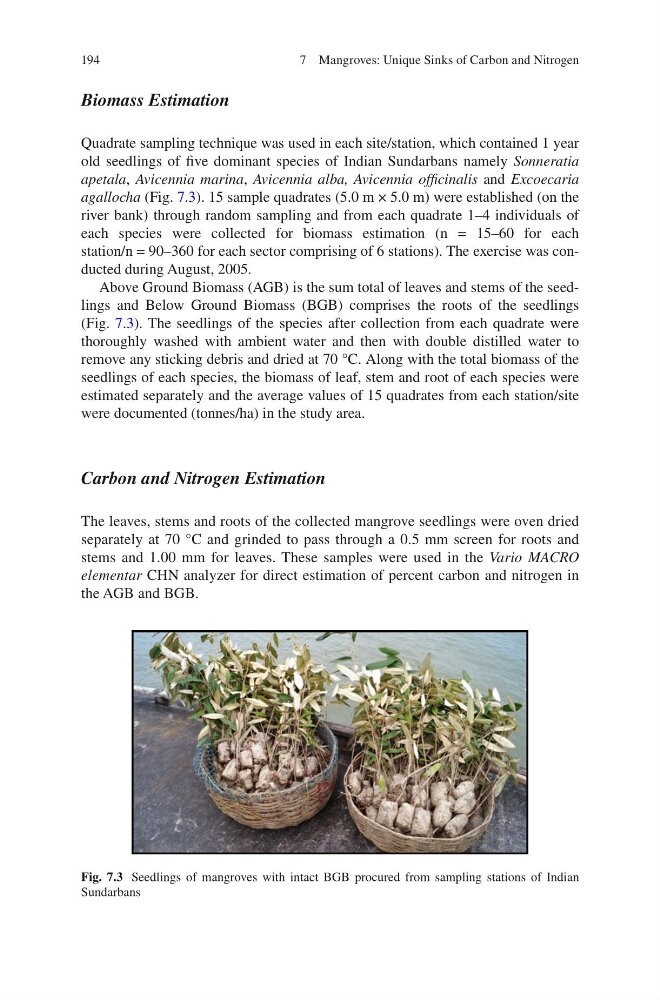
agallocha (Fig. 7.3). 15 sample quadrates (5.0 m × 5.0 m) were established (on the
river bank) through random sampling and from each quadrate 1–4 individuals of
each species were collected for biomass estimation (n = 15–60 for each
station/n = 90–360 for each sector comprising of 6 stations). The exercise was conducted during August, 2005.
Above Ground Biomass (AGB) is the sum total of leaves and stems of the seedlings and Below Ground Biomass (BGB) comprises the roots of the seedlings
(Fig. 7.3). The seedlings of the species after collection from each quadrate were
thoroughly washed with ambient water and then with double distilled water to
remove any sticking debris and dried at 70 °C. Along with the total biomass of the
seedlings of each species, the biomass of leaf, stem and root of each species were
estimated separately and the average values of 15 quadrates from each station/site
were documented (tonnes/ha) in the study area.
Carbon and Nitrogen Estimation
The leaves, stems and roots of the collected mangrove seedlings were oven dried
separately at 70 °C and grinded to pass through a 0.5 mm screen for roots and
stems and 1.00 mm for leaves. These samples were used in the Vario MACRO
elementar CHN analyzer for direct estimation of percent carbon and nitrogen in
the AGB and BGB.
Fig. 7.3 Seedlings of mangroves with intact BGB procured from sampling stations of Indian
Sundarbans
7 Mangroves: Unique Sinks of Carbon and Nitrogen
Biomass Estimation
Quadrate sampling technique was used in each site/station, which contained 1 year
old seedlings of five dominant species of Indian Sundarbans namely Sonneratia
apetala, Avicennia marina, Avicennia alba, Avicennia officinalis and Excoecaria
agallocha (Fig. 7.3). 15 sample quadrates (5.0 m × 5.0 m) were established (on the
river bank) through random sampling and from each quadrate 1–4 individuals of
each species were collected for biomass estimation (n = 15–60 for each
station/n = 90–360 for each sector comprising of 6 stations). The exercise was conducted during August, 2005.
Above Ground Biomass (AGB) is the sum total of leaves and stems of the seedlings and Below Ground Biomass (BGB) comprises the roots of the seedlings
(Fig. 7.3). The seedlings of the species after collection from each quadrate were
thoroughly washed with ambient water and then with double distilled water to
remove any sticking debris and dried at 70 °C. Along with the total biomass of the
seedlings of each species, the biomass of leaf, stem and root of each species were
estimated separately and the average values of 15 quadrates from each station/site
were documented (tonnes/ha) in the study area.
Carbon and Nitrogen Estimation
The leaves, stems and roots of the collected mangrove seedlings were oven dried
separately at 70 °C and grinded to pass through a 0.5 mm screen for roots and
stems and 1.00 mm for leaves. These samples were used in the Vario MACRO
elementar CHN analyzer for direct estimation of percent carbon and nitrogen in
the AGB and BGB.
Fig. 7.3 Seedlings of mangroves with intact BGB procured from sampling stations of Indian
Sundarbans
7 Mangroves: Unique Sinks of Carbon and Nitrogen