

190
Floral communities of the planet Earth (which are popularly called producers of
the ecosystem) absorb carbon dioxide from the ambient environment/atmosphere
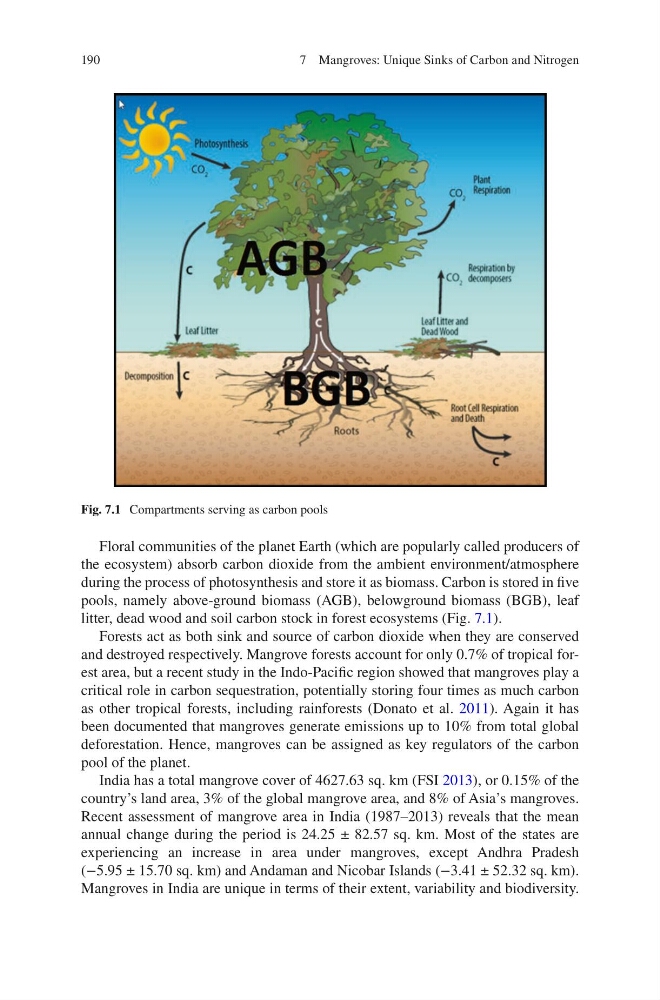
during the process of photosynthesis and store it as biomass. Carbon is stored in five
pools, namely above-ground biomass (AGB), belowground biomass (BGB), leaf
litter, dead wood and soil carbon stock in forest ecosystems (Fig. 7.1).
Forests act as both sink and source of carbon dioxide when they are conserved
and destroyed respectively. Mangrove forests account for only 0.7% of tropical forest area, but a recent study in the Indo-Pacific region showed that mangroves play a
critical role in carbon sequestration, potentially storing four times as much carbon
as other tropical forests, including rainforests (Donato et al. 2011). Again it has
been documented that mangroves generate emissions up to 10% from total global
deforestation. Hence, mangroves can be assigned as key regulators of the carbon
pool of the planet.
India has a total mangrove cover of 4627.63 sq. km (FSI 2013), or 0.15% of the
country’s land area, 3% of the global mangrove area, and 8% of Asia’s mangroves.
Recent assessment of mangrove area in India (1987–2013) reveals that the mean
annual change during the period is 24.25 ± 82.57 sq. km. Most of the states are
experiencing an increase in area under mangroves, except Andhra Pradesh
(−5.95 ± 15.70 sq. km) and Andaman and Nicobar Islands (−3.41 ± 52.32 sq. km).
Mangroves in India are unique in terms of their extent, variability and biodiversity.
Fig. 7.1 Compartments serving as carbon pools
7 Mangroves: Unique Sinks of Carbon and Nitrogen
Floral communities of the planet Earth (which are popularly called producers of
the ecosystem) absorb carbon dioxide from the ambient environment/atmosphere
during the process of photosynthesis and store it as biomass. Carbon is stored in five
pools, namely above-ground biomass (AGB), belowground biomass (BGB), leaf
litter, dead wood and soil carbon stock in forest ecosystems (Fig. 7.1).
Forests act as both sink and source of carbon dioxide when they are conserved
and destroyed respectively. Mangrove forests account for only 0.7% of tropical forest area, but a recent study in the Indo-Pacific region showed that mangroves play a
critical role in carbon sequestration, potentially storing four times as much carbon
as other tropical forests, including rainforests (Donato et al. 2011). Again it has
been documented that mangroves generate emissions up to 10% from total global
deforestation. Hence, mangroves can be assigned as key regulators of the carbon
pool of the planet.
India has a total mangrove cover of 4627.63 sq. km (FSI 2013), or 0.15% of the
country’s land area, 3% of the global mangrove area, and 8% of Asia’s mangroves.
Recent assessment of mangrove area in India (1987–2013) reveals that the mean
annual change during the period is 24.25 ± 82.57 sq. km. Most of the states are
experiencing an increase in area under mangroves, except Andhra Pradesh
(−5.95 ± 15.70 sq. km) and Andaman and Nicobar Islands (−3.41 ± 52.32 sq. km).
Mangroves in India are unique in terms of their extent, variability and biodiversity.
Fig. 7.1 Compartments serving as carbon pools
7 Mangroves: Unique Sinks of Carbon and Nitrogen