

138
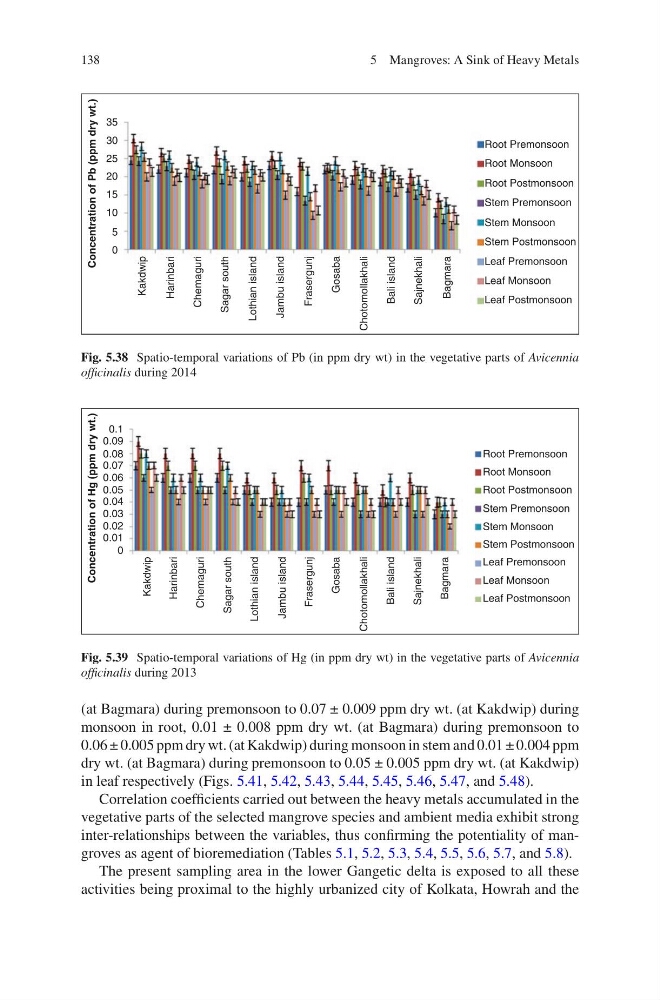
(at Bagmara) during premonsoon to 0.07 ± 0.009 ppm dry wt. (at Kakdwip) during
monsoon in root, 0.01 ± 0.008 ppm dry wt. (at Bagmara) during premonsoon to
0.06 ± 0.005 ppm dry wt. (at Kakdwip) during monsoon in stem and 0.01 ± 0.004 ppm
dry wt. (at Bagmara) during premonsoon to 0.05 ± 0.005 ppm dry wt. (at Kakdwip)
in leaf respectively (Figs. 5.41, 5.42, 5.43, 5.44, 5.45, 5.46, 5.47, and 5.48).
Correlation coefficients carried out between the heavy metals accumulated in the
vegetative parts of the selected mangrove species and ambient media exhibit strong
inter-relationships between the variables, thus confirming the potentiality of mangroves as agent of bioremediation (Tables 5.1, 5.2, 5.3, 5.4, 5.5, 5.6, 5.7, and 5.8).
The present sampling area in the lower Gangetic delta is exposed to all these
activities being proximal to the highly urbanized city of Kolkata, Howrah and the
Kakdwip
Harinbari
Chemaguri
Sagar south
Lothian island
Jambu island
Frasergunj
Gosaba
Chotomollakhali
Bali island
Sajnekhali
Bagmara
Concentration of Pb (ppm dry wt.)
Root Premonsoon
Stem Premonsoon
Leaf Premonsoon
Leaf Monsoon
Stem Postmonsoon
Leaf Postmonsoon
Stem Monsoon
Root Postmonsoon
Root Monsoon
35
25
15
5
0
10
20
30
Fig. 5.38 Spatio-temporal variations of Pb (in ppm dry wt) in the vegetative parts of Avicennia
officinalis during 2014
Kakdwip
Harinbari
Chemaguri
Sagar south
Lothian island
Jambu island
Frasergunj
Gosaba
Chotomollakhali
Bali island
Sajnekhali
Bagmara
Concentration of Hg (ppm dry wt.)
Root Premonsoon
Stem Premonsoon
Leaf Premonsoon
Leaf Monsoon
Stem Postmonsoon
Leaf Postmonsoon
Stem Monsoon
Root Postmonsoon
Root Monsoon
0.1
0.09
0.08
0.07
0.06
0.05
0.04
0.03
0.02
0.01
0
Fig. 5.39 Spatio-temporal variations of Hg (in ppm dry wt) in the vegetative parts of Avicennia
officinalis during 2013
5 Mangroves: A Sink of Heavy Metals
(at Bagmara) during premonsoon to 0.07 ± 0.009 ppm dry wt. (at Kakdwip) during
monsoon in root, 0.01 ± 0.008 ppm dry wt. (at Bagmara) during premonsoon to
0.06 ± 0.005 ppm dry wt. (at Kakdwip) during monsoon in stem and 0.01 ± 0.004 ppm
dry wt. (at Bagmara) during premonsoon to 0.05 ± 0.005 ppm dry wt. (at Kakdwip)
in leaf respectively (Figs. 5.41, 5.42, 5.43, 5.44, 5.45, 5.46, 5.47, and 5.48).
Correlation coefficients carried out between the heavy metals accumulated in the
vegetative parts of the selected mangrove species and ambient media exhibit strong
inter-relationships between the variables, thus confirming the potentiality of mangroves as agent of bioremediation (Tables 5.1, 5.2, 5.3, 5.4, 5.5, 5.6, 5.7, and 5.8).
The present sampling area in the lower Gangetic delta is exposed to all these
activities being proximal to the highly urbanized city of Kolkata, Howrah and the
Kakdwip
Harinbari
Chemaguri
Sagar south
Lothian island
Jambu island
Frasergunj
Gosaba
Chotomollakhali
Bali island
Sajnekhali
Bagmara
Concentration of Pb (ppm dry wt.)
Root Premonsoon
Stem Premonsoon
Leaf Premonsoon
Leaf Monsoon
Stem Postmonsoon
Leaf Postmonsoon
Stem Monsoon
Root Postmonsoon
Root Monsoon
35
25
15
5
0
10
20
30
Fig. 5.38 Spatio-temporal variations of Pb (in ppm dry wt) in the vegetative parts of Avicennia
officinalis during 2014
Kakdwip
Harinbari
Chemaguri
Sagar south
Lothian island
Jambu island
Frasergunj
Gosaba
Chotomollakhali
Bali island
Sajnekhali
Bagmara
Concentration of Hg (ppm dry wt.)
Root Premonsoon
Stem Premonsoon
Leaf Premonsoon
Leaf Monsoon
Stem Postmonsoon
Leaf Postmonsoon
Stem Monsoon
Root Postmonsoon
Root Monsoon
0.1
0.09
0.08
0.07
0.06
0.05
0.04
0.03
0.02
0.01
0
Fig. 5.39 Spatio-temporal variations of Hg (in ppm dry wt) in the vegetative parts of Avicennia
officinalis during 2013
5 Mangroves: A Sink of Heavy Metals