

138
A. Condello
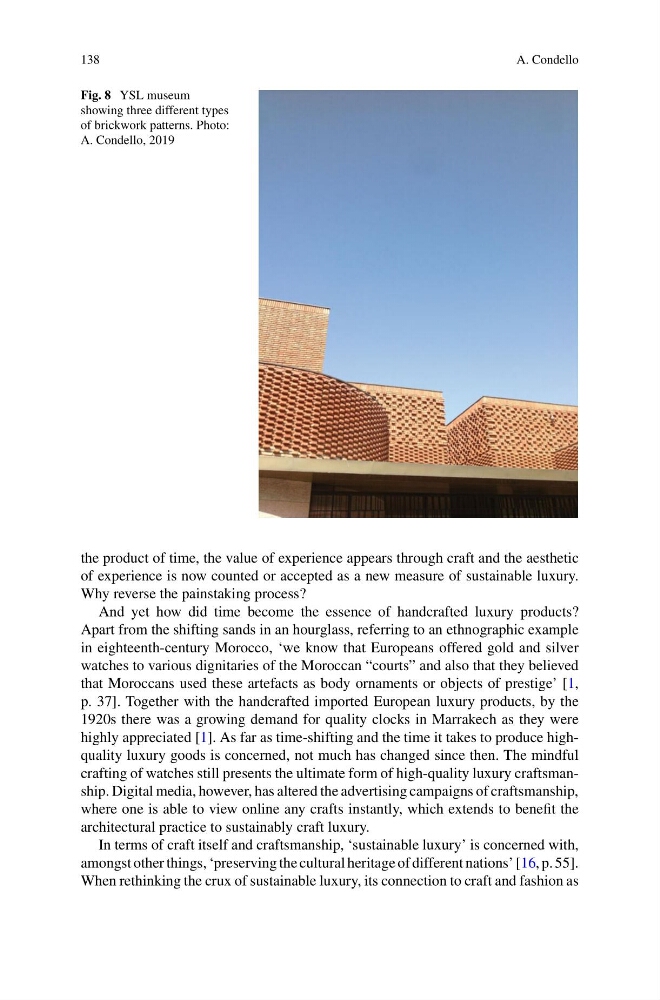
Fig. 8 YSL museum
showing three different types
of brickwork patterns. Photo:
A. Condello, 2019
the product of time, the value of experience appears through craft and the aesthetic
of experience is now counted or accepted as a new measure of sustainable luxury.
Why reverse the painstaking process?
And yet how did time become the essence of handcrafted luxury products?
Apart from the shifting sands in an hourglass, referring to an ethnographic example
in eighteenth-century Morocco, ‘we know that Europeans offered gold and silver
watches to various dignitaries of the Moroccan “courts” and also that they believed
that Moroccans used these artefacts as body ornaments or objects of prestige’ [1,
p. 37]. Together with the handcrafted imported European luxury products, by the
1920s there was a growing demand for quality clocks in Marrakech as they were
highly appreciated [1]. As far as time-shifting and the time it takes to produce highquality luxury goods is concerned, not much has changed since then. The mindful
crafting of watches still presents the ultimate form of high-quality luxury craftsmanship. Digital media, however, has altered the advertising campaigns of craftsmanship,
where one is able to view online any crafts instantly, which extends to benefit the
architectural practice to sustainably craft luxury.
In terms of craft itself and craftsmanship, ‘sustainable luxury’ is concerned with,
amongst other things, ‘preserving the cultural heritage of different nations’ [16, p. 55].
When rethinking the crux of sustainable luxury, its connection to craft and fashion as
A. Condello
Fig. 8 YSL museum
showing three different types
of brickwork patterns. Photo:
A. Condello, 2019
the product of time, the value of experience appears through craft and the aesthetic
of experience is now counted or accepted as a new measure of sustainable luxury.
Why reverse the painstaking process?
And yet how did time become the essence of handcrafted luxury products?
Apart from the shifting sands in an hourglass, referring to an ethnographic example
in eighteenth-century Morocco, ‘we know that Europeans offered gold and silver
watches to various dignitaries of the Moroccan “courts” and also that they believed
that Moroccans used these artefacts as body ornaments or objects of prestige’ [1,
p. 37]. Together with the handcrafted imported European luxury products, by the
1920s there was a growing demand for quality clocks in Marrakech as they were
highly appreciated [1]. As far as time-shifting and the time it takes to produce highquality luxury goods is concerned, not much has changed since then. The mindful
crafting of watches still presents the ultimate form of high-quality luxury craftsmanship. Digital media, however, has altered the advertising campaigns of craftsmanship,
where one is able to view online any crafts instantly, which extends to benefit the
architectural practice to sustainably craft luxury.
In terms of craft itself and craftsmanship, ‘sustainable luxury’ is concerned with,
amongst other things, ‘preserving the cultural heritage of different nations’ [16, p. 55].
When rethinking the crux of sustainable luxury, its connection to craft and fashion as