

Lasting Luxury: Arts and Crafts with Xia Bu 夏布, a Traditional …
93
6 Xia Bu Yarns Preparation
Each Xia Bu village has its own method of processing ramie, such as bleaching
with clear water, daylight rinsing, soaking in due, lime water leaching and charcoal
smoke. Regardless of the method used, it takes time. Afterwards, the fibres are sorted
by grades: farmers distinguish between the following classifications: Zhuang, first
Zhuang, second Zhuang, third Zhuang, Baisuo and Tanqing.
16 According to different
grades, fibres are packed differently for the next step.
The next step includes tearing, rolling, crepe and winding. These works are done
by female worker. They first torn the fibres into pieces and roll them together; then,
put the rolls in a water basin and comb them with their fingers into filament; and then
placed the fibres on their thighs and twisted the fibres into a fine ramie yarn. In the
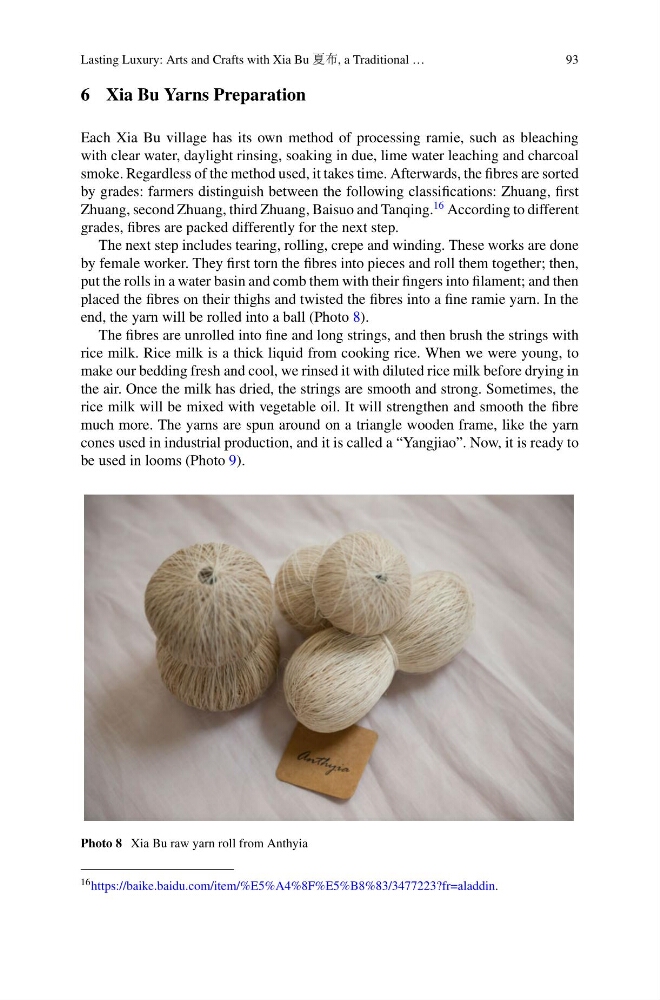
end, the yarn will be rolled into a ball (Photo 8).
The fibres are unrolled into fine and long strings, and then brush the strings with
rice milk. Rice milk is a thick liquid from cooking rice. When we were young, to
make our bedding fresh and cool, we rinsed it with diluted rice milk before drying in
the air. Once the milk has dried, the strings are smooth and strong. Sometimes, the
rice milk will be mixed with vegetable oil. It will strengthen and smooth the fibre
much more. The yarns are spun around on a triangle wooden frame, like the yarn
cones used in industrial production, and it is called a “Yangjiao”. Now, it is ready to
be used in looms (Photo 9).
Photo 8 Xia Bu raw yarn roll from Anthyia
16 https://baike.baidu.com/item/%E5%A4%8F%E5%B8%83/3477223?fr=aladdin.
93
6 Xia Bu Yarns Preparation
Each Xia Bu village has its own method of processing ramie, such as bleaching
with clear water, daylight rinsing, soaking in due, lime water leaching and charcoal
smoke. Regardless of the method used, it takes time. Afterwards, the fibres are sorted
by grades: farmers distinguish between the following classifications: Zhuang, first
Zhuang, second Zhuang, third Zhuang, Baisuo and Tanqing.
16 According to different
grades, fibres are packed differently for the next step.
The next step includes tearing, rolling, crepe and winding. These works are done
by female worker. They first torn the fibres into pieces and roll them together; then,
put the rolls in a water basin and comb them with their fingers into filament; and then
placed the fibres on their thighs and twisted the fibres into a fine ramie yarn. In the
end, the yarn will be rolled into a ball (Photo 8).
The fibres are unrolled into fine and long strings, and then brush the strings with
rice milk. Rice milk is a thick liquid from cooking rice. When we were young, to
make our bedding fresh and cool, we rinsed it with diluted rice milk before drying in
the air. Once the milk has dried, the strings are smooth and strong. Sometimes, the
rice milk will be mixed with vegetable oil. It will strengthen and smooth the fibre
much more. The yarns are spun around on a triangle wooden frame, like the yarn
cones used in industrial production, and it is called a “Yangjiao”. Now, it is ready to
be used in looms (Photo 9).
Photo 8 Xia Bu raw yarn roll from Anthyia
16 https://baike.baidu.com/item/%E5%A4%8F%E5%B8%83/3477223?fr=aladdin.