

50
N. Vigneshwaran and A. Arputharaj
Upon the absorption of UV radiation with energy that matches or exceeds the band
gap energy, the electrons from the valence band are excited to the conduction band,
thus leaving a positively charged hole in the valence band. Therefore, light below
these wavelengths has enough energy to excite electrons and is absorbed by metal
oxides. Since energy always has to go somewhere, and UV is quite strong, metal
oxides absorb UV and turn it into comparably harmless infrared radiation, which
they dispose of as heat.
I s ∝
N d
6
λ 4
m
2
− I
m 2 + 2
2
I i
(1)
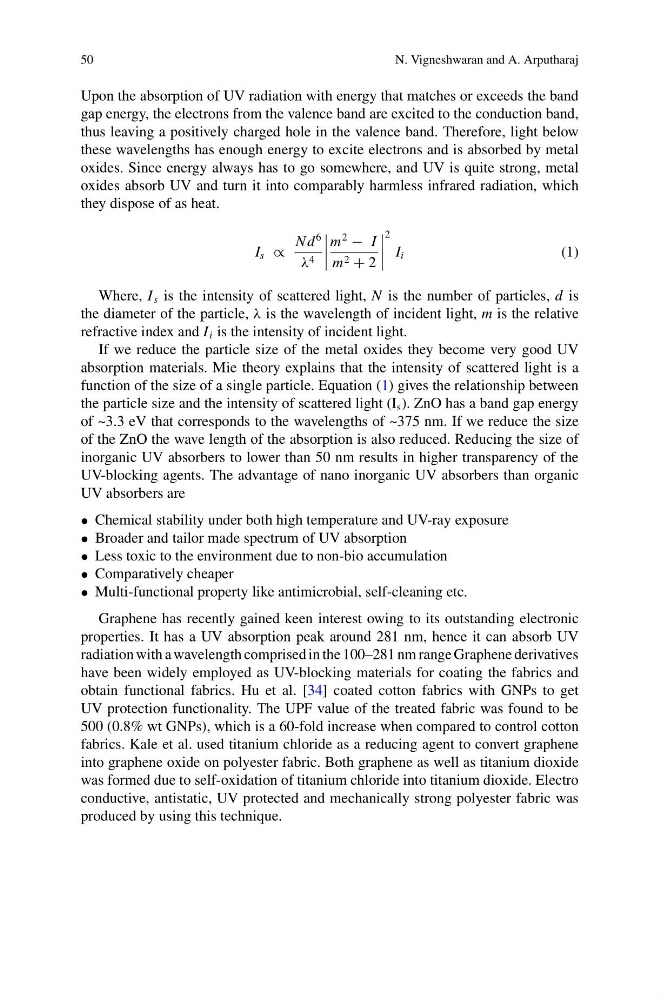
Where, I s is the intensity of scattered light, N is the number of particles, d is
the diameter of the particle, λ is the wavelength of incident light, m is the relative
refractive index and I i is the intensity of incident light.
If we reduce the particle size of the metal oxides they become very good UV
absorption materials. Mie theory explains that the intensity of scattered light is a
function of the size of a single particle. Equation (1) gives the relationship between
the particle size and the intensity of scattered light (I s ). ZnO has a band gap energy
of ~3.3 eV that corresponds to the wavelengths of ~375 nm. If we reduce the size
of the ZnO the wave length of the absorption is also reduced. Reducing the size of
inorganic UV absorbers to lower than 50 nm results in higher transparency of the
UV-blocking agents. The advantage of nano inorganic UV absorbers than organic
UV absorbers are
• Chemical stability under both high temperature and UV-ray exposure
• Broader and tailor made spectrum of UV absorption
• Less toxic to the environment due to non-bio accumulation
• Comparatively cheaper
• Multi-functional property like antimicrobial, self-cleaning etc.
Graphene has recently gained keen interest owing to its outstanding electronic
properties. It has a UV absorption peak around 281 nm, hence it can absorb UV
radiation with a wavelength comprised in the 100–281 nm range Graphene derivatives
have been widely employed as UV-blocking materials for coating the fabrics and
obtain functional fabrics. Hu et al. [34] coated cotton fabrics with GNPs to get
UV protection functionality. The UPF value of the treated fabric was found to be
500 (0.8% wt GNPs), which is a 60-fold increase when compared to control cotton
fabrics. Kale et al. used titanium chloride as a reducing agent to convert graphene
into graphene oxide on polyester fabric. Both graphene as well as titanium dioxide
was formed due to self-oxidation of titanium chloride into titanium dioxide. Electro
conductive, antistatic, UV protected and mechanically strong polyester fabric was
produced by using this technique.
N. Vigneshwaran and A. Arputharaj
Upon the absorption of UV radiation with energy that matches or exceeds the band
gap energy, the electrons from the valence band are excited to the conduction band,
thus leaving a positively charged hole in the valence band. Therefore, light below
these wavelengths has enough energy to excite electrons and is absorbed by metal
oxides. Since energy always has to go somewhere, and UV is quite strong, metal
oxides absorb UV and turn it into comparably harmless infrared radiation, which
they dispose of as heat.
I s ∝
N d
6
λ 4
m
2
− I
m 2 + 2
2
I i
(1)
Where, I s is the intensity of scattered light, N is the number of particles, d is
the diameter of the particle, λ is the wavelength of incident light, m is the relative
refractive index and I i is the intensity of incident light.
If we reduce the particle size of the metal oxides they become very good UV
absorption materials. Mie theory explains that the intensity of scattered light is a
function of the size of a single particle. Equation (1) gives the relationship between
the particle size and the intensity of scattered light (I s ). ZnO has a band gap energy
of ~3.3 eV that corresponds to the wavelengths of ~375 nm. If we reduce the size
of the ZnO the wave length of the absorption is also reduced. Reducing the size of
inorganic UV absorbers to lower than 50 nm results in higher transparency of the
UV-blocking agents. The advantage of nano inorganic UV absorbers than organic
UV absorbers are
• Chemical stability under both high temperature and UV-ray exposure
• Broader and tailor made spectrum of UV absorption
• Less toxic to the environment due to non-bio accumulation
• Comparatively cheaper
• Multi-functional property like antimicrobial, self-cleaning etc.
Graphene has recently gained keen interest owing to its outstanding electronic
properties. It has a UV absorption peak around 281 nm, hence it can absorb UV
radiation with a wavelength comprised in the 100–281 nm range Graphene derivatives
have been widely employed as UV-blocking materials for coating the fabrics and
obtain functional fabrics. Hu et al. [34] coated cotton fabrics with GNPs to get
UV protection functionality. The UPF value of the treated fabric was found to be
500 (0.8% wt GNPs), which is a 60-fold increase when compared to control cotton
fabrics. Kale et al. used titanium chloride as a reducing agent to convert graphene
into graphene oxide on polyester fabric. Both graphene as well as titanium dioxide
was formed due to self-oxidation of titanium chloride into titanium dioxide. Electro
conductive, antistatic, UV protected and mechanically strong polyester fabric was
produced by using this technique.