

Functional Finishing of Cotton Textiles Using Nanomaterials
49
clothing represents the most convenient and reliable method of protecting the skin
against the harmful effects of the Sun. The demand for UV protective clothing has
been growing significantly as consumers have become more aware of the dangers of
excessive exposure to the sun.
Fabric parameters such as the porosity, type, color, weight and thickness have
direct influence on the UV protection of a finished garment. The application of UV
absorbers into the surface of the fabric plays a vital role in the improvement of
UPF of apparel. Stretching and laundering during use can alter the UV-protective
properties of a textile. The use of UV-blocking cloths can provide excellent protection
against the hazards of sunlight; this is especially true for garments manufactured as
UV-protective clothing.
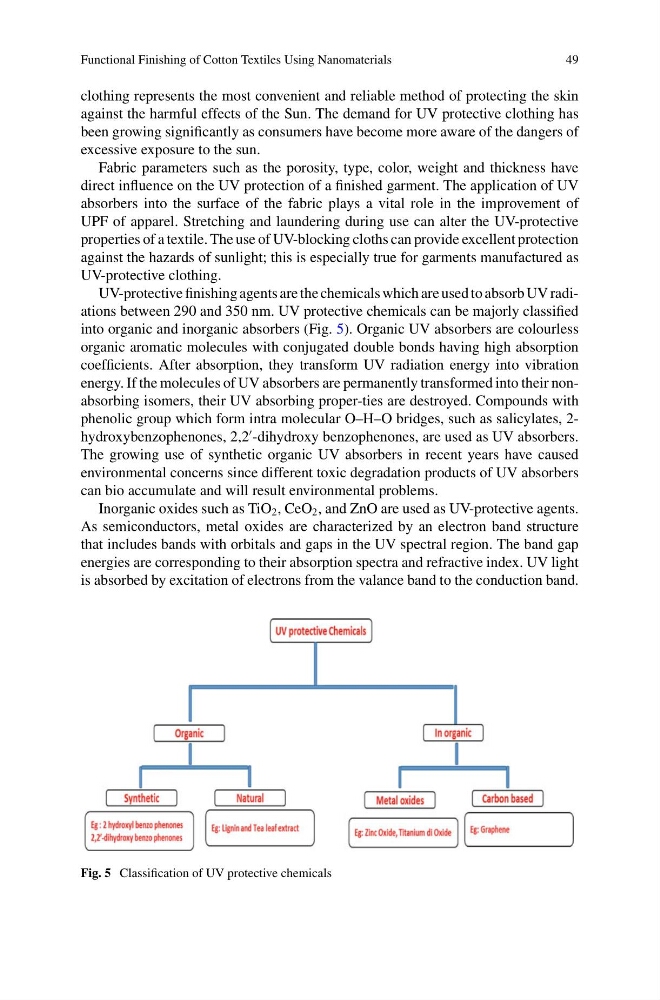
UV-protective finishing agents are the chemicals which are used to absorb UV radiations between 290 and 350 nm. UV protective chemicals can be majorly classified
into organic and inorganic absorbers (Fig. 5). Organic UV absorbers are colourless
organic aromatic molecules with conjugated double bonds having high absorption
coefficients. After absorption, they transform UV radiation energy into vibration
energy. If the molecules of UV absorbers are permanently transformed into their nonabsorbing isomers, their UV absorbing proper-ties are destroyed. Compounds with
phenolic group which form intra molecular O–H–O bridges, such as salicylates, 2hydroxybenzophenones, 2,2
-dihydroxy benzophenones, are used as UV absorbers.
The growing use of synthetic organic UV absorbers in recent years have caused
environmental concerns since different toxic degradation products of UV absorbers
can bio accumulate and will result environmental problems.
Inorganic oxides such as TiO 2 , CeO 2 , and ZnO are used as UV-protective agents.
As semiconductors, metal oxides are characterized by an electron band structure
that includes bands with orbitals and gaps in the UV spectral region. The band gap
energies are corresponding to their absorption spectra and refractive index. UV light
is absorbed by excitation of electrons from the valance band to the conduction band.
Fig. 5 Classification of UV protective chemicals
49
clothing represents the most convenient and reliable method of protecting the skin
against the harmful effects of the Sun. The demand for UV protective clothing has
been growing significantly as consumers have become more aware of the dangers of
excessive exposure to the sun.
Fabric parameters such as the porosity, type, color, weight and thickness have
direct influence on the UV protection of a finished garment. The application of UV
absorbers into the surface of the fabric plays a vital role in the improvement of
UPF of apparel. Stretching and laundering during use can alter the UV-protective
properties of a textile. The use of UV-blocking cloths can provide excellent protection
against the hazards of sunlight; this is especially true for garments manufactured as
UV-protective clothing.
UV-protective finishing agents are the chemicals which are used to absorb UV radiations between 290 and 350 nm. UV protective chemicals can be majorly classified
into organic and inorganic absorbers (Fig. 5). Organic UV absorbers are colourless
organic aromatic molecules with conjugated double bonds having high absorption
coefficients. After absorption, they transform UV radiation energy into vibration
energy. If the molecules of UV absorbers are permanently transformed into their nonabsorbing isomers, their UV absorbing proper-ties are destroyed. Compounds with
phenolic group which form intra molecular O–H–O bridges, such as salicylates, 2hydroxybenzophenones, 2,2
-dihydroxy benzophenones, are used as UV absorbers.
The growing use of synthetic organic UV absorbers in recent years have caused
environmental concerns since different toxic degradation products of UV absorbers
can bio accumulate and will result environmental problems.
Inorganic oxides such as TiO 2 , CeO 2 , and ZnO are used as UV-protective agents.
As semiconductors, metal oxides are characterized by an electron band structure
that includes bands with orbitals and gaps in the UV spectral region. The band gap
energies are corresponding to their absorption spectra and refractive index. UV light
is absorbed by excitation of electrons from the valance band to the conduction band.
Fig. 5 Classification of UV protective chemicals