

Functional Finishing of Cotton Textiles Using Nanomaterials
45
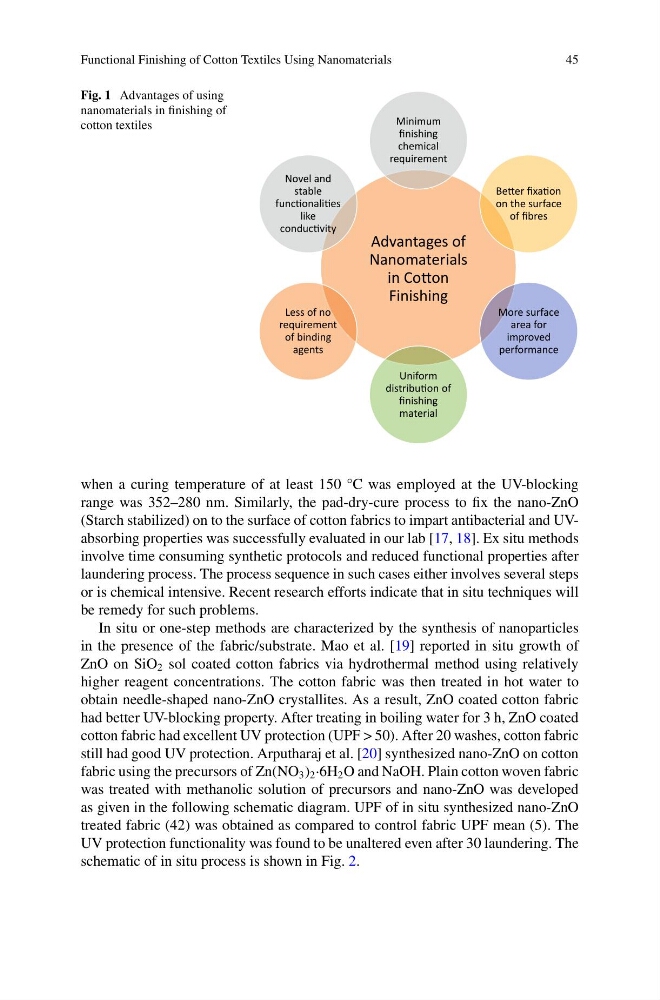
Fig. 1 Advantages of using
nanomaterials in finishing of
cotton textiles
Advantages of
Nanomaterials
in Coon
Finishing
Minimum
finishing
chemical
requirement
Be fixaon
on the surface
of fibres
More surface
area for
improved
performance
Uniform
distribuon of
finishing
material
Less of no
requirement
of binding
agents
Novel and
stable
funconali
like
conducvity
when a curing temperature of at least 150 °C was employed at the UV-blocking
range was 352–280 nm. Similarly, the pad-dry-cure process to fix the nano-ZnO
(Starch stabilized) on to the surface of cotton fabrics to impart antibacterial and UVabsorbing properties was successfully evaluated in our lab [17, 18]. Ex situ methods
involve time consuming synthetic protocols and reduced functional properties after
laundering process. The process sequence in such cases either involves several steps
or is chemical intensive. Recent research efforts indicate that in situ techniques will
be remedy for such problems.
In situ or one-step methods are characterized by the synthesis of nanoparticles
in the presence of the fabric/substrate. Mao et al. [19] reported in situ growth of
ZnO on SiO 2 sol coated cotton fabrics via hydrothermal method using relatively
higher reagent concentrations. The cotton fabric was then treated in hot water to
obtain needle-shaped nano-ZnO crystallites. As a result, ZnO coated cotton fabric
had better UV-blocking property. After treating in boiling water for 3 h, ZnO coated
cotton fabric had excellent UV protection (UPF > 50). After 20 washes, cotton fabric
still had good UV protection. Arputharaj et al. [20] synthesized nano-ZnO on cotton
fabric using the precursors of Zn(NO 3 ) 2 ·6H 2 O and NaOH. Plain cotton woven fabric
was treated with methanolic solution of precursors and nano-ZnO was developed
as given in the following schematic diagram. UPF of in situ synthesized nano-ZnO
treated fabric (42) was obtained as compared to control fabric UPF mean (5). The
UV protection functionality was found to be unaltered even after 30 laundering. The
schematic of in situ process is shown in Fig. 2.
45
Fig. 1 Advantages of using
nanomaterials in finishing of
cotton textiles
Advantages of
Nanomaterials
in Coon
Finishing
Minimum
finishing
chemical
requirement
Be fixaon
on the surface
of fibres
More surface
area for
improved
performance
Uniform
distribuon of
finishing
material
Less of no
requirement
of binding
agents
Novel and
stable
funconali
like
conducvity
when a curing temperature of at least 150 °C was employed at the UV-blocking
range was 352–280 nm. Similarly, the pad-dry-cure process to fix the nano-ZnO
(Starch stabilized) on to the surface of cotton fabrics to impart antibacterial and UVabsorbing properties was successfully evaluated in our lab [17, 18]. Ex situ methods
involve time consuming synthetic protocols and reduced functional properties after
laundering process. The process sequence in such cases either involves several steps
or is chemical intensive. Recent research efforts indicate that in situ techniques will
be remedy for such problems.
In situ or one-step methods are characterized by the synthesis of nanoparticles
in the presence of the fabric/substrate. Mao et al. [19] reported in situ growth of
ZnO on SiO 2 sol coated cotton fabrics via hydrothermal method using relatively
higher reagent concentrations. The cotton fabric was then treated in hot water to
obtain needle-shaped nano-ZnO crystallites. As a result, ZnO coated cotton fabric
had better UV-blocking property. After treating in boiling water for 3 h, ZnO coated
cotton fabric had excellent UV protection (UPF > 50). After 20 washes, cotton fabric
still had good UV protection. Arputharaj et al. [20] synthesized nano-ZnO on cotton
fabric using the precursors of Zn(NO 3 ) 2 ·6H 2 O and NaOH. Plain cotton woven fabric
was treated with methanolic solution of precursors and nano-ZnO was developed
as given in the following schematic diagram. UPF of in situ synthesized nano-ZnO
treated fabric (42) was obtained as compared to control fabric UPF mean (5). The
UV protection functionality was found to be unaltered even after 30 laundering. The
schematic of in situ process is shown in Fig. 2.