

Role of Radiation Treatment as a Cost-Effective Tool for Cotton …
341
13 Effect of UV Radiation on Polyester Fabric
Tariq [56] studied, ultraviolet radiation also played an important role in disperse
dyeing. It is found that that (Fig. 21) for the dyeing of polyester fabric, UV irradiation
of dye solution of Disperse Red 153 (DR 153) for 60 min. gives high K/S utilizing
un-irradiated polyester fabric. Irradiation for a long time and short time do not create
any changes at the surface of polyester fabric, to improve its uptake ability. Thus,
depending upon the nature of the dye bath, irradiation of solution for 60 min. should be
employed for the coloration of un-irradiated fabric. Good color strength was obtained
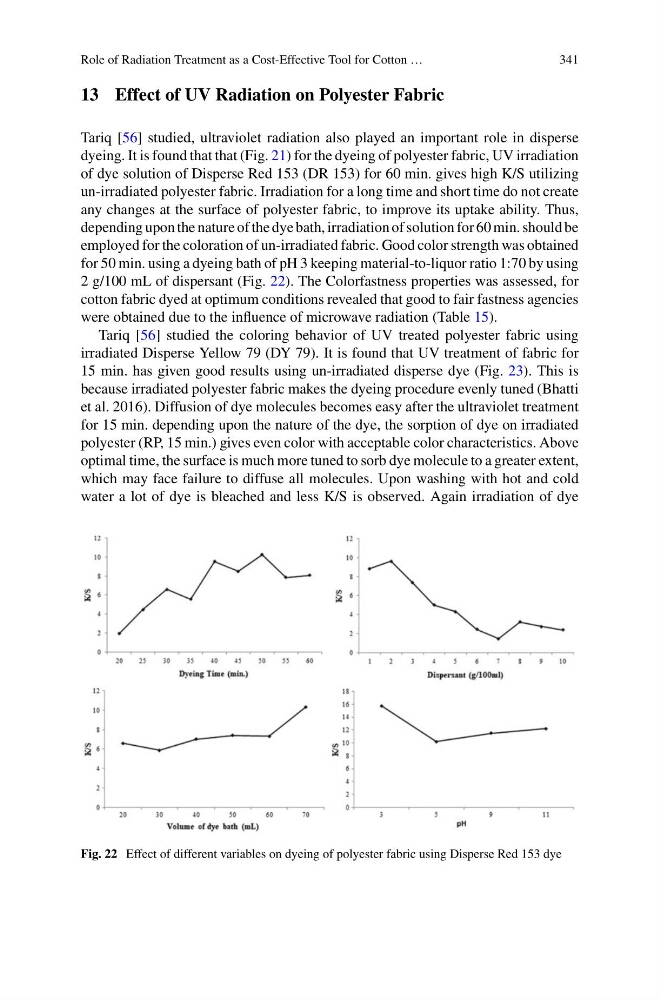
for 50 min. using a dyeing bath of pH 3 keeping material-to-liquor ratio 1:70 by using
2 g/100 mL of dispersant (Fig. 22). The Colorfastness properties was assessed, for
cotton fabric dyed at optimum conditions revealed that good to fair fastness agencies
were obtained due to the influence of microwave radiation (Table 15).
Tariq [56] studied the coloring behavior of UV treated polyester fabric using
irradiated Disperse Yellow 79 (DY 79). It is found that UV treatment of fabric for
15 min. has given good results using un-irradiated disperse dye (Fig. 23). This is
because irradiated polyester fabric makes the dyeing procedure evenly tuned (Bhatti
et al. 2016). Diffusion of dye molecules becomes easy after the ultraviolet treatment
for 15 min. depending upon the nature of the dye, the sorption of dye on irradiated
polyester (RP, 15 min.) gives even color with acceptable color characteristics. Above
optimal time, the surface is much more tuned to sorb dye molecule to a greater extent,
which may face failure to diffuse all molecules. Upon washing with hot and cold
water a lot of dye is bleached and less K/S is observed. Again irradiation of dye
Fig. 22 Effect of different variables on dyeing of polyester fabric using Disperse Red 153 dye
341
13 Effect of UV Radiation on Polyester Fabric
Tariq [56] studied, ultraviolet radiation also played an important role in disperse
dyeing. It is found that that (Fig. 21) for the dyeing of polyester fabric, UV irradiation
of dye solution of Disperse Red 153 (DR 153) for 60 min. gives high K/S utilizing
un-irradiated polyester fabric. Irradiation for a long time and short time do not create
any changes at the surface of polyester fabric, to improve its uptake ability. Thus,
depending upon the nature of the dye bath, irradiation of solution for 60 min. should be
employed for the coloration of un-irradiated fabric. Good color strength was obtained
for 50 min. using a dyeing bath of pH 3 keeping material-to-liquor ratio 1:70 by using
2 g/100 mL of dispersant (Fig. 22). The Colorfastness properties was assessed, for
cotton fabric dyed at optimum conditions revealed that good to fair fastness agencies
were obtained due to the influence of microwave radiation (Table 15).
Tariq [56] studied the coloring behavior of UV treated polyester fabric using
irradiated Disperse Yellow 79 (DY 79). It is found that UV treatment of fabric for
15 min. has given good results using un-irradiated disperse dye (Fig. 23). This is
because irradiated polyester fabric makes the dyeing procedure evenly tuned (Bhatti
et al. 2016). Diffusion of dye molecules becomes easy after the ultraviolet treatment
for 15 min. depending upon the nature of the dye, the sorption of dye on irradiated
polyester (RP, 15 min.) gives even color with acceptable color characteristics. Above
optimal time, the surface is much more tuned to sorb dye molecule to a greater extent,
which may face failure to diffuse all molecules. Upon washing with hot and cold
water a lot of dye is bleached and less K/S is observed. Again irradiation of dye
Fig. 22 Effect of different variables on dyeing of polyester fabric using Disperse Red 153 dye