

334
S. Adeel et al.
diffusion into voids of polyester fabric more promisingly [59, 60]. Therefore, after
the process of dyeing due to, washing, fewer dye molecules are detached and good
color strength is obtained. For long-time heating, the equilibrium of the dye bath is
disturbed and dye molecules rushed towards dye bath from fabric that results in low
color depth. In this study depending upon the nature of the dye, fabric irradiation is
not required as it did not give good results. In the case of low microwave heating,
dye molecules are big that cannot penetrate into the fabric because the voids are
unable to open through low treatment time to hold dye molecules tightly [61]. Thus
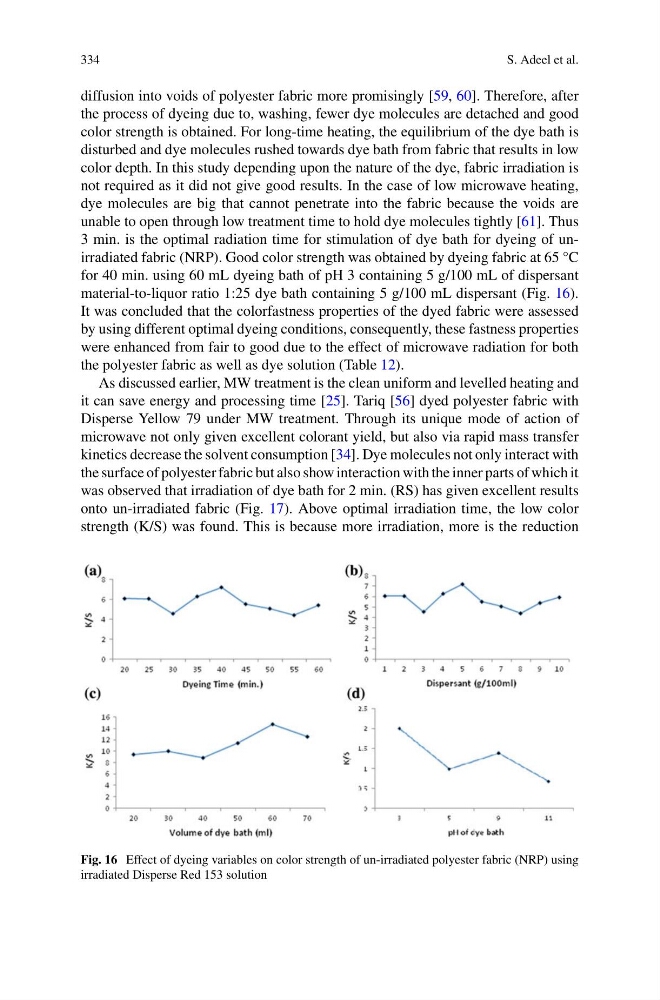
3 min. is the optimal radiation time for stimulation of dye bath for dyeing of unirradiated fabric (NRP). Good color strength was obtained by dyeing fabric at 65 °C
for 40 min. using 60 mL dyeing bath of pH 3 containing 5 g/100 mL of dispersant
material-to-liquor ratio 1:25 dye bath containing 5 g/100 mL dispersant (Fig. 16).
It was concluded that the colorfastness properties of the dyed fabric were assessed
by using different optimal dyeing conditions, consequently, these fastness properties
were enhanced from fair to good due to the effect of microwave radiation for both
the polyester fabric as well as dye solution (Table 12).
As discussed earlier, MW treatment is the clean uniform and levelled heating and
it can save energy and processing time [25]. Tariq [56] dyed polyester fabric with
Disperse Yellow 79 under MW treatment. Through its unique mode of action of
microwave not only given excellent colorant yield, but also via rapid mass transfer
kinetics decrease the solvent consumption [34]. Dye molecules not only interact with
the surface of polyester fabric but also show interaction with the inner parts of which it
was observed that irradiation of dye bath for 2 min. (RS) has given excellent results
onto un-irradiated fabric (Fig. 17). Above optimal irradiation time, the low color
strength (K/S) was found. This is because more irradiation, more is the reduction
Fig. 16 Effect of dyeing variables on color strength of un-irradiated polyester fabric (NRP) using
irradiated Disperse Red 153 solution
S. Adeel et al.
diffusion into voids of polyester fabric more promisingly [59, 60]. Therefore, after
the process of dyeing due to, washing, fewer dye molecules are detached and good
color strength is obtained. For long-time heating, the equilibrium of the dye bath is
disturbed and dye molecules rushed towards dye bath from fabric that results in low
color depth. In this study depending upon the nature of the dye, fabric irradiation is
not required as it did not give good results. In the case of low microwave heating,
dye molecules are big that cannot penetrate into the fabric because the voids are
unable to open through low treatment time to hold dye molecules tightly [61]. Thus
3 min. is the optimal radiation time for stimulation of dye bath for dyeing of unirradiated fabric (NRP). Good color strength was obtained by dyeing fabric at 65 °C
for 40 min. using 60 mL dyeing bath of pH 3 containing 5 g/100 mL of dispersant
material-to-liquor ratio 1:25 dye bath containing 5 g/100 mL dispersant (Fig. 16).
It was concluded that the colorfastness properties of the dyed fabric were assessed
by using different optimal dyeing conditions, consequently, these fastness properties
were enhanced from fair to good due to the effect of microwave radiation for both
the polyester fabric as well as dye solution (Table 12).
As discussed earlier, MW treatment is the clean uniform and levelled heating and
it can save energy and processing time [25]. Tariq [56] dyed polyester fabric with
Disperse Yellow 79 under MW treatment. Through its unique mode of action of
microwave not only given excellent colorant yield, but also via rapid mass transfer
kinetics decrease the solvent consumption [34]. Dye molecules not only interact with
the surface of polyester fabric but also show interaction with the inner parts of which it
was observed that irradiation of dye bath for 2 min. (RS) has given excellent results
onto un-irradiated fabric (Fig. 17). Above optimal irradiation time, the low color
strength (K/S) was found. This is because more irradiation, more is the reduction
Fig. 16 Effect of dyeing variables on color strength of un-irradiated polyester fabric (NRP) using
irradiated Disperse Red 153 solution