

Role of Radiation Treatment as a Cost-Effective Tool for Cotton …
333
Table 11 Effect of microwave radiation on colorfastness properties of fabric dyed with reactive
black 5
Shade (%) Light
fastness
Washing
fastness
Rubbing
Dry cleaning Perspiration
c.c
c.s
Dry Wet
Alkaline Acidic
1
4/5
4
4/5 5
5
4/5
4
4
2
5
4/5 4
5
4/5
4
3/4
4
3
4/5
4/5 4
4/5
4
4/5
3
3/4
4
5
4
4/5 5
4/5
5
3/4
3/4
5
4/5
4
4/5 4/5
4
4/5
3
4
Here control is un−irradiated fabric, c.c color change, c.s color stain
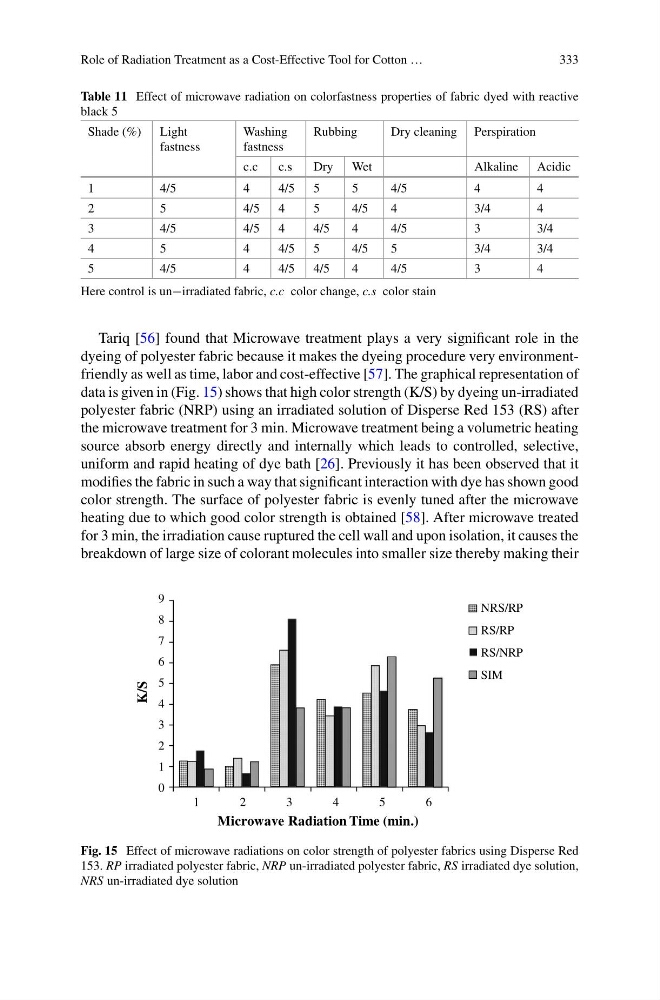
Tariq [56] found that Microwave treatment plays a very significant role in the
dyeing of polyester fabric because it makes the dyeing procedure very environmentfriendly as well as time, labor and cost-effective [57]. The graphical representation of
data is given in (Fig. 15) shows that high color strength (K/S) by dyeing un-irradiated
polyester fabric (NRP) using an irradiated solution of Disperse Red 153 (RS) after
the microwave treatment for 3 min. Microwave treatment being a volumetric heating
source absorb energy directly and internally which leads to controlled, selective,
uniform and rapid heating of dye bath [26]. Previously it has been observed that it
modifies the fabric in such a way that significant interaction with dye has shown good
color strength. The surface of polyester fabric is evenly tuned after the microwave
heating due to which good color strength is obtained [58]. After microwave treated
for 3 min, the irradiation cause ruptured the cell wall and upon isolation, it causes the
breakdown of large size of colorant molecules into smaller size thereby making their
0
1
2
3
4
5
6
7
8
9
1
2
3
4
5
6
K/S
Microwave Radiation Time (min.)
NRS/RP
RS/RP
RS/NRP
SIM
Fig. 15 Effect of microwave radiations on color strength of polyester fabrics using Disperse Red
153. RP irradiated polyester fabric, NRP un-irradiated polyester fabric, RS irradiated dye solution,
NRS un-irradiated dye solution
333
Table 11 Effect of microwave radiation on colorfastness properties of fabric dyed with reactive
black 5
Shade (%) Light
fastness
Washing
fastness
Rubbing
Dry cleaning Perspiration
c.c
c.s
Dry Wet
Alkaline Acidic
1
4/5
4
4/5 5
5
4/5
4
4
2
5
4/5 4
5
4/5
4
3/4
4
3
4/5
4/5 4
4/5
4
4/5
3
3/4
4
5
4
4/5 5
4/5
5
3/4
3/4
5
4/5
4
4/5 4/5
4
4/5
3
4
Here control is un−irradiated fabric, c.c color change, c.s color stain
Tariq [56] found that Microwave treatment plays a very significant role in the
dyeing of polyester fabric because it makes the dyeing procedure very environmentfriendly as well as time, labor and cost-effective [57]. The graphical representation of
data is given in (Fig. 15) shows that high color strength (K/S) by dyeing un-irradiated
polyester fabric (NRP) using an irradiated solution of Disperse Red 153 (RS) after
the microwave treatment for 3 min. Microwave treatment being a volumetric heating
source absorb energy directly and internally which leads to controlled, selective,
uniform and rapid heating of dye bath [26]. Previously it has been observed that it
modifies the fabric in such a way that significant interaction with dye has shown good
color strength. The surface of polyester fabric is evenly tuned after the microwave
heating due to which good color strength is obtained [58]. After microwave treated
for 3 min, the irradiation cause ruptured the cell wall and upon isolation, it causes the
breakdown of large size of colorant molecules into smaller size thereby making their
0
1
2
3
4
5
6
7
8
9
1
2
3
4
5
6
K/S
Microwave Radiation Time (min.)
NRS/RP
RS/RP
RS/NRP
SIM
Fig. 15 Effect of microwave radiations on color strength of polyester fabrics using Disperse Red
153. RP irradiated polyester fabric, NRP un-irradiated polyester fabric, RS irradiated dye solution,
NRS un-irradiated dye solution